Best hairball-control cat foods: the three worth trying
At the front desk, the same scene played out every shedding season: a long-haired cat comes in for a wellness visit, and the owner mentions the hairballs almost as an afterthought, one or two show up on the rug most weeks. Most of the time that’s normal cat biology, not a medical problem. But “my cat keeps throwing up hairballs” is also one of those topics where the first fix people reach for, a hairball-formula food, works through a mechanism that’s worth understanding before you buy one. Here are the three fiber-formula diets worth trying, and what the actual research says about which fiber does the job.
As Amazon Associates we earn from qualifying purchases. Some links in this post are affiliate links; if you buy through them, we earn a small commission at no extra cost to you. We only recommend products we’ve used or researched thoroughly. See our full disclosure.
The three hairball formulas, at a glance
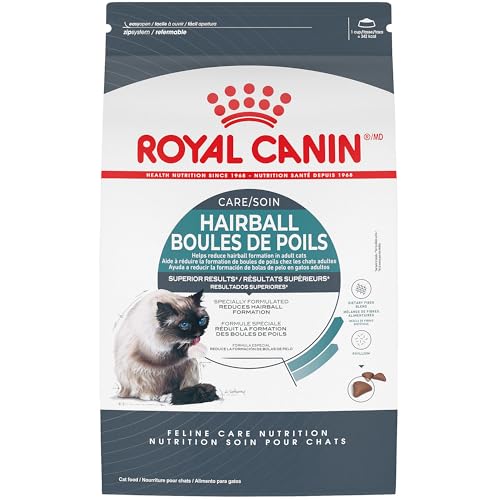
Royal Canin Hairball Care Adult Dry
Psyllium-forward fiber blend · thin chewable kibble · widely stocked at vet clinics
- ✓ Fiber built around psyllium husk rather than cellulose
- ✓ Small, thin kibble shaped to encourage chewing
- ✓ Added fructo-oligosaccharides as a prebiotic
- ✓ Mid-range price tier
on Amazon
Price as of Oct 26, 2026, 9:21 AM EDT. Product prices and availability are accurate as of the date/time indicated and are subject to change.
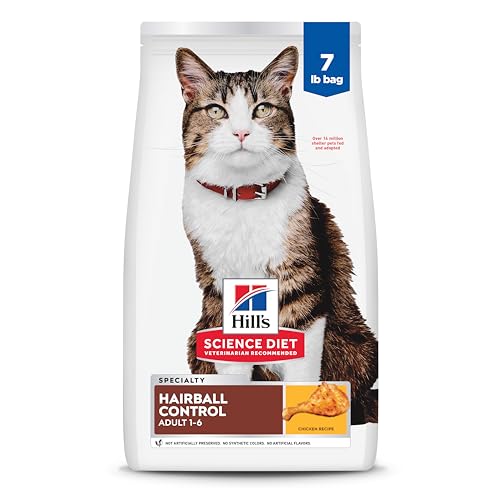
Hill’s Science Diet Hairball Control Adult
Cellulose and beet pulp fiber blend · chicken-first recipe · long-running formula line
- ✓ Highest crude fiber minimum of the three foods here
- ✓ Fiber sourced from powdered cellulose and dried beet pulp
- ✓ Chicken listed as the first ingredient
- ✓ Mid-range price tier
on Amazon
Price as of Oct 26, 2026, 9:21 AM EDT. Product prices and availability are accurate as of the date/time indicated and are subject to change.

Iams Proactive Health Indoor Weight & Hairball Care
Beet pulp and cellulose fiber blend · indoor weight-management calories · budget-friendly
- ✓ Combines hairball fiber with reduced-calorie indoor formula
- ✓ Fiber blend includes beet pulp, powdered cellulose and prebiotics
- ✓ Real chicken as the first ingredient
- ✓ Budget-friendly everyday option
on Amazon
Price as of Oct 26, 2026, 9:21 AM EDT. Product prices and availability are accurate as of the date/time indicated and are subject to change.
Quick take:
- Hairball-formula foods work by adding fiber that helps move swallowed hair through the digestive tract instead of letting it settle and tangle in the stomach.2
- Cornell’s Feline Health Center considers it normal for a cat to bring up a hairball every week or two. Long-haired breeds and older, more experienced groomers are more prone to them, especially during heavy shedding seasons.1
- The one peer-reviewed feline trial to test fiber types head-to-head found that a long insoluble fiber (sugarcane fibre) reduced hairball elimination, while plain cellulose, the fiber named on two of the three bags below, showed no measurable effect.3
- Royal Canin builds its blend around psyllium instead of cellulose. Hill’s has the highest crude fiber number. Iams pairs its fiber blend with indoor weight-control calories.
- None of these foods are the right answer if hairballs show up more than every week or two, or come with vomiting, appetite loss or a lack of bowel movements. That’s a vet visit, not a food swap.12
What’s actually forming that hairball
A hairball isn’t really a ball. Cornell’s Feline Health Center describes it as a damp, compressed wad of hair, usually shaped more like a small cigar or sausage than a sphere, the elongated shape coming from the narrow esophagus it passes through on the way back up. It forms because a cat’s tongue is covered in tiny backward-slanted projections that catch loose hair during grooming and push it toward the throat. Most of that hair passes all the way through the digestive tract and comes out in the litter box without you ever seeing it. Some of it stays behind in the stomach and gradually clumps together instead.1
Long-haired breeds like Persians and Maine Coons carry more risk than short-haired cats, and older cats tend to produce more hairballs than kittens simply because they’ve had more years to become thorough groomers. Shedding season makes the whole thing more frequent for everyone. According to Cornell, a cat bringing up a hairball once every week or two is not a red flag on its own.1 The concern starts when a hairball doesn’t come back up at all, and instead moves from the stomach into the intestine, where it can become large enough to cause a blockage. VCA Animal Hospitals lists vomiting, abdominal pain and a lack of bowel movements as the signs of that kind of obstruction, and notes that cats with underlying gut motility issues or skin conditions that trigger excess licking are more prone to it.2
What the fiber research actually says
Hairball-formula food is built on one basic idea: add enough fiber, and the extra bulk helps carry swallowed hair through the gut before it has a chance to tangle into a mass. That’s the same mechanism VCA points to when it recommends a hairball-specific diet for cats prone to trichobezoars.2 But the specific question of which fiber actually does that job turned out to matter more than the marketing on any given bag suggests. The only peer-reviewed feline study to test fiber types head-to-head fed thirty-two cats one of four kibble diets for six weeks at a Brazilian university’s companion-animal nutrition lab: a no-added-fiber control, two levels of added sugarcane fibre, or added purified cellulose. Researchers then collected and measured the hairballs in the cats’ feces.3
Cats on the sugarcane fibre diets excreted fewer and smaller hairballs than the control group, and by the end of the study the highest-fibre group had stopped producing the largest, most dangerous size class entirely. Cats on the cellulose diet showed no improvement over the control at all.3 That’s a meaningful footnote for anyone comparing these three bags. Hill’s and Iams both name powdered cellulose as a fiber source on their ingredient panels. Royal Canin builds its hairball blend around psyllium husk instead, a soluble fiber that works through a different mechanism (it absorbs water and softens stool, rather than the “long insoluble fiber speeds transit” effect the sugarcane study measured). None of these three finished, extruded foods has actually been tested this way, so this isn’t a strike against any of them specifically. It’s a reason not to assume a higher fiber percentage on the label automatically means better hairball control, and a reason to watch how your own cat responds rather than trusting the number on the bag alone.
The three worth trying
Royal Canin Hairball Care Adult Dry
Royal Canin’s Hairball Care formula leans on psyllium husk as its main fiber source rather than cellulose, with added fructo-oligosaccharides to support the gut bacteria at the same time. The kibble itself is small and thin, shaped to encourage more chewing per piece, which Royal Canin markets as reducing how much hair gets swallowed whole. This is the pick if you’d rather try the soluble-fiber route first, or if your cat is already on a Royal Canin formula for another reason and you want to stay in the same product family.
Hill’s Science Diet Hairball Control Adult
Hill’s Hairball Control carries the highest crude fiber minimum of the three, built from powdered cellulose and dried beet pulp, with chicken as the first ingredient. It’s the longest-running formula of the group and the one I saw prescribed most often at the clinic for cats with no other dietary restrictions. Given the sugarcane-fibre research above, I wouldn’t assume the higher fiber number makes this automatically more effective than the other two. I’d treat it as the reasonable default to start with, and switch if it isn’t moving the needle after a full bag.
Iams Proactive Health Indoor Weight & Hairball Care
Iams’ Indoor Weight & Hairball Care formula pairs a beet pulp, cellulose and prebiotic fiber blend with reduced-calorie indoor formulation, so it’s the pick for a cat who needs both hairball support and help managing weight rather than treating them as two separate problems. It’s also the most budget-friendly of the three, which matters if you’re testing whether a hairball formula helps at all before committing to a pricier bag.
When it’s a food switch and when it’s a vet visit
A hairball formula is a reasonable, low-effort thing to try for a cat producing an occasional hairball on a normal schedule, once every week or two, with no other symptoms.1 It stops being the right first move if the frequency climbs well past that, if your cat goes off food or seems lethargic for more than a day, or if you see repeated unproductive retching with nothing coming up. Those are signs the hairball may have moved from the stomach into the intestine and created a blockage, or that something unrelated to hairballs, a respiratory issue or an underlying gut condition, is actually driving the symptoms.12 A sudden jump in hairball frequency in a cat who was previously fine is also worth a visit rather than another bag of food. It can point to a skin condition causing over-grooming or a change in gut motility, either of which needs a diagnosis a food swap can’t provide.2
The bottom line
All three of these foods are reasonable places to start, and none of them is a guaranteed fix, since the fiber-type research is still thinner than the marketing implies. Daily brushing does more of the actual prevention work than any bag of food, because it removes loose hair before your cat swallows it in the first place. Think of a hairball formula as a second layer on top of that, not a replacement for it, and keep an eye on whether your cat’s own hairball frequency actually improves over a full bag before deciding it’s working.
Sources
- Cornell Feline Health Center, “A Hairy Dilemma”
- VCA Animal Hospitals, “Trichobezoars (Hairballs) in Cats”
- Loureiro et al., “Sugarcane fibre may prevent hairball formation in cats,” Journal of Nutritional Science
TheCatWellness is reader-supported and we are not veterinarians. This article is general information, not medical advice for your individual cat. If your cat’s hairballs increase suddenly or come with vomiting, appetite loss or a lack of bowel movements, talk to your vet.