Vertical vs horizontal scratching posts: which one does your cat need?
The two return stories I heard most at the rescue were the same cat in two different outfits. One cat shredded the arm of the couch and the adopter bought a flat cardboard pad, which the cat ignored. The other cat dug at the hallway runner and the adopter bought a tall post, which the cat walked past. Both owners had bought a perfectly good scratcher. Both had matched it to the wrong habit. A vertical post wins when your cat reaches up and rakes downward on furniture, drapes or door frames. A horizontal scratcher wins when your cat claws at the rug, the floor or the flat of the sofa cushion. Watch where the damage is, then buy the shape that fits it.
As Amazon Associates we earn from qualifying purchases. Some links in this post are affiliate links; if you buy through them, we earn a small commission at no extra cost to you. We only recommend products we’ve used or researched thoroughly. See our full disclosure for details.
How they compare at a glance

SmartCat Ultimate Scratching Post
Vertical · woven sisal · 32 inches tall
- ✓ Tall enough for a cat to stretch the full length of her body
- ✓ Woven sisal on four sides, so more than one scratching spot
- ✓ Weighted 16 by 16 inch base that resists tipping
- ✓ Plain, neutral look that sits next to a sofa without shouting
on Amazon
Price as of Oct 26, 2026, 9:21 AM EDT. Product prices and availability are accurate as of the date/time indicated and are subject to change.

SmartyKat Super Scratcher Chaise
Horizontal · corrugated cardboard · catnip-infused
- ✓ Low, contoured chaise shape for scratching, crouching and lounging
- ✓ Catnip infused between the layers of corrugate
- ✓ Bark-like corrugated texture
- ✓ Light enough to move from room to room
on Amazon
Price as of Oct 21, 2026, 1:56 AM EDT. Product prices and availability are accurate as of the date/time indicated and are subject to change.

Raw Paws Silvervine Powder for Cats
An add-on for either scratcher, not a scratcher itself · 2.64 oz
- ✓ Maker’s suggested use: sprinkle on a toy, bed or scratch post
- ✓ Sold as a natural catnip alternative
- ✓ Maker says it is safe for cats of all ages and sizes
- ✓ A way to make a new post smell worth visiting
on Raw Paws Pet Food
Price as of Oct 26, 2026, 9:21 AM EDT. Product prices and availability are accurate as of the date/time indicated and are subject to change.
| SmartCat Ultimate Post | SmartyKat Super Scratcher Chaise | Raw Paws Silvervine Powder | |
|---|---|---|---|
| Orientation | Vertical, 32 inches tall | Horizontal, sits on the floor | Not a scratcher. Works with either style |
| Surface | Woven sisal on a wood frame | Corrugated paper with catnip between the layers | Powder you sprinkle on the surface |
| Habit it answers | Reaching up and raking down on furniture, drapes and door frames | Clawing at rugs, floors and flat cushions | A cat who ignores a new scratcher |
| Space it takes | A 16 by 16 inch patch of floor, but tall | A low footprint that can slide under a sideboard or beside a bed | A shelf in the cupboard |
| Price tier | Mid-range | Budget-friendly | Budget-friendly, an add-on cost |
| Best fit | A cat who stretches tall to scratch and a household that wants one durable post | A floor scratcher, a small space or a second cat who likes to lounge and scratch | Any household where a new scratcher has gone unvisited |
The short version
- Match the scratcher to the habit, not the cat’s size. Cornell advises choosing a post that matches your cat’s preferred scratching direction. [1]
- Vertical is for the stretcher. If your cat reaches up and rakes down, the SmartCat Ultimate post gives a full-length stretch in sisal.
- Horizontal is for the floor scratcher. Cornell names a flattened cardboard box as an example, and the SmartyKat chaise is the ready-made version. [1]
- Offering both is the safest bet. The AAFP recommends a mix of tall, horizontal and angled scratchers. [2]
- Placement counts as much as shape. Put the new scratcher beside the spot your cat already uses. [1]
- A sprinkle can help a new scratcher get noticed. The maker of the Raw Paws silvervine powder suggests dusting it on a scratch post. [6]
In this guide
Why cats scratch · Vertical posts · Horizontal scratchers · Reading your cat’s habit · Where to put them · How I compared them · Common questions · When to talk to your vet
Why cats scratch, and why shape matters
Scratching isn’t misbehavior. Cornell calls it largely a marking behavior: the paws carry scent glands, so every pull leaves a visible mark and a scent mark together. It also sheds the outer sheaths of the claws. [1] Because the urge is built in, the goal is to give the habit a legal outlet, not to stop it. That’s where shape comes in. A cat who marks by reaching high on a door frame is chasing a different physical experience than a cat who rakes a flat surface, and a scratcher that doesn’t allow her usual motion gets ignored. The AVMA’s summary of the feline environmental needs guidelines lists scratching areas alongside toileting and play areas as resources a cat needs, offered in more than one place. [3] So the question isn’t whether to buy a scratcher. It’s which direction to scratch in.
Vertical posts: the full-body stretch
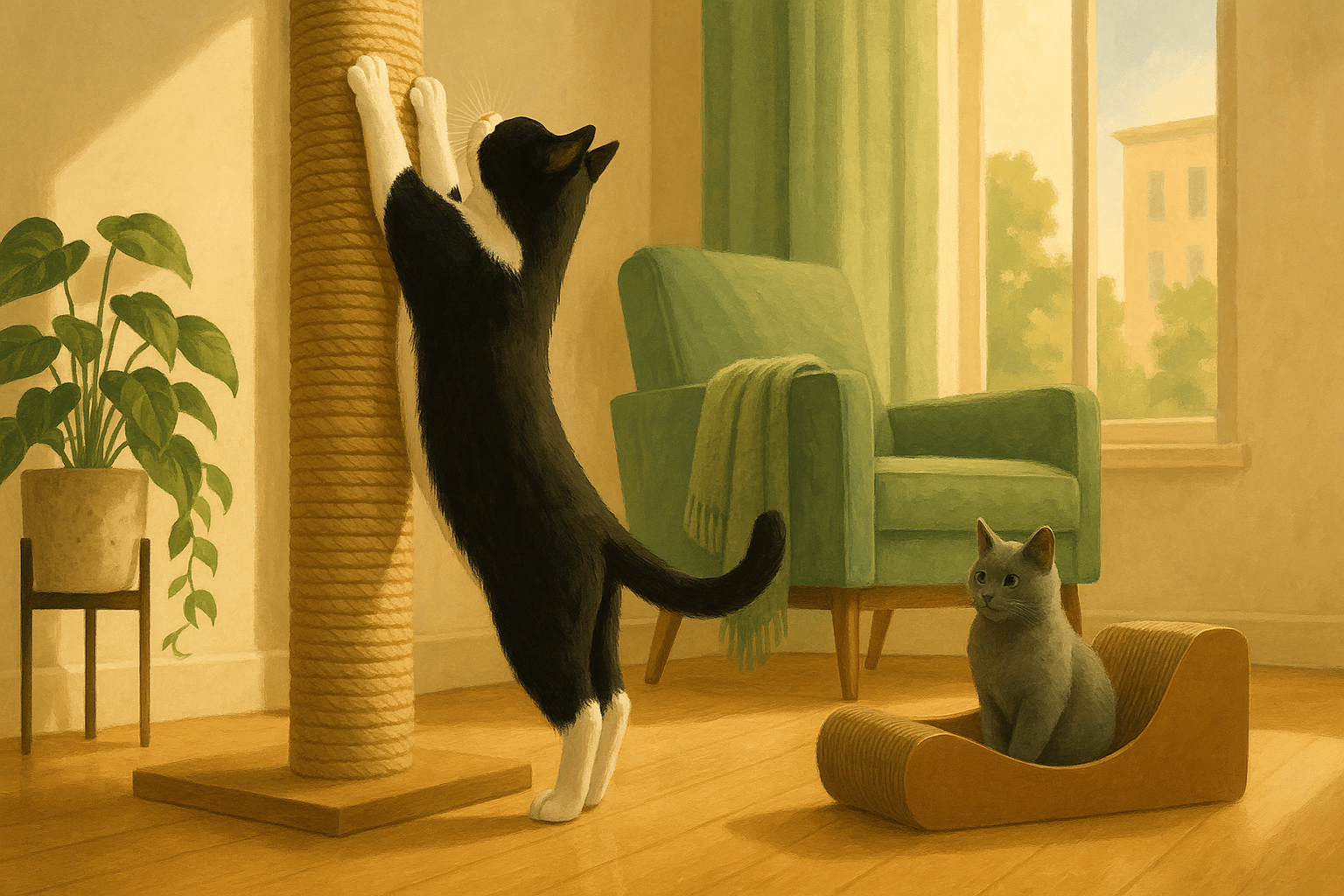
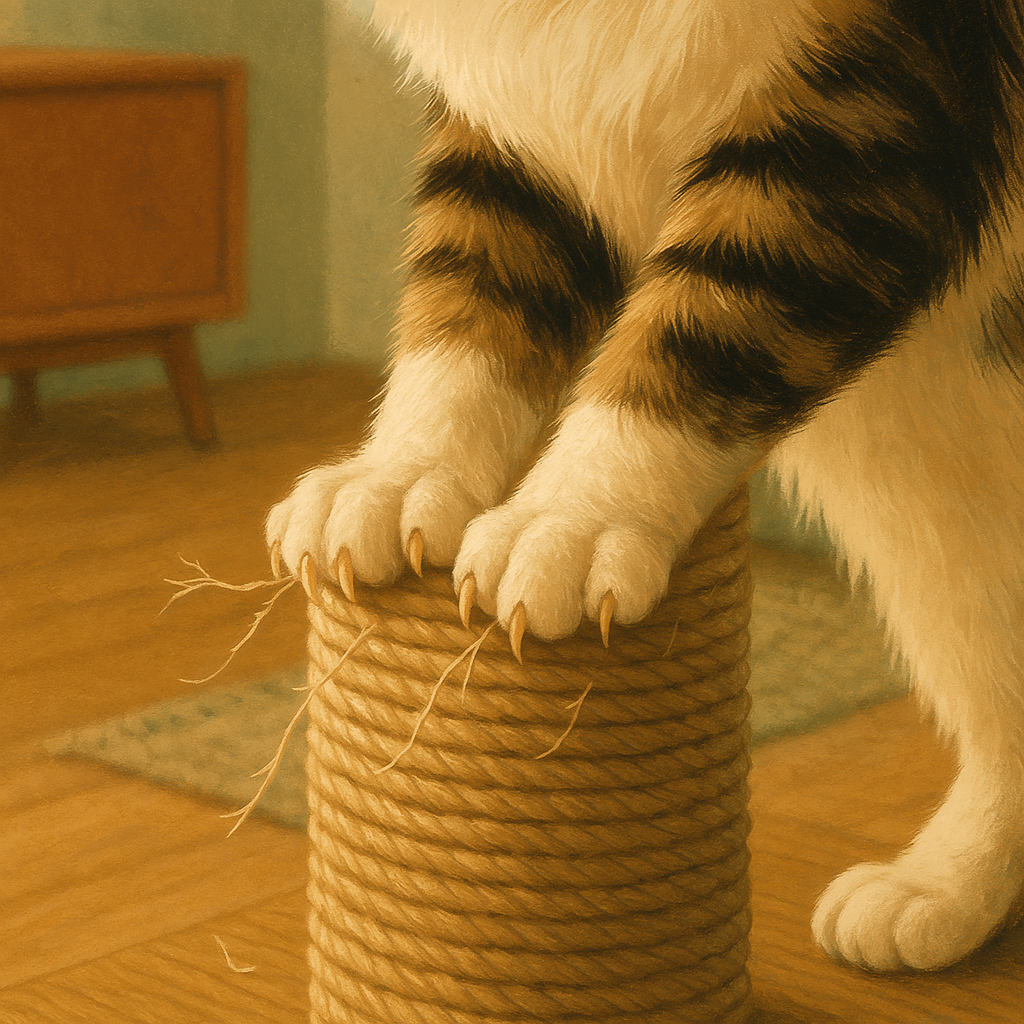
A vertical post lets a cat stand on her hind legs, hook the claws in and pull down through a long stretch. Cornell’s advice is specific: a cat who scratches vertically needs a post tall enough for a long stretch (at least as tall as she is standing on her hind legs) and sturdy enough not to topple while she hauls on it. [1] Wobble ends the experiment fast. The SmartCat Ultimate post is built around those two points. It stands 32 inches tall, sits on a weighted 16 by 16 inch base and offers woven sisal on four sides. [4] Cornell also notes that cats who go after couches and other nubby surfaces often prefer a rope-like covering such as sisal, which is what this post uses. [1] The trade-off is footprint. It claims a patch of floor and a lot of vertical space, so it suits a room with a clear corner more than a cramped nook.
Horizontal scratchers: the floor-level rake
Some cats never reach up at all. They dig at the rug, work over the hallway runner or knead a flat cushion with their claws out. For those cats Cornell suggests a flattened cardboard box or a log placed on its side, which is the idea behind a corrugated floor scratcher. [1] The SmartyKat Super Scratcher Chaise is a ready-made version. It has a contoured, lounge-like shape, corrugated layers with catnip infused between them and a surface the maker likens to tree bark. [5] It stands under four inches tall, so it tucks beside a bed or under a sideboard where a post never would. [5] My expectation, not something I’ve confirmed over months of use, is that corrugated paper wears down faster than woven sisal, so plan on replacing it sooner. That’s the honest cost of a low price and a cat bed that doubles as a scratcher.
Reading your cat’s habit
Let the damage give the answer. Check where the claw marks are before you shop. Marks high on a door frame, a sofa arm or a curtain say vertical. Frayed carpet edges, a worn stair runner or a torn flat of a cushion say horizontal. Some cats do both, and then you have your answer too: buy one of each. The AAFP puts it plainly, recommending a mix of tall, horizontal and angled scratchers in sisal rope, carpet, cardboard or wood. [2] In a multi-cat home I’d lean harder on variety, because one cat may stretch up the post while her housemate claims the cardboard lounge. Give each of them a choice and the argument over a single scratcher mostly disappears.
Where to put them
Shape gets the cat interested and placement keeps her coming back. Cornell advises placing a new post next to a spot she already scratches and moving it gradually to where you’d like it. If she scratches in several places, put one near each. [1] The AAFP adds two useful spots: near where she sleeps and in front of the piece of furniture she’s been targeting. [2] Cats often stretch and scratch right after waking, so a scratcher beside the bed or the favorite sunny perch gets used. If you use a pinch of silvervine powder as a lure, the maker’s directions are to sprinkle it on the scratch post. [6] It’s a nudge, not a fix, and I’d treat the claims on the label (including that it redirects destructive scratching) as the maker’s own. Some cats respond to a scent like this and some shrug.
How I compared them
This is a researched comparison, not a side-by-side test. I haven’t had these two scratchers in a home with a cat, so I won’t say I did. What I did was read Cornell’s and the AAFP’s scratching advice, line up each product’s dimensions and materials from retailer and maker listings and check how closely each one meets the advice on height, stability and surface. I’d choose the vertical post first for a cat who damages furniture, because stretching tall is the habit that does the most harm to a sofa. But the cardboard chaise earns its place: it costs less, it fits where a post can’t and it doubles as a bed. In a small apartment with a cat who scratches the rug, it may be the better first purchase. Where the two tie, the cat’s own habit decides.
Common questions
Do I need both a vertical and a horizontal scratcher?
If your cat scratches in both ways, yes. The AAFP recommends offering a mix of orientations and materials. [2] If she only ever does one, start with the matching shape and add the other later.
How tall should a vertical post be?
Cornell says at least as tall as your cat standing on her hind legs with her front legs stretched out, and sturdy enough not to tip. [1] A post that bends or rocks under her weight won’t get a second try.
My cat ignores the new scratcher. What now?
Move it. Cornell’s advice is to put it beside the spot she already scratches and shift it gradually. [1] Check that the shape matches her habit before blaming the cat.
When to talk to your vet
A scratcher solves a normal behavior. It doesn’t solve a medical or stress problem. If a cat who always used her post suddenly stops, starts scratching or overgrooming in new places or seems reluctant to stretch, mention it to your vet. The same goes for limping, swollen or tender paws, or claws that have grown into the pad or look torn or discolored. Those are examination questions, not product questions. A cat who is scratching more than usual alongside other changes in routine, appetite or litter box habits is also worth a call.
The bottom line
- Choose the SmartCat Ultimate post if your cat reaches up and rakes down on the couch, drapes or door frames, and you have a clear corner for a tall, stable post.
- Choose the SmartyKat chaise if your cat scratches the rug or floor, you’re short on space or you want a low-cost scratcher that doubles as a lounge.
- Add the Raw Paws silvervine powder if a new scratcher sits unvisited and you want to try a scent lure before giving up on it.
Whichever shape you choose, put it where your cat already scratches. A decent scratcher in the right spot beats a perfect one in the wrong corner.
Sources
- Cornell Feline Health Center, “Feline Behavior Problems: Destructive Behavior”
- American Association of Feline Practitioners, “It’s NATURAL for Cats to Scratch!”
- AVMA JAVMA News, “Guidelines address feline environmental needs”
- Mud Bay, “SmartCat The Ultimate Cat Scratching Post, 32-in” (retailer listing, used for specs only)
- Kohl’s, “SmartyKat Super Scratcher Corrugate Chaise Lounge” (retailer listing, used for specs only)
- Raw Paws Pet Food, “Silvervine Powder for Cats, 2.64-oz” (manufacturer product page, claims are the maker’s own)