Cat tree vs cat shelves vs window perch: which one fits your space?
A foster family I worked with in a fourth-floor walk-up bought a tall tree for their shy tabby, wedged it into the spot where the armchair used to sit and watched her ignore it for a month. She spent that month on the windowsill behind the TV stand. The tree was fine. It answered a question she wasn’t asking, which was where she could watch the street without being in anyone’s way. A cat tree wins when you have floor space and a cat who wants to climb, hide and scratch in one spot. Wall shelves win when the floor is spoken for but the wall is free and you’re allowed to drill. A window perch wins when the view is the point and you want nothing in the wall at all. Work out what your cat is after, then buy the shape that gives it.
As Amazon Associates we earn from qualifying purchases. Some links in this post are affiliate links; if you buy through them, we earn a small commission at no extra cost to you. We only recommend products we’ve used or researched thoroughly. See our full disclosure for details.
How they compare at a glance

Vesper High Base Cat Tree (Walnut)
Cat tree · about 48 inches tall · 22 inch square base · four levels
- ✓ Cube den with two entrances, so a cat is not cornered
- ✓ Four levels with cushioned platforms for perching and sleeping
- ✓ Seagrass posts and a sisal mat built in for scratching
- ✓ Smooth laminate finish that resists cat hair
on Amazon
Price as of Oct 26, 2026, 9:21 AM EDT. Product prices and availability are accurate as of the date/time indicated and are subject to change.

FUKUMARU Cat Wall Shelf (17 x 10 in)
Wall shelf · solid rubberwood · sisal mat · screws into the wall
- ✓ Takes no floor space at all
- ✓ Solid rubberwood platform with a sisal mat for grip
- ✓ Mounting screws and anchors come in the box
- ✓ Repeats at staggered heights to build a climbing route
on Amazon
Price as of Oct 26, 2026, 9:21 AM EDT. Product prices and availability are accurate as of the date/time indicated and are subject to change.

Window perch · steel frame · suction cups · machine-washable fleece cover
- ✓ No drilling, so it suits a rental
- ✓ Suction cups rated by the maker at 50 pounds
- ✓ Folds up against the glass when not in use
- ✓ Puts the cat exactly where the view is
on Amazon
Price as of Oct 26, 2026, 9:21 AM EDT. Product prices and availability are accurate as of the date/time indicated and are subject to change.

Raw Paws Kitty Ganja Natural Dried Catnip
An add-on for any of the three, not a perch itself · 1 oz
- ✓ Maker’s suggested use: sprinkle on a toy, bed or scratch post
- ✓ All-natural loose leaf catnip
- ✓ A way to make a new perch worth a first visit
- ✓ Works with whichever piece you choose above
on Raw Paws Pet Food
Price as of Oct 26, 2026, 9:21 AM EDT. Product prices and availability are accurate as of the date/time indicated and are subject to change.
| Vesper High Base tree | FUKUMARU wall shelf | K&H EZ Mount window perch | Raw Paws Catnip | |
|---|---|---|---|---|
| Where it lives | On the floor, usually in a corner | On the wall, at whatever height you choose | On a window pane | Anywhere you can sprinkle it |
| How it stays put | Weighted base and its own footprint | Screws into the wall with the included hardware | Suction cups on clean glass | Not applicable |
| What it gives the cat | Climbing, a hideaway cube, scratching and sleeping in one piece | A high perch and a sisal landing pad | A bed with a view of the outdoors | A scent that may draw a cat to a new spot |
| Floor space it takes | About 22 by 22 inches | None | None | None |
| Commitment | Moves with you but needs assembly and a clear corner | Holes in the wall to patch if you leave | Lowest. Comes off the glass in minutes | Lowest. A jar in the cupboard |
| Best fit | A home with floor space and a cat who likes to hide as much as climb | A small home with wall space and an owner free to drill | A renter or a cat who mostly wants to watch the street | Any cat who has ignored a new perch |
The short version
- Height is the resource, not floor space. The AAFP and ISFM guidelines say access to an elevated area increases a cat’s vertical space and lets her monitor her surroundings. [1]
- The tree is the all-rounder. The Vesper High Base packs a two-entrance cube, cushioned platforms and scratching surfaces into about two feet square of floor. [4]
- Shelves are for homes with walls to spare. The FUKUMARU shelf takes no floor at all and stacks into a route, but it means holes in the wall. [6]
- The window perch is the low-commitment test. The K&H EZ Mount perch hangs on suction cups the maker rates at 50 pounds and comes off the glass without a trace. [5]
- Match the number of places to the number of cats. The guidelines call for at least as many safe places as there are cats. [1]
- A pinch of scent can break the ice. The maker of Raw Paws catnip suggests sprinkling it on a toy, bed or scratch post. [7]
In this guide
Why height beats floor space · The cat tree · Wall shelves · The window perch · Fitting one to your home · How I compared them · Common questions · When to talk to your vet
Why height beats floor space
Cats treat the room as a set of levels. The AAFP and ISFM guidelines list elevated areas among the core resources of a cat’s environment and say access to one increases her vertical space and lets her keep an eye on what’s happening. [1] The same guidelines describe hiding as a coping behavior and note that a cat who can’t see a threat feels safer, even if her whole body isn’t concealed. [1] VCA makes the same point in plainer language: many cats seek high resting places where they can relax while watching for trouble, which matters most for a cat who needs a break from other pets or young children. [2] Cornell lists living in a multi-cat household among the stress factors linked to feline lower urinary tract signs, and it names climbing posts among the ways to give a cat an outlet for natural predatory behavior. [3] None of that asks for a big apartment. It asks for a few well-placed levels, and the three pieces in this comparison are three different ways to add them.
The cat tree: climbing, hiding and scratching in one piece
A tree concentrates everything in a single footprint. The Vesper High Base stands about 48 inches tall on a 22 inch square base, with four levels of cushioned platforms, seagrass posts, a sisal mat and a cube den with two entrances. [4] That last detail is not decoration. The AAFP and ISFM guidelines say safe places in a multi-cat home should have more than one entry so that another cat can’t block access. [1] A single-cat home gets the hiding spot, and a two-cat home gets a den neither cat can be trapped in. VCA also advises putting activity trees where the family spends time, not in a back room, and securing them away from a wall if possible so a cat can jump on from different angles. [2] The trade-off is the footprint. It needs a clear corner, it needs assembling and the laminate finish suits a living room better than a hallway. [4] If your cat wants to be up high and out of sight in the same moment, nothing else here does both so neatly.
Wall shelves: a route that costs no floor
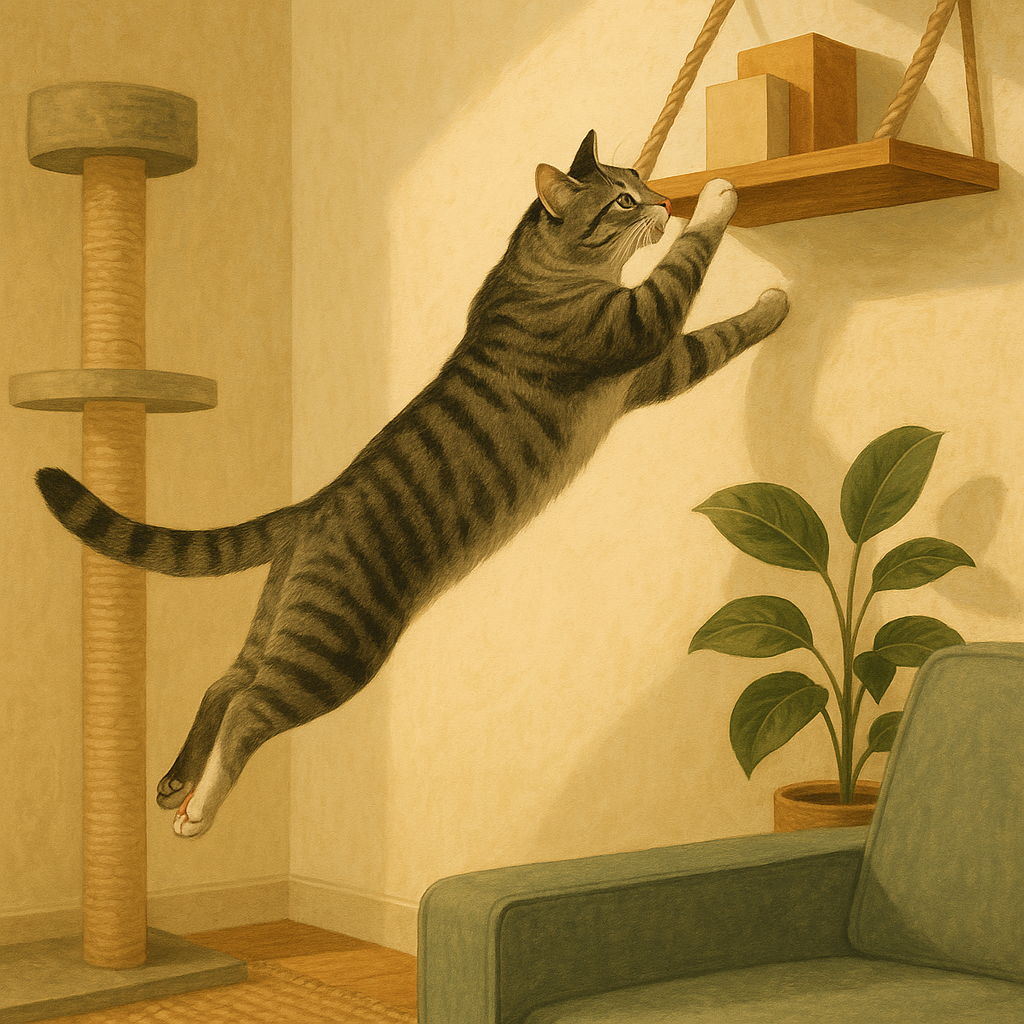
The FUKUMARU shelf is a solid rubberwood platform listed at 17 by 10 inches with a sisal mat on top, and the box includes screws and anchors for mounting. [6] Because it lives on the wall, it adds height to a room that has no floor left to give. One shelf is a perch. Three at staggered heights become a path, which is how cats like to move through a room. The AAFP and ISFM guidelines say perches should be wide and long enough for a cat to stretch out fully, so a large cat may overhang a shelf this size and a small or medium cat will fit more comfortably. [1] The same guidelines advise placing perches low or reachable by ramp for kittens and older cats with limited mobility, which means the first shelf in a staggered set should sit close to a sofa arm or a low table. [1] The retailer listing doesn’t state a weight rating or say whether to hit studs or use the anchors, so check the hardware against your wall type before trusting a heavy cat to it. [6]
The window perch: the view first, the furniture second
The K&H EZ Mount perch skips furniture altogether. It is a steel-frame bed with a machine-washable fleece cover that hangs on suction cups the maker rates at 50 pounds, and it folds up against the glass so blinds and curtains still work. [5] The maker lists a minimum window of 24 inches wide by 19 inches high for its single-level sill, so measure your pane and check the listing for your size. [5] The case for it comes from two places. The AAFP and ISFM guidelines say a cat’s indoor resting areas should include a spot with visibility of the outdoors, and they note that a hammock-style dip in a perch helps a cat feel hidden. [1] VCA lists perching near a window with a view among the things many cats enjoy. [2] The honest limit is the seal. Suction needs clean, dry glass and an occasional check that the cups haven’t loosened, and a cat who launches onto it with full force is the one to watch. A perch like this won’t give you a hideaway or a scratching surface, so it adds one thing and does it well.
Fitting one to your home
Start with the lease and the cat count. In a rental where drilling is off the table, the window perch is the obvious first move, and it tells you cheaply whether your cat uses height at all. In a studio with one cat and a free corner, the tree gives the most behavior per square foot. If you own the place and the floor is full, shelves are the way to keep adding. In a two-cat home, use the guidelines as a rule of thumb: at least as many safe places as cats, kept in separate parts of the home. [1] That usually means two different pieces rather than two of the same, so one cat’s retreat isn’t in sight of the other’s.
Placement matters as much as the pick. A perch the cat can’t reach, or one tucked where no one ever walks, goes unused. If a new piece sits ignored, a small sprinkle of Raw Paws catnip on the cushion or sisal is a low-cost nudge, following the maker’s suggestion to scatter it on a toy, bed or scratch post. [7] Not every cat reacts to catnip, so treat it as a trial and not a promise.
How I compared them
This is a researched comparison, not a side-by-side test. I haven’t had these three in a home with a cat, so I won’t claim I did. What I did was read the AAFP and ISFM environmental guidelines, VCA’s enrichment advice and Cornell’s notes on stress, then line up each product’s listed dimensions, materials and mounting method from the maker or retailer pages and check them against that advice. I’d point most people with floor space to the Vesper High Base first, because it offers the most kinds of use in one purchase. But the K&H EZ Mount perch deserves real credit: it asks for the least commitment, it needs no tools and for a cat whose main hobby is watching birds it may be used more than a tree ever is. The FUKUMARU shelf loses to the tree on variety but wins when floor space is the scarce thing. Where the pieces tie, your cat’s own habits decide.
Common questions
Can I use more than one of these?
Yes, and for many homes that’s the best answer. The guidelines recommend multiple, separated resources, and a shelf by the sofa plus a window perch gives a cat two different reasons to be up high. [1]
Will a window perch hold a big cat?
The maker rates the suction cups at 50 pounds. [5] Most cats weigh far less, but a heavy cat jumping on at speed puts more load on the cups than her weight alone, so check the seal regularly.
My cat ignores the new piece. What now?
Move it. VCA advises placing trees where the family spends time and not in a back room. [2] Check that she can reach it easily, then try a sprinkle of catnip on the surface. [7]
When to talk to your vet
Climbing and perching are normal behaviors, and a change in them can be a health signal. If a cat who used to leap onto her tree or shelf starts hesitating, taking a lower route, missing jumps or stiffening after she lands, mention it to your vet, especially in an older cat. The same goes for a cat who stays high because she appears frightened, as VCA notes that being up high is not a good sign if the reason is fear. [2] A sudden shift in where and how your cat rests, alongside changes in appetite or litter box habits, is worth a call.
The bottom line
- Choose the Vesper High Base if you have a clear corner, one or two cats and want a single piece that covers climbing, hiding and scratching.
- Choose the FUKUMARU shelf if floor space is gone, you can drill into the wall and you’d like to build a climbing route over time.
- Choose the K&H EZ Mount perch if you rent, your cat’s main interest is the view or you want to test whether she uses height before committing to more.
- Add the Raw Paws catnip if a new perch sits unvisited and you want a low-cost nudge to try first.
Whichever you pick, put it where your cat already spends her time. A modest perch in the right spot beats a perfect one in the wrong room.
Sources
- Ellis et al., “AAFP and ISFM Feline Environmental Needs Guidelines,” Journal of Feline Medicine and Surgery (2013)
- VCA Animal Hospitals, “Cat Behavior and Training: Enrichment for Indoor Cats”
- Cornell Feline Health Center, “Feline Lower Urinary Tract Disease”
- Catit, “Vesper High Base” (manufacturer product page, used for specs only)
- K&H Pet Products, “EZ Mount Window Kitty Sill” (manufacturer product page, used for specs only)
- Chewy, “FUKUMARU Solid Rubber Wood Wall Mounted Cat Wall Shelf with Sisal Mat” (retailer listing, used for specs only)
- Raw Paws Pet Food, “Kitty Ganja Natural Dried Catnip for Cats, 1-oz” (manufacturer product page, claims are the maker’s own)