Catit Flower Fountain vs PetSafe Drinkwell Platinum: which fountain fits your indoor cat?
Hydration was the quiet worry behind half the questions I fielded working intake at a small-animal clinic. An owner would mention, almost in passing, that their cat never seemed to touch the water bowl, and you could see them bracing for bad news about the kidneys. A fountain was the fix they’d usually already bought, or were about to. Two names came up more than any others: the Catit Flower Fountain and the PetSafe Drinkwell Platinum. The Catit wins when you’ve got one cat and a small space to work with. The PetSafe wins when you’ve got more cats or less patience for refilling a tank. Here’s how to tell which one you are, plus a caveat up front that matters: a fountain is a nudge, not a cure.
As Amazon Associates we earn from qualifying purchases. Some links in this post are affiliate links; if you buy through them, we earn a small commission at no extra cost to you. We only recommend products we’ve used or researched thoroughly. See our full disclosure for details.
How they compare at a glance
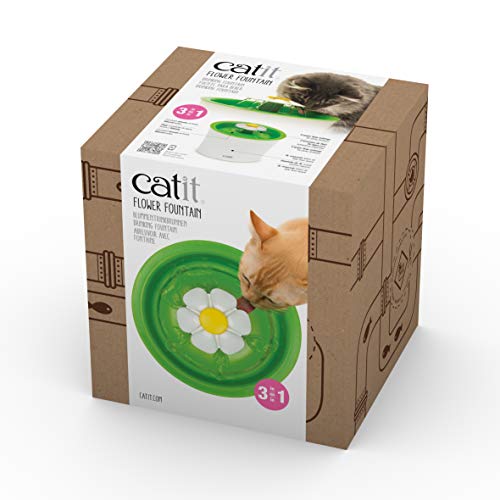
Small footprint · three flow settings · triple-action filter
- ✓ 3 liters (about 100 oz) capacity
- ✓ Foam, carbon and ion-exchange resin filter
- ✓ Gentle, low-noise pump
- ✓ BPA-free plastic, stainless version available
on Amazon
Price as of Sep 21, 2026, 9:21 AM EDT. Product prices and availability are accurate as of the date/time indicated and are subject to change.

PetSafe Drinkwell Platinum (168 oz)
Large capacity · free-falling stream · adjustable flow
- ✓ 168 oz (5 liters) capacity
- ✓ Carbon filter plus foam pre-filter
- ✓ Adjustable flow, falling-stream design
- ✓ Dishwasher-safe upper tray
on Amazon
Price as of Sep 21, 2026, 9:21 AM EDT. Product prices and availability are accurate as of the date/time indicated and are subject to change.
| Catit Flower Fountain | PetSafe Drinkwell Platinum | |
|---|---|---|
| Capacity | 3 liters, about 100 oz | 168 oz, about 5 liters |
| Filter | Triple-action: ion-exchange resin, carbon and fiber mesh | Carbon filter plus a foam pre-filter |
| Flow style | Three adjustable settings, quieter by design | Free-falling stream, adjustable, louder by design |
| Typical price | Lower upfront cost across most retailers | Higher upfront cost, often the better price per ounce of capacity |
| Best fit | One cat, small space, low noise tolerance | Multi-cat home or infrequent refills |
The short version
- A fountain helps some cats, modestly. The best controlled study on this found cats drank only a little more from flowing water than from a still bowl, and the difference wasn’t statistically significant. [1] Treat a fountain as one tool, not a guarantee.
- Catit Flower Fountain holds 3 liters (about 100 ounces), runs three flow patterns and uses a triple-action filter. It’s compact, quiet and cheap to run.
- PetSafe Drinkwell Platinum holds 168 ounces (5 liters), with a free-falling stream and an adjustable-flow pump. The bigger reservoir means fewer refills, which suits a multi-cat home.
- Both are BPA-free plastic. If you want metal, Catit sells a stainless-steel version of the Flower Fountain, and PetSafe makes a stainless Drinkwell too.
- Upkeep is the real differentiator. Both need the filter changed and the pump cleaned on a schedule, or the flow drops and biofilm builds. The Catit has fewer parts. The PetSafe has more parts but a top tray that’s dishwasher-safe.
- For an indoor cat, pick on capacity and noise, then commit to cleaning it. The single biggest hydration lever isn’t the fountain at all. It’s wet food. [2]
In this guide
What a fountain can and can’t do · Capacity and household fit · Filtration · Flow, noise and the apartment problem · Cleaning and upkeep · Materials · Which one fits an indoor cat · How I compared them · Common questions · When to talk to your vet
What a fountain can and can’t do
It’s worth being honest about the evidence before you spend a cent, because the marketing oversells it. The cleanest study on water source compared healthy cats drinking from a still bowl against a circulating fountain. The cats drank a little more from the fountain, but the increase was small and didn’t reach statistical significance, and their urine concentration didn’t meaningfully change either. [1] So the fountain isn’t magic. What it does do is give a finicky cat a reason to visit the water more often, and for a subset of cats that reason is enough to bump their intake in the right direction. Plenty of owners report exactly that, and a fountain that gets your particular cat drinking is a win even if the average effect across all cats is modest.
Why does hydration get this much attention in the first place? Cats evolved from desert animals with a low thirst drive, so they’re built to get most of their water from prey rather than a bowl. [3] Chronic low-grade dehydration is one of the stressors that gets linked to feline kidney and urinary problems, which is why a cat that ignores water makes a vet tech’s eyebrows go up. [4] A fountain is one way to encourage drinking. Adding or switching to wet food is the bigger lever, since canned food is roughly three-quarters water and pulls a cat’s intake up without relying on them choosing to drink. [2] Keep that hierarchy in mind: wet food first, fountain as a helpful extra.
Capacity and household fit
This is the cleanest practical split between the two. The Catit Flower holds 3 liters, around 100 ounces. The PetSafe Platinum holds 168 ounces, about 5 liters, with a built-in reservoir that does most of that work. For a single cat in an apartment, the Catit‘s 3 liters is plenty and the smaller body takes up less counter or floor space. For two or more cats, or for anyone who travels for a night and wants the bowl to outlast them, the PetSafe‘s larger tank means fewer top-ups and less risk of the pump running dry. Running a fountain dry is worth avoiding with either model, since a pump that pushes air instead of water gets loud and wears out faster.
Filtration
Both run the water through a replaceable filter, and the job is the same: trap hair and debris, pull odors with activated carbon and keep the water tasting fresh enough that your cat doesn’t snub it. The Catit‘s triple-action filter adds an ion-exchange resin that softens hard tap water, which is a small but real plus if your tap leaves mineral spots on everything. The PetSafe pairs its carbon filter with a foam pre-filter that catches hair before it reaches the pump, which helps in a shedding household. Neither filter purifies the water in any medical sense. Their real value is keeping the water appealing, because an unappealing bowl is exactly the problem you bought the fountain to solve. Plan on swapping filters every two to four weeks for either one.
Flow, noise and the apartment problem
Noise is the complaint I’d weight most heavily if you live in a small space, because a fountain that annoys you at 2 a.m. is a fountain you’ll unplug, and an unplugged fountain hydrates nobody. The Catit Flower runs a gentle pump with three flow patterns, from a calm bubbling top to a more visible stream, so a noise-sensitive cat (and a noise-sensitive owner) can dial it down. The PetSafe Platinum uses a free-falling stream that some cats love for the movement and sound, with an adjustable-flow pump to soften it. The falling stream is the louder design of the two by nature. Both get noticeably noisier as the water level drops, which loops back to capacity and cleaning. A clean pump sitting in a full reservoir is a quiet pump. A gunked-up pump in a low tank is the one that rattles.
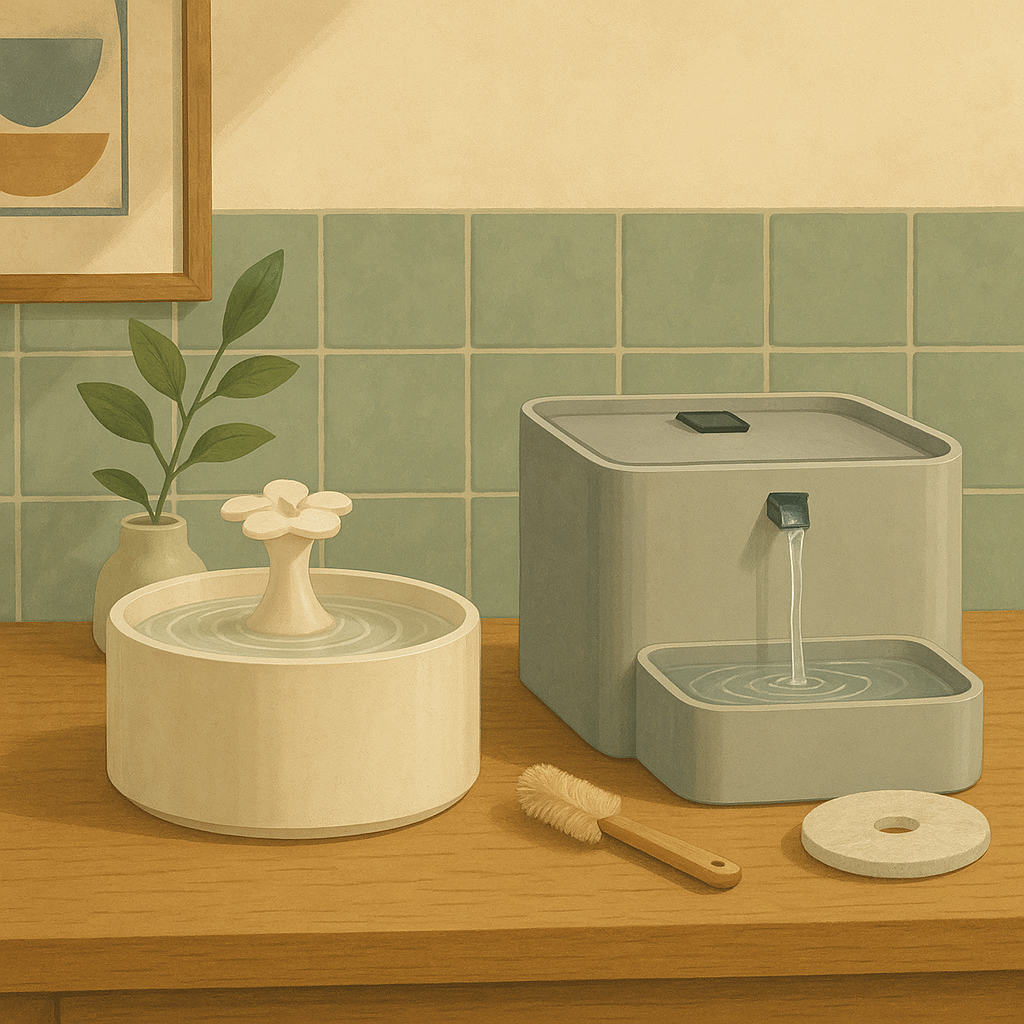
Cleaning and upkeep
Here’s the part nobody enjoys and everybody underestimates. A fountain that isn’t cleaned grows a slick film on every wet surface, and that film will put a cat off the water faster than a dirty bowl will. The pump is the piece that matters most, since hair and slime clog the impeller and kill the flow. The Catit has fewer parts to pull apart, which makes a quick weekly rinse genuinely quick. The PetSafe has more components, a tradeoff for its capacity and its falling-stream design, but its upper tray is dishwasher-safe, so the routine deep clean is easier even though there’s more to disassemble. Whichever you choose, plan on a full pump cleaning every week or two and a filter change every few weeks. The Cornell Feline Health Center’s basic point about keeping water fresh and clean applies to a fountain as much as a bowl. [3]
Materials
Both standard models are BPA-free plastic. Plastic is fine for most cats, but it scratches over time, and those micro-scratches are where biofilm gets a foothold, so a plastic fountain rewards regular cleaning and the occasional replacement. If you’d rather sidestep that, both brands offer a stainless-steel option. Catit makes a stainless Flower Fountain and PetSafe makes stainless Drinkwell models. Steel costs more and resists scratching and odor better. A small number of cats also break out on the chin from plastic dishes, and for those cats a steel or ceramic surface is the simpler fix. [3]
Which one fits an indoor cat
If you’ve got one cat in an apartment and you care about noise and counter space, the Catit Flower Fountain is the easier daily companion. It’s compact, the flow is adjustable down to a quiet trickle and the smaller parts make the weekly clean less of a chore, which matters because the fountain only helps if you keep it running. If you’ve got a multi-cat home, a bigger floor plan or you’d rather not refill a tank every other day, the PetSafe Drinkwell Platinum‘s 168-ounce reservoir is the practical winner, and its falling stream wins over a lot of cats who like to bat at moving water. There’s no universal best here. There’s the one that fits your home and the one you’ll keep clean.
And whichever you pick, pair it with the move that shifts the numbers. Offer wet food, put a second water station in a separate room from the food and litter, and watch whether your cat’s habits change over a couple of weeks. [2] The fountain is the nudge. The wet food and the placement are the lever.
How I compared them
This is a researched comparison, not a side-by-side test in my own home, so I won’t claim I ran both fountains on the same counter for a month. What I did do is read each manufacturer’s stated capacity and filter composition, and check current listed pricing for both models across more than one retailer rather than trusting a single listing. That pricing check turned up something worth naming plainly: the PetSafe costs more upfront everywhere I checked, but its price per ounce of reservoir capacity usually comes out lower than the Catit‘s, so the bigger fountain isn’t just bigger, it’s often the better deal per ounce too. Going the other way, the Catit‘s ion-exchange resin stage is a genuine filtration edge the Platinum’s carbon-and-foam setup doesn’t match, and it matters specifically if your tap water runs hard. Where the two are functionally tied, like durability of the standard plastic bodies or the basic job either filter does, I’ve said so instead of inventing a difference. I weighed all of that against years of intake-desk conversations where the same three questions came up: will my cat drink from it, how loud is it and how much am I going to hate cleaning it.
Common questions
Can I use regular tap water in either fountain?
Yes. Both filters are built to handle tap water, and the Catit‘s ion-exchange stage specifically softens hard tap water. Neither filter is a substitute for a working municipal or well-water supply, and neither claims to be.
Will my cat need training to use a fountain?
Most cats investigate a running fountain on their own within a few days out of curiosity. If yours ignores it, keep the old water bowl nearby for a week or two rather than removing it cold, and let your cat switch over on their own schedule.
Is it safe to leave a fountain running while I’m away for a day or two?
Yes, that’s the point of the reservoir. Check the water level before you go. A tank that’s already low when you walk out the door can run dry by the time you’re back, and a pump running dry gets loud and wears out faster.
How often do I need to replace the filter?
Every two to four weeks for either fountain under normal use, sooner in a multi-cat or heavy-shedding household. A filter that’s overdue is the most common reason a fountain starts smelling or running slow.
When to talk to your vet
A fountain is for a healthy cat who just drinks less than you’d like. It is not the answer to a sudden change. If your cat starts drinking a lot more than usual, or suddenly drinks much less, call your vet rather than reaching for a new gadget, because a real shift in thirst can be an early sign of kidney disease, diabetes or thyroid trouble. [4] Same goes for straining in the litter box, peeing far more or far less, or any signs of dehydration like tacky gums or skin that’s slow to settle when you gently lift it. [1] Those belong in an exam room, not a buyer’s guide. A fountain supports a cat who’s well. It doesn’t diagnose one who isn’t.
The bottom line
- Choose the Catit Flower Fountain if you’ve got one cat, a small kitchen or counter to work with and you want the quietest, lowest-fuss fountain to keep running.
- Choose the PetSafe Drinkwell Platinum if you’re feeding two or more cats, don’t want to refill a reservoir every other day or your cat prefers a stronger, more visible stream.
Both are honest products that do the same modest job, and the one you’ll keep clean beats the one with the longer spec sheet. Remember what the research says, though. A fountain is a worthwhile nudge toward better hydration, not a substitute for wet food and a vet’s eye when something changes. [1][2]
Sources
More hydration guides
- Indoor cat hydration: what actually works
- Cat water fountain vs water bowl: which does your indoor cat actually need?
- The Best Cat Water Fountains Under $50
- The Best Stainless-Steel Cat Water Fountains for Indoor Cats
- Ceramic vs stainless steel vs plastic: the cat water bowl that actually stays clean
- Best Ceramic Water Bowls for Whisker-Sensitive Cats
- Indoor cat kidney disease: how to lower the risk and catch it early