How to train your cat to walk on a harness
The most enthusiastic leash-walker I ever met at the rescue was a stocky brown tabby named Pilot who had spent two years in a third-floor apartment and clearly wanted more out of life. His adopter asked me, half-joking, whether walking a cat outside was a real thing or something people only did for the internet. It’s real. Pilot took to a harness in about a week and spent his evenings patrolling a fenced garden at the end of a leash, nose working overtime. But I’ve also buckled a harness onto a cat who flattened to the floor and refused to move a whisker, and that’s the honest place to start. Some cats love this, some want no part of it and your job is to find out which one you have without souring them on the idea.
The short version
- Not every cat is a candidate. Confident, curious cats do best. Anxious or shy cats usually don’t, and pushing them tends to backfire.2
- Use a proper harness, never a collar. A collar slips off or chokes a cat that pulls. A harness spreads the pressure across the body.1
- Fit it snug. Aim for about a finger’s width underneath and no more, because a loose harness is one your cat can back out of.2
- Move in slow stages: wear the harness indoors, add the leash indoors, then step outside. Think days to weeks, not one afternoon.1
- Let your cat set the pace and never drag the leash. Lure with treats and praise instead.2
- Before any trip outdoors, sort out vaccines, parasite prevention and a microchip.23
First question: is your cat even a candidate?
Before you buy anything, watch your cat. The whole point of leash training an indoor cat is enrichment, giving a housebound hunter a safe taste of the sights and smells its instincts are built for.3 That only works if the cat finds the outdoors exciting rather than terrifying. VCA puts it plainly: some cats, especially those started young, come to love their walks, some flatly refuse to step out the door and plenty land in the middle, ambling a few feet and then sitting down to watch the world.2 A bold cat that greets visitors and investigates the vacuum is a good bet. A cat that bolts under the bed at a knock probably isn’t, and there’s no shame in stopping there. Indoor harness practice on its own is still enrichment, and forcing a nervous cat outside does more harm than a skipped walk ever would.
The gear, and why the harness matters more than the leash
You need three things: a well-fitting harness, a lightweight leash of about five or six feet and your cat’s favorite treats.1 Skip the retractable and extra-long leads, which give a startled cat enough line to shoot up a tree or over a fence before you can react.2 The harness is the piece that earns its keep. A collar is far too easy for a cat to slip, and a cat that lunges against a collar can choke, so a body harness is the only safe option for walking.1 Fit is everything. Size it so your cat can’t wriggle free, roughly a finger’s width of slack and no more.2 One honest caveat worth knowing: no harness is truly escape-proof. A determined cat in a panic can back out of most of them, which is why calm training and a slack leash matter as much as the buckle does.
The method, one stage at a time
The mistake I see most often is treating this like a single event: harness on, leash clipped, out the door, cat horrified. It’s a series of small steps spread over days, each one paired with food and praise so the harness becomes a predictor of good things.1
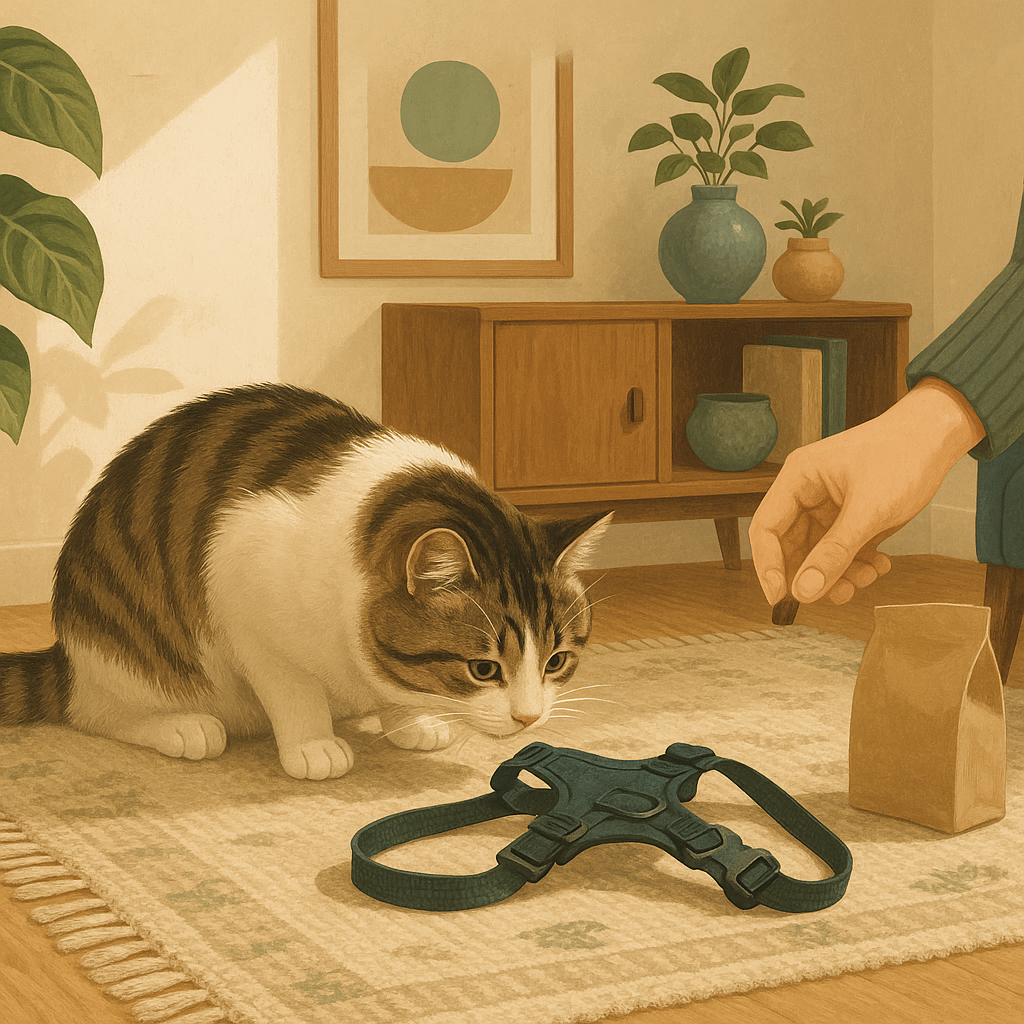
Make the harness furniture. Leave it near your cat’s food, bed or favorite napping spot and reward any sniff or rub with a treat. When the sight of it is boring, you’re ready for the next step.1
Put it on for short spells. Lure your cat’s head through the loop with a treat, fasten it loosely and reward right away, then take it off after a few minutes. Build the time up gradually. It’s completely normal for a cat to freeze, hunch or walk like a crab the first few times it wears one, so don’t read that as failure.1
Add the leash indoors. Clip it on and let your cat drag it around the house while you watch that it doesn’t snag on anything. Once that’s old news, pick the leash up and follow your cat around with zero tension on it, tossing a treat in the direction you’d like it to go.1
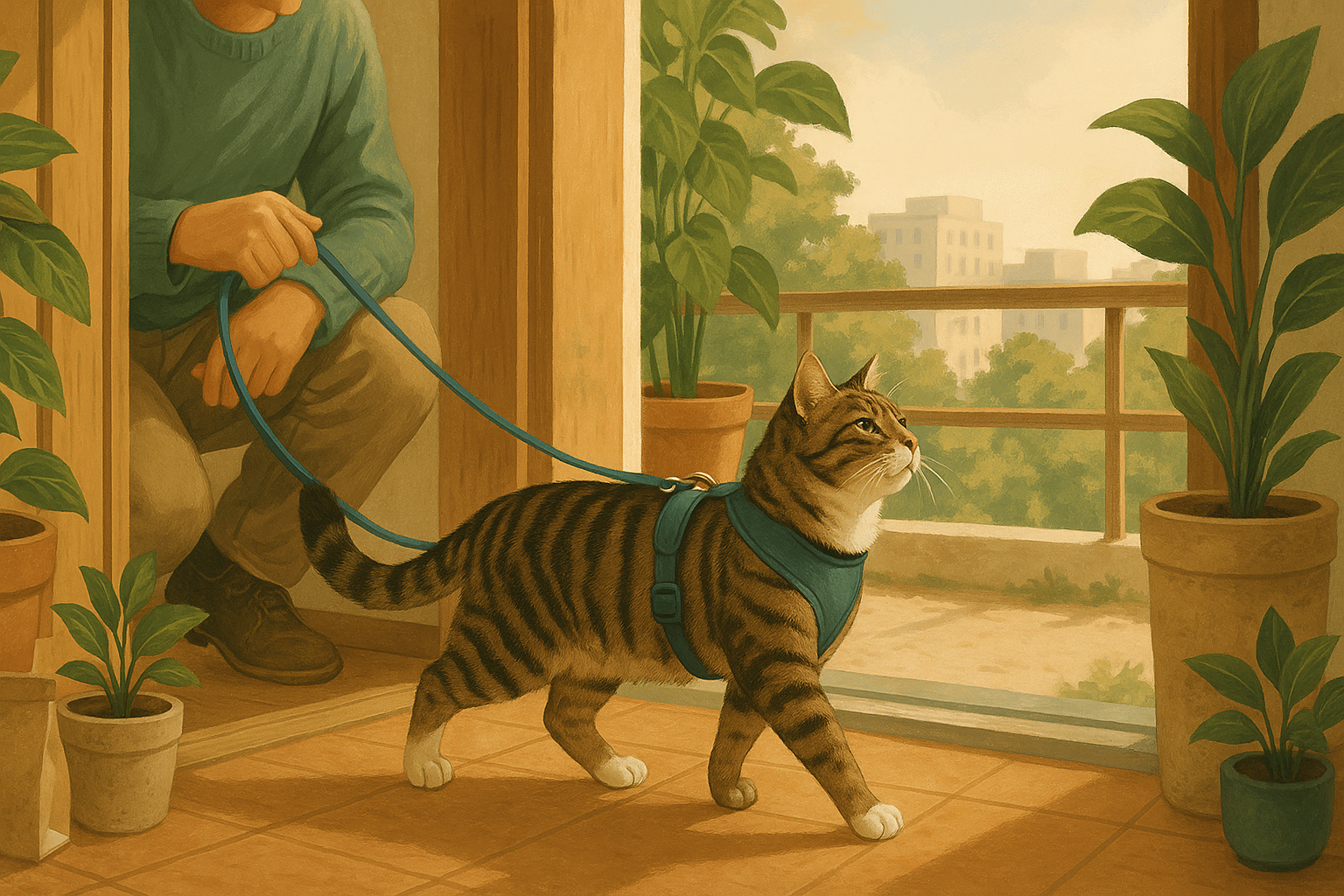
Step outside, briefly. Pick a quiet time of day and a calm side of the house. Open the door and toss a treat just past the threshold so your cat learns that going out is linked to a cue from you, not a chance to dart.1 Keep the first outings tiny, the driveway or a patch of yard, then back inside.2 Let your cat lead, reward the direction you want with a treat and never pull. Dragging a cat on a leash teaches it that the harness means being hauled around, which is exactly the association you’re trying to avoid.2
Going at the cat’s pace is the whole game
If there’s one rule that carries the rest, it’s this: your cat sets the speed.2 Watch for the quiet signs of stress, a crouched body, flattened ears, a tucked tail or a scramble to hide, and treat any of them as a cue to slow down or stop for the day. Back up to the last stage your cat was comfortable with and spend longer there. Plenty of cats top out at happily wearing the harness indoors and never want the sidewalk, and that is a perfectly good result. Push a reluctant cat and you don’t get a walking cat, you get one that runs at the sight of the harness. Rewards and patience get you everywhere here. Punishment gets you nowhere.
Before you open the door
Leash walking is the safest way to give an indoor cat outdoor time, but safest doesn’t mean risk-free. Time outside raises the odds of your cat meeting a stray animal or picking up fleas and ticks, so get vaccines current and parasite prevention in place before the first real walk.2 Make sure your cat is identifiable too. A microchip, kept registered with your current details, is what turns a bolted cat back into a found one, and it’s the reason shelters push identification so hard.3 Then stack the deck on the day itself: quiet streets over busy ones, a slack leash always and a hard pass on hot pavement or anywhere a sudden dog or car could send your cat into a panic.
When to talk to your vet
Book the practical prep before you start: your vet can confirm your cat is up to date on vaccines and on a parasite preventive suited to outdoor exposure.2 If training seems to be tipping your cat into lasting stress, hiding more than usual, eating less or over-grooming after your sessions, ease right off and mention it at the next visit, since a cat this uneasy is telling you it isn’t a walking cat. And if your cat does tangle with another animal outside or you find ticks latched on after a walk, call your vet rather than waiting it out. Most cats who take to the leash never give you a reason to worry, but the outdoors adds variables an indoor life doesn’t, and it’s worth having a vet in the loop before the first trip.
Whether or not your cat ever makes it to the sidewalk, harness work is one more way to keep an indoor cat busy and engaged. If that’s the goal, it pairs well with the rest of an indoor enrichment routine, and it’s worth reading up on the signs that an indoor cat is bored in the first place.