Indoor cat behavior and enrichment: what works, what doesn’t
A scratched-up couch arm. A cat racing across the apartment at 3 AM. Two cats who used to nap together now hissing in the hallway. Most of what gets called “bad behavior” in indoor cats is normal cat behavior happening in a setup that hasn’t accommodated it. Here’s what indoor cats actually need, what to change first when things go wrong and the signals that turn a behavior problem into a vet visit.
The short version:
- Scratching is hardwired, not optional. Provide the right post and most furniture scratching stops.
- Indoor cats need daily structured play (10 to 15 minutes, twice a day). Zoomies are a symptom of unspent energy.
- Vertical space matters more than floor space. Apartment cats use ceilings.
- “Bad” behavior usually has an environmental cause. Look at the setup before assuming a personality issue.
- Resource competition (food, water, litter, perches) is the silent driver of most multi-cat conflict.
- Sudden behavior changes in any cat deserve a vet visit. Pain often shows up as behavior first.
What I learned in the shelter
In four years coordinating behavior cases at a rescue, the patterns repeated. Cats who looked “aggressive” to adopters were usually frightened cats in over-stimulating intake rooms. Cats who “couldn’t be alone” were cats who had never been taught to settle and had no enrichment to settle into. Cats who were “destroying the furniture” were cats with no scratching post, or the wrong scratching post or the right post in the wrong place. By the time families called us about behavior, they often blamed the cat for something the environment was telling the cat to do.
The pattern underneath: cats are predators with very specific environmental needs, and an indoor apartment is an environment built for humans. Most behavior problems live in the gap between what the cat needs and what the apartment provides. Closing that gap fixes more than people think.
What indoor cats actually need
The AAFP and the International Society of Feline Medicine codified five core environmental needs for cats in their 2013 guidelines, and they’re still the gold standard reference.5 Translated for an indoor apartment: first, space to move vertically: cats live in the third dimension naturally, and a cat with only floor-level access is a cat using a fraction of her territory. Wall shelves, cat trees, the tops of bookcases and cleared windowsills all expand the usable home. Second, structured predatory play: feather-wand sessions that include the full predator sequence (stalk, chase, pounce, “kill,” eat). Cornell flags interactive play as essential because cats are predators who need to express it.1 Third, scratching surfaces in the right places and the right shapes. Fourth, multiple resources distributed across the home: food bowls, water, litter boxes and resting spots, to prevent quiet resource competition. Fifth, predictable routines: cats are creatures of pattern, and abrupt schedule changes are stressors.
Most “behavior problems” trace back to a gap in one or more of these. Full take on cat zoomies and what they mean.
Scratching: not optional, just redirectable
Scratching isn’t something cats do because they’re naughty. It’s three behaviors in one. Cornell describes it as a marking behavior (scent glands in the paws deposit territory markers), a claw-maintenance behavior (the outer claw sheaths come off) and a stretching behavior for the shoulders and back.2 All three are wired in, and a cat who doesn’t scratch is either declawed or has a pain issue worth investigating.
What you can change is where she does it. Cornell’s guidance on scratching posts is specific: pick a post that matches her preference for orientation (vertical or horizontal) and substrate (sisal, cardboard, wood, carpet), sturdy enough not to topple and at least as tall as the cat fully stretched.2 Place the post next to wherever she’s currently scratching, not across the room. Reward her for using it, ignore the wrong target. Most furniture scratching resolves with the right post in the right place. Full take on cat scratching and how to redirect it.
Play, energy and the 3 AM zoomies
Indoor cats have a predator’s energy budget and almost nothing to spend it on. They aren’t hunting, aren’t patrolling territory, aren’t crossing back roads at dawn. What they don’t burn during the day comes out at night, often as the classic 3 AM zoomies. The pattern: the cat tears across the apartment, leaps onto things, sometimes meows urgently and looks possessed for ninety seconds.
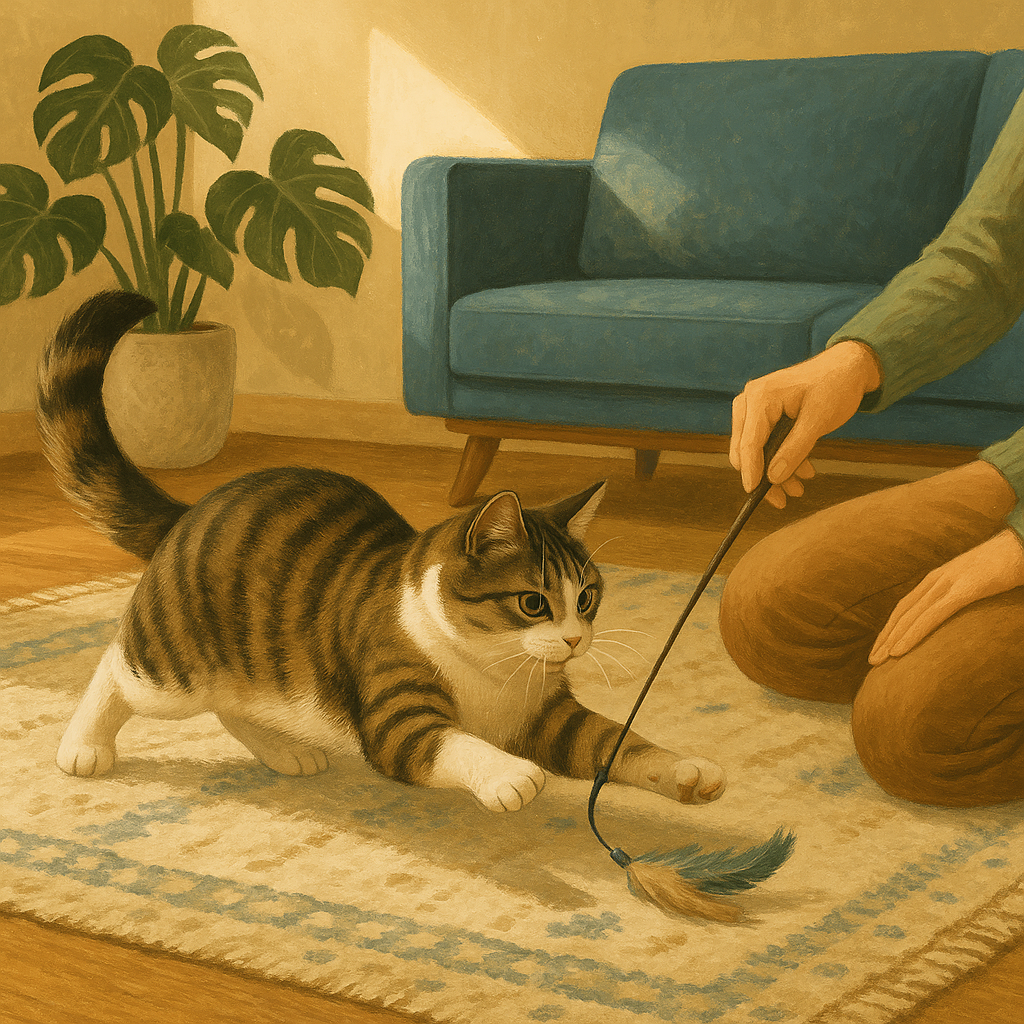
The cure is daytime play that mimics the hunt. Cornell flags interactive play and toys that encourage chasing and pouncing as essential enrichment.1 Ten to fifteen minutes, twice a day, with a feather wand or similar prey-mimicking toy: stalk, chase, pounce, “catch,” small food reward at the end. The food reward closes the predator sequence the way an actual successful hunt would. Two sessions a day is the threshold most owners notice the night zoomies decreasing within a week or two.
Multi-cat tension is usually about resources
Most “cat fights” in apartments aren’t personality clashes. They’re resource competition. Cornell’s guidance on aggression flags multi-cat household conflict as one of the most common behavior issues and traces a lot of it to environmental setup.3 The classic mistake is one of everything: one food bowl, one water bowl, one litter box, one prime sleeping spot. In a multi-cat home, that produces a daily friction point where one cat blocks another from a resource. The friction stays low-grade until something tips it.
The rule of thumb: one of each resource per cat, plus one extra, distributed across different parts of the home. Two cats, three litter boxes, three water stations. Three cats, four. Place them so a cat using one can’t be blocked by another cat using or guarding the alternative. Vertical space helps here too: a higher-status cat resting on a perch can monitor without controlling floor-level access.
For introductions between cats, the gradual protocol (separate rooms, scent swap, supervised glimpses, slow integration) is the difference between long-term housemates and long-term tension. Most rushed introductions never fully recover.
Anxiety, stress and the limits of environmental fixes
Some behavior changes are environmental. Some are medical or psychological. The line between them isn’t always obvious to an owner. Cornell’s resources on behavior problems repeatedly flag that medical causes should be ruled out before assuming a behavior is purely psychological.3 A cat suddenly avoiding the litter box may be in pain. A cat who suddenly starts hiding may have a thyroid issue. A cat who’s stopped grooming may be depressed, in pain or both.
For environmental-stress behaviors (a recent move, a new pet, a schedule change), the time scale on the natural recovery is usually weeks, not days. If the behavior is persisting past a few weeks, or getting worse, that’s the signal to escalate. Pheromone diffusers come up a lot in this conversation. The evidence for them is real but modest and context-specific. Full take on whether pheromone diffusers actually work.
Vertical space: the apartment-cat upgrade
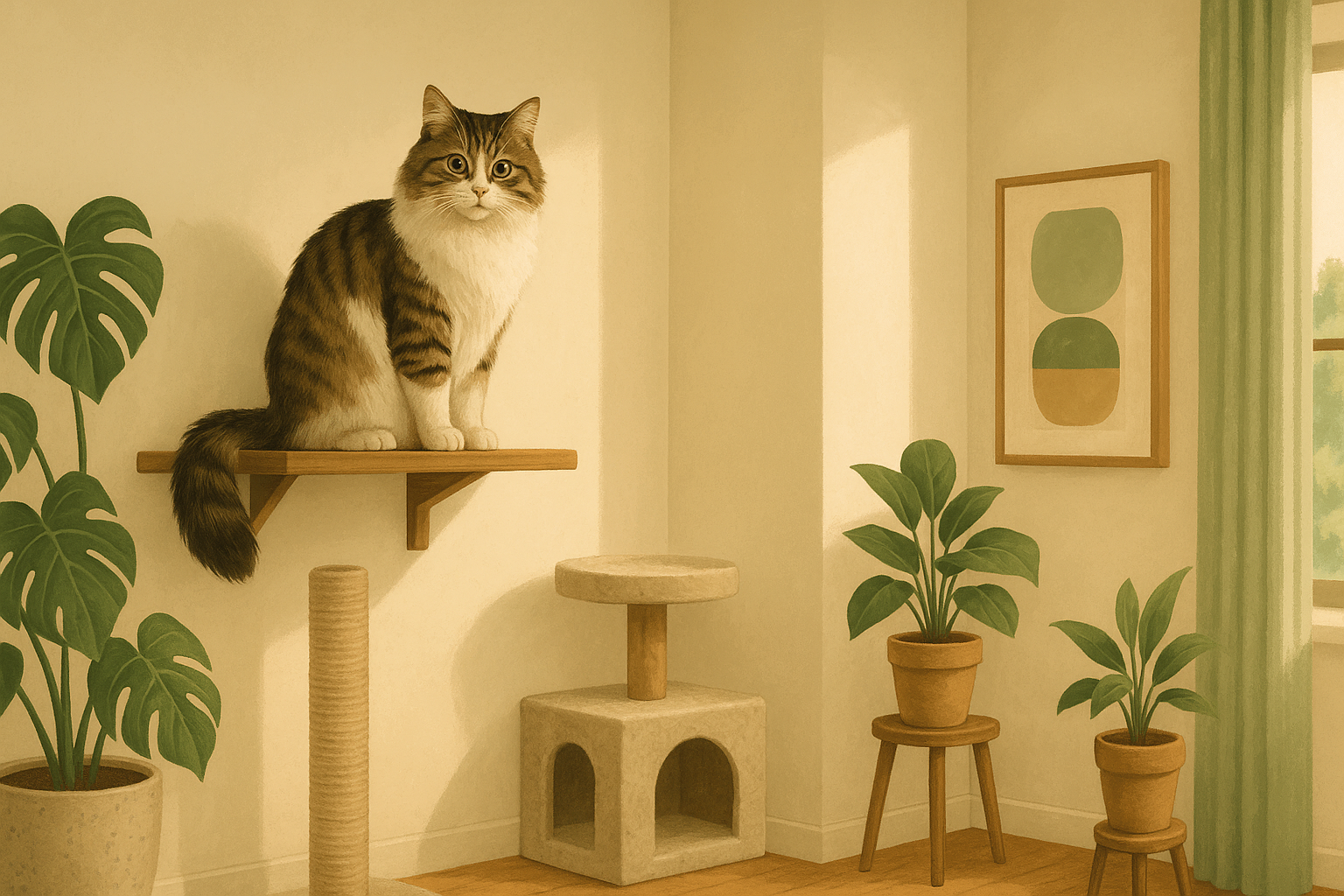
A small apartment can hold a lot of cat territory if you build upward. Wall-mounted shelves at varying heights, a tall cat tree near a window, a cleared-off top of a bookcase, a perch above the door: each adds usable terrain without taking floor space. Cats use vertical spaces for the same reasons their wild relatives do: visibility, safety, control of who can approach them. A nervous cat with one good elevated perch often behaves like a different cat from the same cat without one. This is one of the highest-leverage and lowest-cost changes you can make in an indoor home.
When to talk to your vet, not just adjust the setup
Some behavior changes are vet calls before they’re behavior conversations. The list:
- Sudden litter box avoidance, especially in a male cat (rule out urinary issues first)
- Hiding more than usual, especially if it lasts more than a couple of days
- Loss of appetite alongside any behavior change
- New aggression in a previously friendly cat
- Excessive grooming or over-grooming one area
- Repeated meowing or vocalization that’s new for that cat
- Any behavior change in a senior cat (often the first sign of dental pain, arthritis or systemic disease)
Cornell explicitly notes that owners often miss medical causes of what looks like behavioral problems.4 Earlier diagnosis matters: a cat in pain who’s labeled “anxious” loses weeks of treatment time. When in doubt, the vet visit is the right first move, not the last one.
The bottom line
Indoor cat behavior and enrichment is more setup than personality. Get the basics right (right scratching posts in the right places, daily structured play, multiple resources in multi-cat homes, vertical space, predictable routines) and most of what people call “behavior problems” don’t show up. When they do, look at the environment first, escalate to a vet if something feels off and only then consider it a “personality” or “training” problem. Most of the time the apartment was the issue, not the cat.
Sources
- Cornell Feline Health Center, “Safe Toys and Gifts”
- Cornell Feline Health Center, “Feline Behavior Problems: Destructive Behavior”
- Cornell Feline Health Center, “Feline Behavior Problems: Aggression”
- Cornell Feline Health Center, “Feline Behavior Issues”
- Ellis, S.L.H., Rodan, I., Carney, H.C., et al. (2013). “AAFP and ISFM Feline Environmental Needs Guidelines.” Journal of Feline Medicine and Surgery
More on indoor cat behavior & enrichment
Buying guides:
- The Best Cat Trees for Small Apartments
- The Best Scratching Posts for Indoor Cats: Sisal or Cardboard?
- The Best Calming Products for a Stressed Indoor Cat
Common questions:
- How do I introduce my cat to a dog?
- Why does my cat attack my ankles?
- Why does my cat headbutt me?
- Why does my cat knead me with her paws?
- Covered or uncovered litter box: which is better?
- Where should I put the litter box?
- How often should I scoop and clean the litter box?
- What kind of litter do cats prefer?
- Why is my cat pooping outside the litter box?
- Why is my cat peeing outside the litter box?
- What are the best toys for indoor cats?
- How much play do indoor cats need?
- Why do my two cats suddenly hate each other?
- How many litter boxes does a multi-cat home need?
- How do I introduce two cats?
- How can I reduce my cat’s stress at the vet?
- What are signs of cat anxiety?
- Can two cats share a litter box?
- Declawing cats: what it actually is, and why most vets say no
- Why does my cat knock things off tables?
- Why does my cat bite when I pet her?
- Do calming collars work for cats?
- Why does my cat meow excessively at night?
- Do indoor cats need a cat tree?
- Why does my cat hide so much?
- Can you train a cat?
- Vertical space for cats: the apartment-design guide
- Do cats actually get bored?
- Should I declaw my cat?
- Are vertical or horizontal scratchers better?
- My cat won’t use the scratching post — what do I do?
- Where should I put a scratching post?