Senior cat health checklist: what to watch and when to act
I spent a few years at the front desk of a small-animal clinic, and the saddest sentence I heard came from good owners who plainly loved their cats. “She’s just getting old.” The cat had stopped jumping on the bed, or was drinking from every glass in the house, or had dropped weight so slowly nobody clocked it. Almost every time, old age turned out to be something with a name and a treatment behind it: arthritis, a thyroid problem, early kidney disease. Aging itself isn’t a disease.1 The trap is assuming that the changes which come with it can’t be helped.
So here’s the reframe that changes how you care for an older cat. You can’t stop her getting older, but most of what makes old age miserable can be slowed, managed or fixed when you catch it early. Indoor cats live longer than they used to, which is the good news and the catch. More of them reach the age where these conditions surface, and you, seeing the food bowl and the litter box every single day, are the person best placed to notice the first quiet sign. This is the checklist I wish every senior-cat owner had on the fridge.
The short version
- Senior starts around age 10, sometimes as early as 7 or 8. Age-related changes often begin between 7 and 10.
- Move to twice-yearly vet visits, with once-a-year senior bloodwork, a urine test and a blood-pressure check.
- Weigh her monthly. A slow slide down and a creep upward both matter.
- Watch four things: how much she drinks and pees, her weight and appetite, how she moves and grooms, and her mouth.
- Adapt the home: a low-sided litter box on each level, steps up to favorite perches, easy water and a warm draft-free bed.
- Never file a new change under “old age.” Get it checked.
A reader who stops here already has the plan. The rest is why each item earns its place, and how to actually read your cat.
When “senior” actually starts
Cats today live well into their teens and often their twenties, so the old notion that eight is elderly is out of date. Vets now tend to consider a cat properly old at around 12 to 14, thanks to better nutrition, indoor life and modern medicine.2 The number that’s useful to you, though, is earlier. Many cats begin age-related physical changes somewhere between seven and ten, and the 2021 life-stage guidelines vets work from put the senior label at over ten, with some cats earning it as young as eight depending on breed and health.4 You don’t need to wait for a particular birthday. Once your cat is anywhere in that seven-to-ten window, it’s worth tightening how closely you watch her.
The one rule: aging is not a disease
This is the rule the whole checklist hangs on. Cornell puts it plainly: advancing age in itself isn’t a disease, and many of the conditions that do show up in older cats can be controlled or slowed when they’re found early.1 Cats make that hard on you. They’re built to hide illness, a holdover from being a small predator who can’t afford to look weak, so a senior cat can have a serious problem well underway and still act more or less like herself.1 That’s why the honest answer to almost every “is this just old age?” question is the same. Probably not, and the only way to know is to have it looked at. Any shift in behavior or condition, sudden or gradual, is a reason to call your vet rather than a reason to shrug.1
The vet schedule that catches things early
A young healthy cat can get by on an annual visit. A senior cat shouldn’t. The guideline is at least twice a year for cats over ten, and more often for one with a chronic condition.4 Six months is the right interval because a lot can change in a cat in that time, and because the entire game with feline aging is early detection.
Once a year, ask for the fuller senior workup and not only a hands-on exam. Blood work, a urine test and a fecal check together screen the organ systems most likely to slip first: kidneys, thyroid, liver and blood sugar.1 Cornell’s own recommendation for geriatric cats is a yearly exam with blood work, plus a lighter check-in between.2 Two extras are worth requesting by name. A urinalysis alongside the blood panel, because urine concentration is often the earliest place kidney trouble shows. And a blood-pressure reading, since high blood pressure travels with kidney disease and an overactive thyroid and can quietly damage the eyes. Early kidney disease is especially worth chasing, because it’s common in older cats and does far better when it’s found before your cat ever looks sick.5 We go deeper on that in our piece on kidney disease in indoor cats.
Five things to watch between visits
This is the heart of the checklist, and it’s the part that’s on you. You don’t need to be a vet to catch most of what matters. You need to know what to look for.
1. Thirst and the litter box
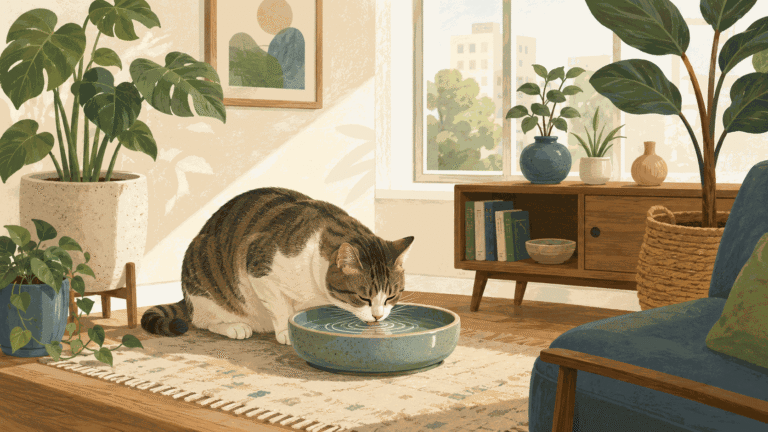
A senior cat who’s suddenly draining the water bowl and leaving bigger, wetter clumps is handing you one of the most useful early signals there is. Drinking and urinating more turns up with kidney disease, diabetes and an overactive thyroid, all common in older cats and all better caught early.1 Cornell flags drinking more than roughly an ounce of water per pound of body weight a day as worth a call.1 The other direction counts too: straining, going outside the box or passing almost nothing. Our guide to spotting dehydration covers the version of this that hides indoors.
2. Weight and appetite
Weight is the number owners miss, because it moves too slowly to see across a day. Some cats get heavy as they age, and the extra load stresses the joints and raises other risks. Others quietly waste away, and that loss can be the first flag of kidney disease, thyroid trouble or diabetes.1 A monthly home weigh-in catches both directions long before your eyes would. Weigh yourself, then yourself holding the cat, and subtract.
3. How she moves and grooms
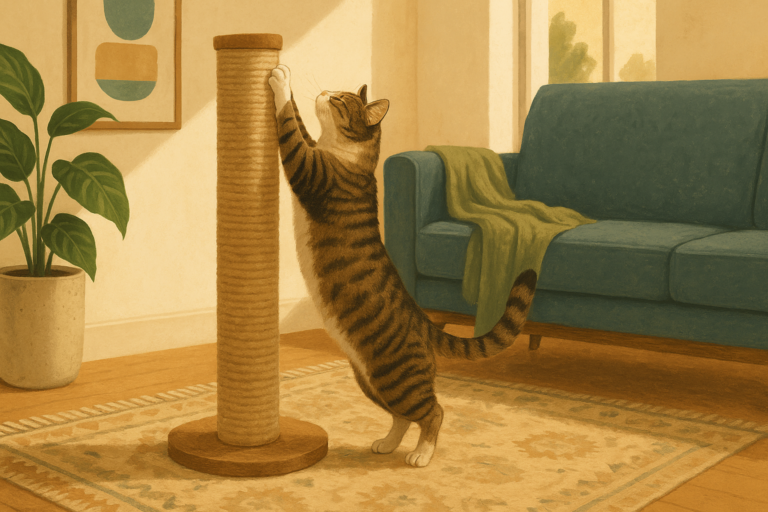
Arthritis is the great under-noticed disease of old cats. Cornell puts radiographic joint disease at around 90 percent of cats over twelve, and cats mask the pain almost completely. They don’t limp like a dog, they simply do less.3 The signs are quiet: she stops jumping to the counter, hesitates at the stairs, picks a low warm spot to sleep or struggles getting in and out of the litter box.3 A coat gone unkempt or matted belongs to the same story, because a stiff, sore cat can’t twist to groom the way she used to.1 None of this is “she’s lazy now.” It’s usually a treatable pain.
4. Her mouth
Dental disease is extremely common in older cats and genuinely painful, and it can turn a hungry cat off her food or make her drop kibble and chew on one side.1 Bad breath, drooling and a new preference for soft food all earn a look. The prevention you own is daily brushing with a cat-specific toothpaste, which Cornell calls the single most effective way to prevent dental disease.1
5. Behavior and the senior brain
Older cats can develop a feline version of dementia. Cornell describes the pattern: wandering, loud meowing especially at night, apparent disorientation and pulling back from contact.1 Some of that overlaps with pain, thyroid disease or fading senses, so it’s a reason to check rather than to assume the worst. The rule holds. A new behavior in an old cat is a health question first.
A five-minute home check
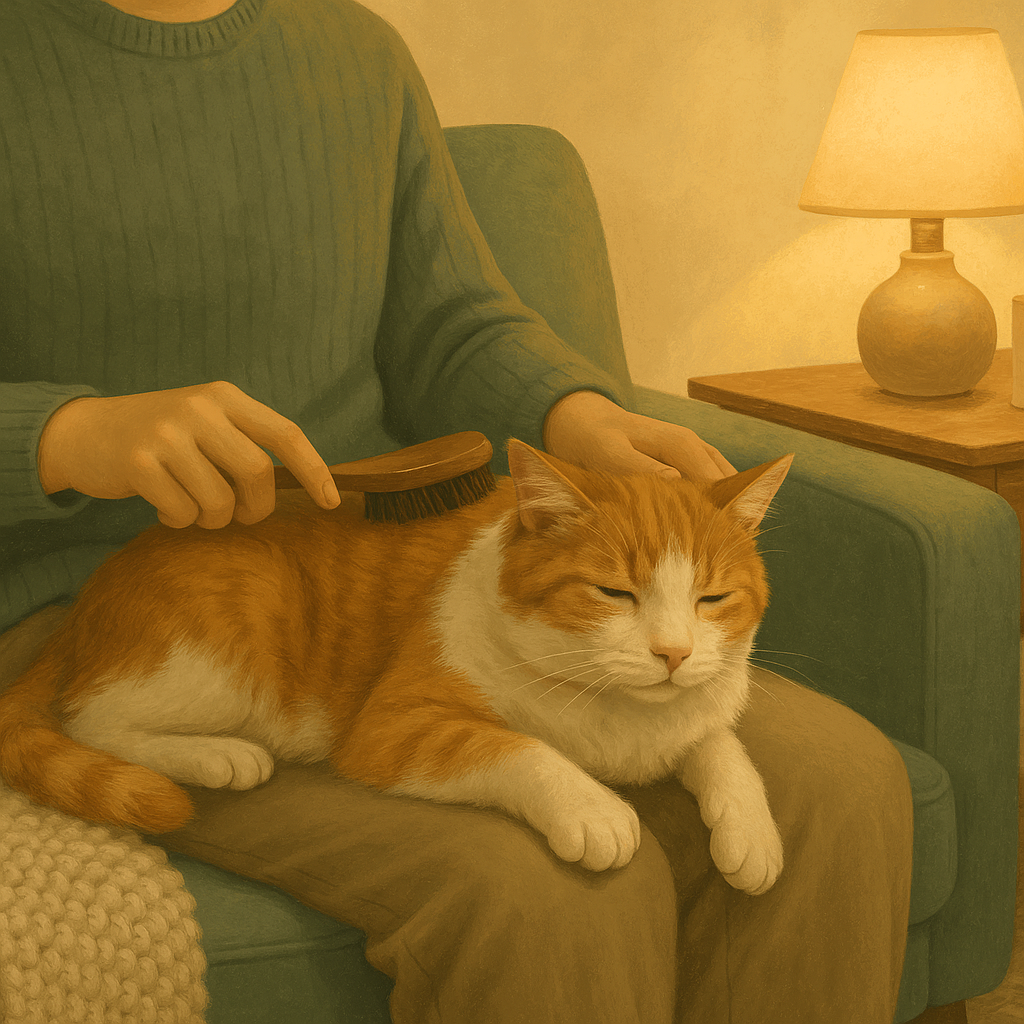
Cornell suggests turning your normal handling into a light once-over every few weeks, and it takes about five minutes.1 While you’re rubbing her chin, lift the lip and look at the teeth and gums. Pink and clean is good, red or smelly is not. Run your hands down her body and feel for new lumps, scabs or sore spots. Check that the coat is smooth rather than greasy or matted. Look at the nails, which in older cats grow thick and can curl into the pad when nobody trims them.1 Do the weigh-in. Glance in the box for anything off. Note what you find, even loosely, so a slow trend has something to measure against.
Set the apartment up for an older cat
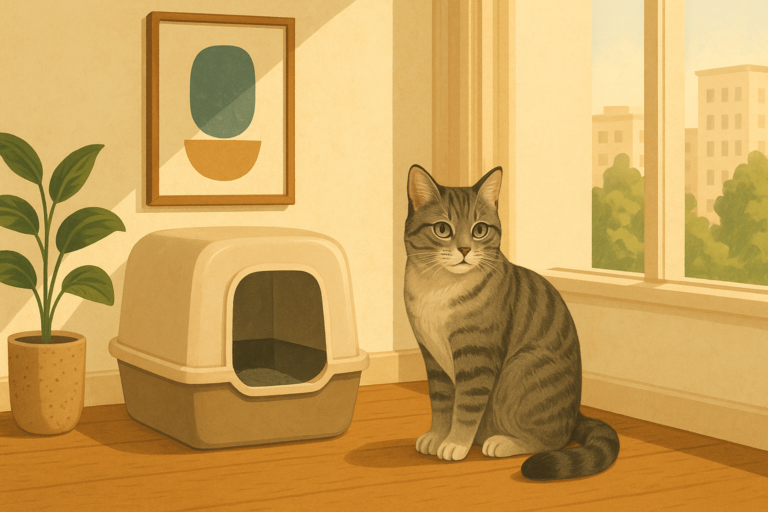
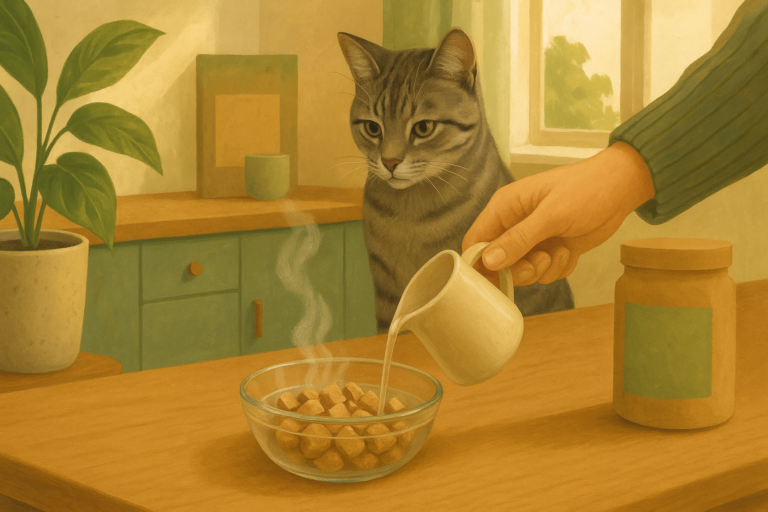
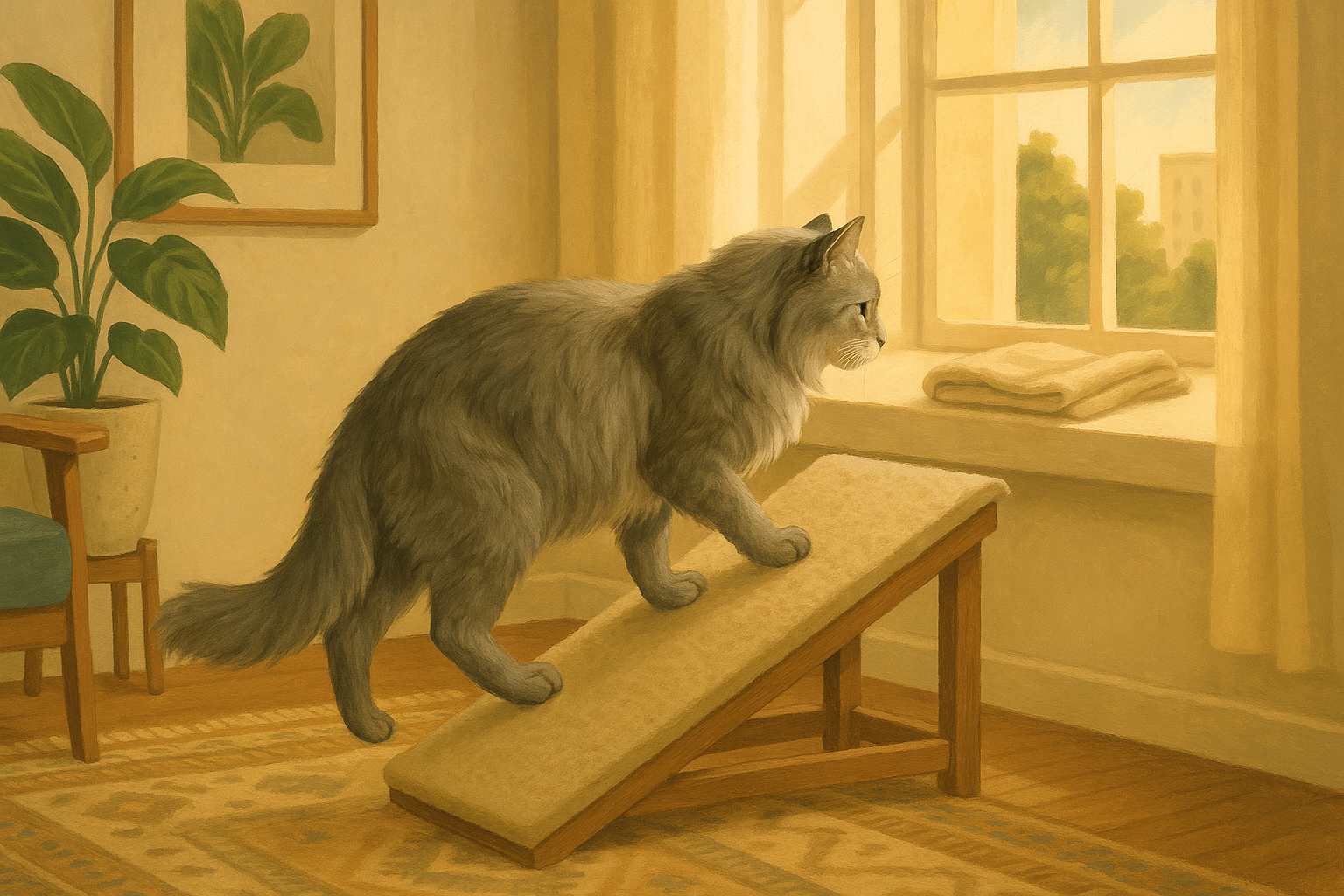
Small changes to the home remove a lot of daily misery, and they’re where indoor owners hold the most leverage. Put a litter box on every level she uses, and switch at least one to a low-sided box or a tray with a cut-down entrance so stiff hips don’t have to climb.2 Give her a way up. Carpeted steps or a ramp to the windowsill or the couch lets her keep a favorite perch without a painful jump.2 Keep a warm, soft bed out of the draft. Make water easy to reach in more than one spot, and since kidney function fades with age, leaning the diet toward wet food or adding water to meals helps her stay hydrated.2 Older cats also lean hard on routine, so keep feeding times, furniture and the general rhythm of the house predictable.2
When to talk to your vet
Move quickly, not next month, for a senior cat who stops eating for a day or more, is breathing hard at rest, is straining in the litter box with little coming out or has a sudden change in how she walks or holds herself. Book a visit soon for the quieter shifts: drinking or peeing noticeably more, a slow drop or gain in weight, new hiding or night-yowling, a dull or matted coat or bad breath and dropped food. Keep the twice-yearly senior visits on the calendar even when she seems fine, since the whole point is to find the slow stuff while it’s still easy to manage.4 For a fuller sort of what can wait and what can’t, our cat health red flags guide lays out the emergencies. You know your cat’s normal better than anyone, and that baseline is the most valuable thing you bring to the exam room.
The bottom line
Caring for a senior cat isn’t about doing more. It’s about paying closer attention and refusing to write things off. Aging is not a disease.1 The cat who’s slowing down, drinking more or eating less is usually telling you about something with a name, and the earlier you and your vet hear it, the more you can do about it. Watch the bowl, the box and the way she moves, keep the two visits a year and make the home kind to old joints. Most senior cats have years of good life still in them. The attention is what protects it.