Indoor cat hydration: what actually works
Most cats look like they drink enough. Most don’t. The indoor part is the wrinkle: your cat’s whole water supply is whatever you put out, and the math doesn’t favor casual setup choices. Here’s the practical playbook for indoor cat hydration. The numbers, the common traps and the small changes that move the needle most.
The short version:
- Aim for roughly 4 ounces of water per 5 pounds of body weight per day, much of it through food
- Shift toward wet food, or add water to meals; kibble alone leaves a lot of drinking work
- Move bowls away from food, the litter box and traffic, and add a second or third station
- Wash and refill bowls daily so the water tastes fresh
- Try a fountain only if your cat is drawn to running water; the research on whether it helps is mixed
- Watch the trend over time, because a real change in how much your cat drinks is information for the vet
Woodgreen Pets Charity on getting your cat to drink more water.
What I saw at the clinic
In five years on the intake desk at a vet clinic, the hydration question came up almost every week. The pattern barely changed. An owner sure their cat “just doesn’t drink” and a cat that drank fine, just not from the bowl the owner had picked. The cat used the bathroom sink, the tub, a houseplant saucer, anywhere except the supposed drinking spot. Most of the time the owner wasn’t the problem either. The bowl’s location and freshness were. Once the bowl moved and got cleaner, most cats went back to it within a few days.
The cases clustered into a few shapes. The apartment cat whose bowl sat six inches from the litter box. The senior cat whose owner had refilled the bowl once that week. The pair of cats where the bolder one always took the bowl first and the other quietly drank less. None of these owners were careless. The setup was doing the wrong job.
The water math
A working figure from the Cornell Feline Health Center: about 4 ounces of water per 5 pounds of lean body weight per day. For an average 10-pound cat, that comes to roughly one cup a day.1 But “one cup a day” doesn’t mean a cup from the bowl. Water comes from two places: drinking and food.
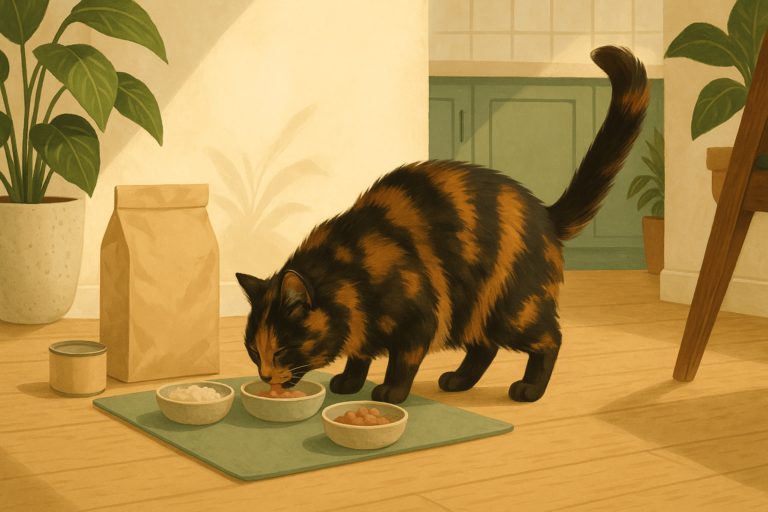
The food side does more work than most people think. Canned cat food is at least 75 percent water,2 so every wet meal carries hydration. Dry kibble runs only 6 to 10 percent water,2 so a kibble-only cat has to make up almost the entire daily figure by drinking. Same cat, very different math depending on the diet. Cornell puts it plainly: cats on wet food tend to drink less from the bowl, and cats on dry food take in more of their water by drinking.1
Don’t try to hit the number with a measuring cup. Intake varies day to day, by season, by activity. What you’re watching for is a pattern over weeks. A drop noticeably below your cat’s baseline, or a rise noticeably above it, is the thing that matters.
Why indoor cats are easy to under-hydrate
Cats evolved as hunters, and their bodies still expect a diet built around prey.2 Prey carries a lot of moisture, so a cat eating the way evolution set it up gets most of its water with the food. The modern indoor cat, eating dry kibble in a dry apartment, is asking that body to make up the difference at a bowl.
The indoor environment makes that harder, not easier. There’s no supplemental water source: no garden puddle, no dew on the grass, no prey. Whatever you set out is the whole supply. Cornell’s list of reasons cats drink too little includes a quiet hazard for multi-cat households: territorial conflict, where one cat gets blocked from the bowl by another.1 In a small apartment, where resources sit close together, this happens more than people think. A nervous cat will quietly give up rather than push past a bolder one.
Placement is the other indoor-specific trap. Bowls parked next to food, near the litter box, or in the kitchen walkway get avoided. Cornell notes that heavy traffic, noise and nearby litter boxes deter cats from their food,2 and the same instincts shape where they’ll drink. In a 600-square-foot apartment, the same eight feet that’s “out of the way” in a house is the main thoroughfare.
What helps, and what’s marketing
The single most effective change for most cats is moving some or all of the diet to wet food, or adding water to what you already feed. Canned at 75-plus percent water2 does hydration work the bowl would otherwise have to do. Transitions should go gradually. Cats are wary of sudden change, and a week or two of slow shifting is easier on both the stomach and the patience.
Bowl placement comes next. Walk through your home and look at where the water actually sits. Is it next to the litter box? In the kitchen walkway? Beside a noisy appliance? Moving the bowl six feet often does more than buying anything. The AAFP’s Cat Friendly Homes guidance is specific on placement: scatter bowls throughout the home, away from food, litter and busy areas; prefer ceramic or glass bowls that are wide or shallow so they don’t press on whiskers.5 Add a second or third station so a shy cat in a multi-cat home is never blocked from water by a bolder one.1 And wash bowls daily; a film on the surface or a crust at the rim is the kind of thing cats notice and people don’t.
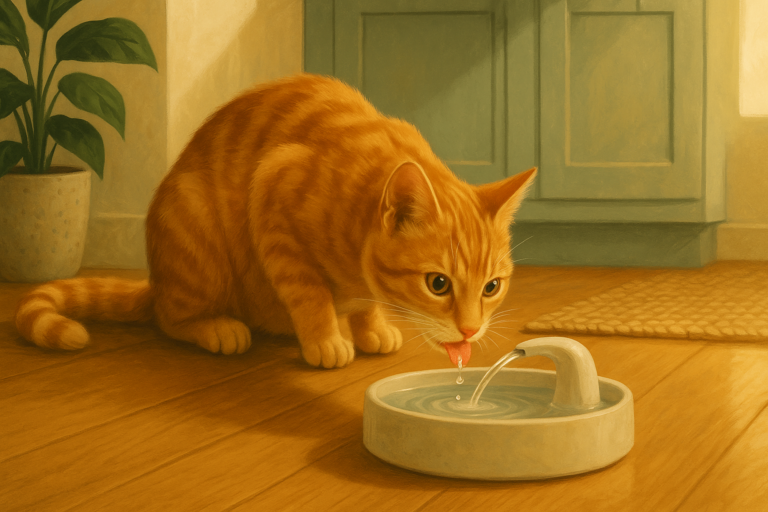
Fountains get recommended everywhere, and some cats clearly love moving water. The research is more mixed. In a controlled crossover study of 12 healthy indoor cats published in the Journal of Feline Medicine and Surgery, a fountain did not produce a meaningful increase in water intake or more dilute urine compared with a standard bowl.3 One cat in that study refused the fountain entirely. Cornell separately notes that many cats do prefer fountains, with the preference varying a lot from cat to cat.1 So treat a fountain as an experiment, not a solution, and pay attention to whether your particular cat takes to it. Bowl placement and wet food do more, more reliably, for less money. More on the faucet-versus-bowl question.
For a stubborn drinker, Cornell suggests a small amount of low-sodium chicken broth, or the liquid from a can of tuna, stirred into the water to make the bowl more appealing.1 A splash, not a soup. The big caveat: most store-bought broths contain onion or garlic, both toxic to cats, so the ingredient list matters. Full guide to broth for cats.

Reading the signs
The early signs of dehydration are quiet, which is part of why it’s easy to miss in an indoor cat. Cornell’s list: lethargy, weakness, a poor appetite, dry or tacky gums and in more serious cases sunken eyes.1 At home you can also do a rough skin-pinch test by gently lifting the skin over the shoulders and watching how fast it returns. In a well-hydrated cat it settles back almost at once; in a dehydrated cat it can stay “tented.”1 One caveat on the pinch: older cats can show reduced skin elasticity even when properly hydrated,1 so weigh it alongside gums, energy and appetite rather than on its own. Full guide to recognizing dehydration at home.
When the change is medical
The other reason to watch your cat’s drinking is what a change can signal. As kidneys lose their ability to concentrate urine, cats begin drinking and urinating more to compensate.4 Increased thirst also shows up early with diabetes and an overactive thyroid.1 Chronic kidney disease is common in older cats, affecting up to 40 percent over the age of 10 and 80 percent over 15,4 and earlier diagnosis is reliably the better outcome. So a sudden, sustained jump in how much your cat drinks isn’t a quirk to manage; it’s a vet visit, and the sooner the better.
The reverse is the urgent direction. A cat that suddenly stops drinking, won’t eat, or seems weak or lethargic should be seen promptly,1 especially if there’s also vomiting or diarrhea, which drive fluid loss fast. Dehydration is often a symptom of something else, and the clinic can both rehydrate the cat with fluids and work out the cause.1
If you do bring an over-drinking cat in, expect blood work (BUN, creatinine and SDMA are the kidney markers Cornell highlights) and a urinalysis to see how well the urine is being concentrated.4 For older cats, a thyroid panel is routine. None of it is unpleasant for the cat, and the findings shape the management. Earlier-stage CKD has more options than later-stage, which is the reason a sustained change in drinking is worth catching early rather than watching for a few months.
The bottom line
If you want your indoor cat to drink more, start with the setup, not the cat. Adjust the food first, because shifting toward wet food or adding water to meals does the most work. Then fix placement: more bowls, away from food and litter, out of the traffic. Keep them clean and full. Treat a fountain as an optional experiment rather than a solution, and reach for a flavor splash if your cat needs convincing. And keep half an eye on the trend, because a real change in how much your cat drinks is information worth bringing to a vet.
Sources
- Cornell Feline Health Center, “Hydration”
- Cornell Feline Health Center, “Feeding Your Cat”
- Grant, D.C. (2010). “Effect of water source on intake and urine concentration in healthy cats.” Journal of Feline Medicine and Surgery
- Cornell Feline Health Center, “Chronic Kidney Disease”
- American Association of Feline Practitioners, “Enhancing Water Intake for Your Cat” (Cat Friendly Homes)
More on indoor cat hydration
Buying guides:
- Best Ceramic Water Bowls for Whisker-Sensitive Cats
- The Best Stainless-Steel Cat Water Fountains for Indoor Cats
- The Best Cat Water Fountains Under $50
Common questions:
- Can dehydration cause urinary problems in cats?
- Why won’t my cat drink from her new bowl?
- How many water bowls should one cat have?
- Can I flavor my cat’s water to get her to drink more?
- Can cats drink distilled water?
- Why does my cat try to drink from my glass?
- Why does my cat splash water out of the bowl?
- Ceramic vs stainless steel vs plastic: the cat water bowl that actually stays clean
- Why does my cat dip her paw in the water bowl before drinking?
- Cat water fountain vs water bowl: which does your indoor cat actually need?
- Indoor cat kidney disease: how to lower the risk and catch it early
- Why does my cat drink from the toilet?
- Do cats really need a water fountain?
- Catit Flower Fountain vs PetSafe Drinkwell Platinum: which fountain fits your indoor cat?
- Why does my cat prefer running water?
- What’s whisker fatigue, and does it affect my cat’s drinking?
- Can cats get dehydrated in winter?
- Does wet food count toward my cat’s daily water intake?
- Can I give my cat ice cubes?
- Why is my cat drinking less water than usual?
- Why is my cat suddenly drinking a lot more water?
- How many water stations should a multi-cat home have?
- Is bottled water safer for cats than tap?
- Can I give my cat tap water?
- Can dehydration cause constipation in cats?
- Should the water bowl be next to the food bowl?
- Where should I put my cat’s water bowl?
- Ceramic, stainless or plastic: what’s the best water bowl for cats?
- How often should I wash my cat’s water bowl?
- Wet vs dry cat food: the hydration math
- Can my cat drink milk?
- Can I add water to dry cat food?
- Is it OK that my cat eats but won’t drink water?
- Why won’t my cat drink water?
- How much water does an indoor cat need per day?