How to Get a Kibble Cat to Eat Wet Food
Some cats inhale wet food the first time it touches the dish. Many indoor cats raised on dry kibble do the opposite: they sniff the can, give you a flat look and walk away. That refusal is not stubbornness. A cat who has eaten crunchy, low-moisture food her whole life has learned that this is what food smells, feels and sounds like, and a warm wet pat in a bowl reads as something else entirely. The good news is that almost every kibble cat can be brought across to wet food. It just takes a bridge, not a leap.
Quick take:
- Go slow. Plan on 7 to 14 days, and longer for a committed kibble cat.1
- Bridge with texture: crushed kibble or a freeze-dried topper sprinkled on the wet food makes it smell and feel familiar.
- Serve wet food warmed to about body temperature. Aroma is most of the appeal for a cat, and cold food has almost none.
- Switch the routine, not just the food: feed at set times in small fresh portions instead of leaving a kibble bowl out all day.
- Never starve a cat into it. If she refuses all food for 24 to 48 hours, that is a vet call, not a standoff.2
Why kibble cats dig in their heels
Cats form their idea of “food” early and hold onto it. A kitten learns what counts as a meal from her mother and from the first foods she is offered, and many cats stay neophobic, wary of the unfamiliar, for the rest of their lives. For a lifelong kibble eater, three things about wet food are all wrong at once: the soft, sticky texture instead of a satisfying crunch, the strong fishy or meaty aroma instead of the mild smell of dry food, and the lack of the constant grazing she is used to. Any one of those can be enough for her to decide the new thing is not really food. You are not fighting a personality flaw. You are working with a built-in caution, and the trick is to change one variable at a time so she barely notices the shift.
It is worth knowing why the effort pays off. Canned food is at least 75 percent water, while dry kibble runs around 6 to 10 percent. A kibble-only cat has to make up that entire water deficit at the bowl, every single day, and many indoor cats simply do not drink enough to manage it. Moving even part of her diet to wet food shifts her hydration in a healthier direction, which matters most for the urinary issues indoor cats are prone to. If you want the full picture on that tradeoff, see our breakdown of wet versus dry cat food.
The slow-bridge method
The reliable way through is a gradual transition, the same approach a vet would suggest for any food change, stretched out and made gentler for a reluctant cat.1 Switching too fast also tends to cause an upset stomach from the jump in moisture, so slow is safer in both senses.
- Days 1 to 3: Serve mostly her usual kibble with just a small amount of wet food worked in. Rather than dropping a spoonful on top, mix the wet food through so it coats the kibble and she cannot easily eat around it.
- Days 4 to 6: Move to roughly half kibble and half wet food, still mixed together.
- Days 7 to 10: Shift to mostly wet food with a little kibble worked through it.
- Day 10 onward: Serve wet food on its own. If she stalls at any stage, drop back to the last ratio she accepted and hold there for a few extra days before nudging forward again.
The single most important rule: do not leave a separate bowl of dry food out alongside as a free option. A cat who knows the kibble is still available will simply hold out for it, and the transition stalls indefinitely. Pick up the all-day kibble bowl and move to set mealtimes. That routine change does a lot of the work on its own.
Bridge the texture with a topper
If your cat balks even at the mixed bowl, the fastest fix is to make the wet food smell and feel more like what she already trusts. Two cheap tricks do most of the heavy lifting. The first is to crush a small handful of her own kibble and scatter it over the wet food, which adds back the crunch and the familiar dry-food smell on top of the new texture underneath. The second, and often the more powerful, is a freeze-dried topper: a sprinkle of crushed freeze-dried chicken or fish gives the bowl an intense aroma that pulls a hesitant cat in, while the meal underneath is still the wet food you are trying to establish. As she accepts the bowl, you taper the topper down over a week or two until the wet food can stand on its own.
Warm it up and play with texture
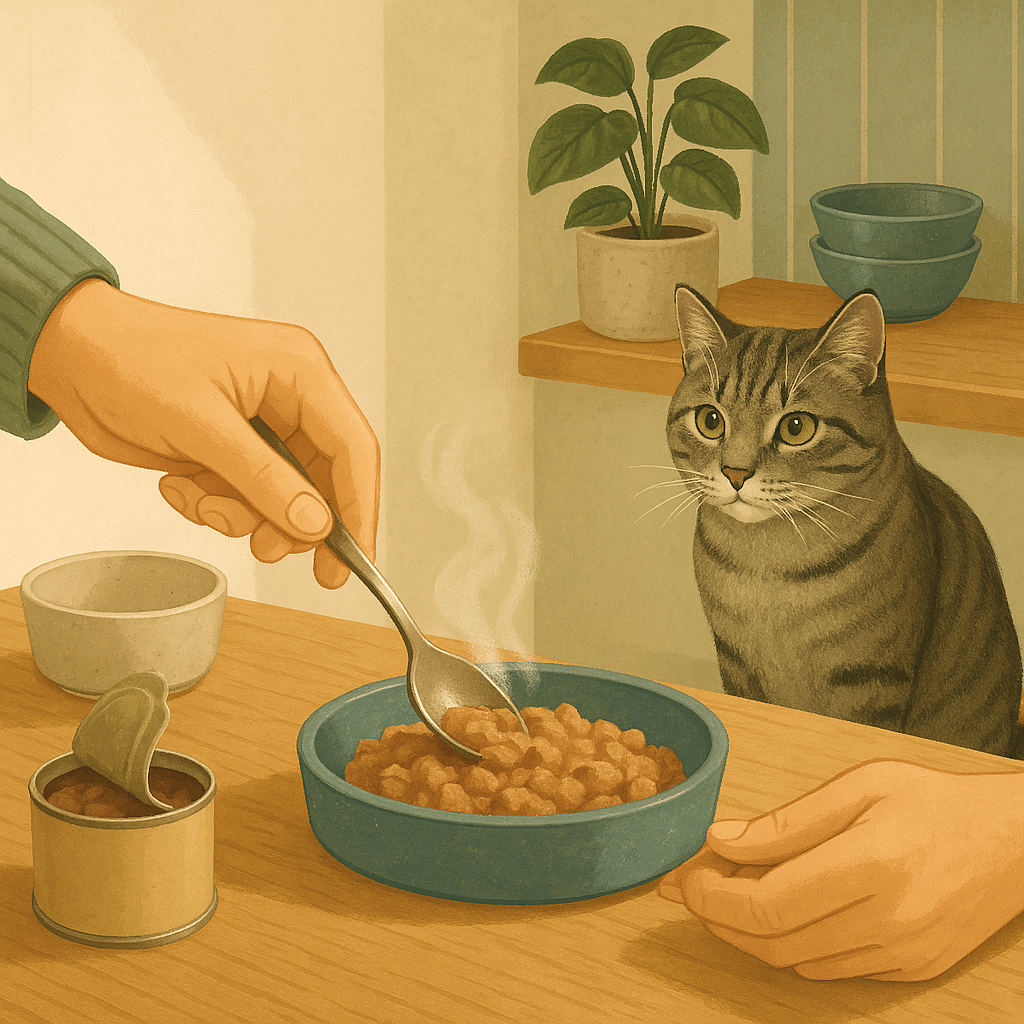
Aroma is most of what makes food appealing to a cat, and aroma comes from warmth. Wet food straight from the fridge is nearly scentless to a cat and far easier to refuse. Warm it to roughly body temperature, around 100 degrees Fahrenheit, before serving: a few seconds in the microwave, stirred well so there are no hot spots, or a little warm water mixed through. That one change turns plenty of refusals into clean plates.
Texture is the other lever. “Wet food” is not one thing, and a cat who refuses one form will sometimes take another. If a smooth paté gets a flat no, try a chunky food in gravy, or a shredded or minced texture. Mashing a paté with a little warm water into a looser, soupier consistency helps some cats, especially those used to the light coating of fat and dust on kibble. You are looking for the specific texture your particular cat will accept, then building from there.
What not to do
- Do not go cold turkey. Pulling the kibble entirely and putting down only wet food usually ends in a hungry standoff, and a cat who refuses to eat for long enough is in real danger (see the next section).
- Do not leave wet food out for hours. It dries, crusts and turns off-putting fast. Offer a small fresh portion, give her 20 to 30 minutes, then take it up and try again at the next meal.
- Do not bury the wet food under her favorite treats every time. A light topper to bridge the gap is fine; drowning the bowl in treats just teaches her to eat the treats and leave the rest.
- Do not give up after two or three tries. Genuinely resistant cats can take weeks. Persistence at a gentle pace beats a fast push every time.
When the bowl isn’t the problem
A patient bridge brings most kibble cats across. When it does not, the issue may not be the food at all. A cat who suddenly refuses food she used to eat, who is hiding, drooling, losing weight or acting unwell, is telling you something different from “I prefer crunchy.” Refusal that comes on suddenly is worth a closer read in our guide to a cat who suddenly won’t eat.
There is a hard safety line here. A cat must not go without eating for long. Cornell’s Feline Health Center notes that anorexia can seriously affect a cat’s health in as little as 24 hours, and that going without food puts cats at risk of hepatic lipidosis, a dangerous fatty-liver condition that can become life-threatening.2 The practical rule during any food transition: if your cat eats almost nothing for 24 to 48 hours, stop the experiment, put down whatever she will reliably eat, even if that is her old kibble, and call your vet. Getting calories into her safely always beats winning the wet-food battle.
Know what kind of eater you have
A kibble loyalist who refuses wet food is one specific kind of picky eater, and the bridge that works for her is not the one that works for a cat who gets bored of a flavor after a week, or one who is nervous around the bowl itself. If you are not sure which pattern you are dealing with, our picky-eater quiz sorts your cat into a profile in a couple of minutes and points you at the approach and the products that actually fit her. It is the fastest way to stop guessing and start with the method most likely to work.
Sources
TheCatWellness is reader-supported and we are not veterinarians. This article is general information, not medical advice for your individual cat. If your cat stops eating, loses weight or seems unwell, talk to your vet.