Pumpkin vs psyllium husk for cat constipation
Working the front desk at a vet clinic, I watched the same visit happen over and over. An owner’s cat hadn’t used the litter box in a day or two, so out came a can of pumpkin, stirred into that morning’s food. When it didn’t work by the next visit, the vet on staff usually reached for something else entirely: psyllium husk. Pumpkin and psyllium get lumped together as the same home fix for a sluggish cat, and they aren’t. Here’s what each one does, and which belongs in your cabinet.
As Amazon Associates we earn from qualifying purchases. Some links in this post are affiliate links; if you buy through them, we earn a small commission at no extra cost to you. We only recommend products we’ve used or researched thoroughly. See our full disclosure.
Pumpkin or psyllium, at a glance

Weruva Pumpkin Patch Up!
Pureed pumpkin · single-serve pouches · nothing else added
- ✓ A fussy cat will usually eat this without a fight
- ✓ No fridge needed until a pouch is opened
- ✓ Gentle top-up, not a measured fiber dose
- ✓ 12 single-serve pouches per bag
on Amazon
Price as of Oct 26, 2026, 9:21 AM EDT. Product prices and availability are accurate as of the date/time indicated and are subject to change.

It’s Just! Psyllium Husk Powder (Unflavored)
One ingredient · unflavored · measured scoop
- ✓ The fiber behind a lot of vet-authorized GI diets
- ✓ Dose is controllable and consistent scoop to scoop
- ✓ No added sweeteners or flavoring for humans
- ✓ Start small and increase only with your vet’s guidance
on Amazon
Price as of Oct 26, 2026, 9:21 AM EDT. Product prices and availability are accurate as of the date/time indicated and are subject to change.
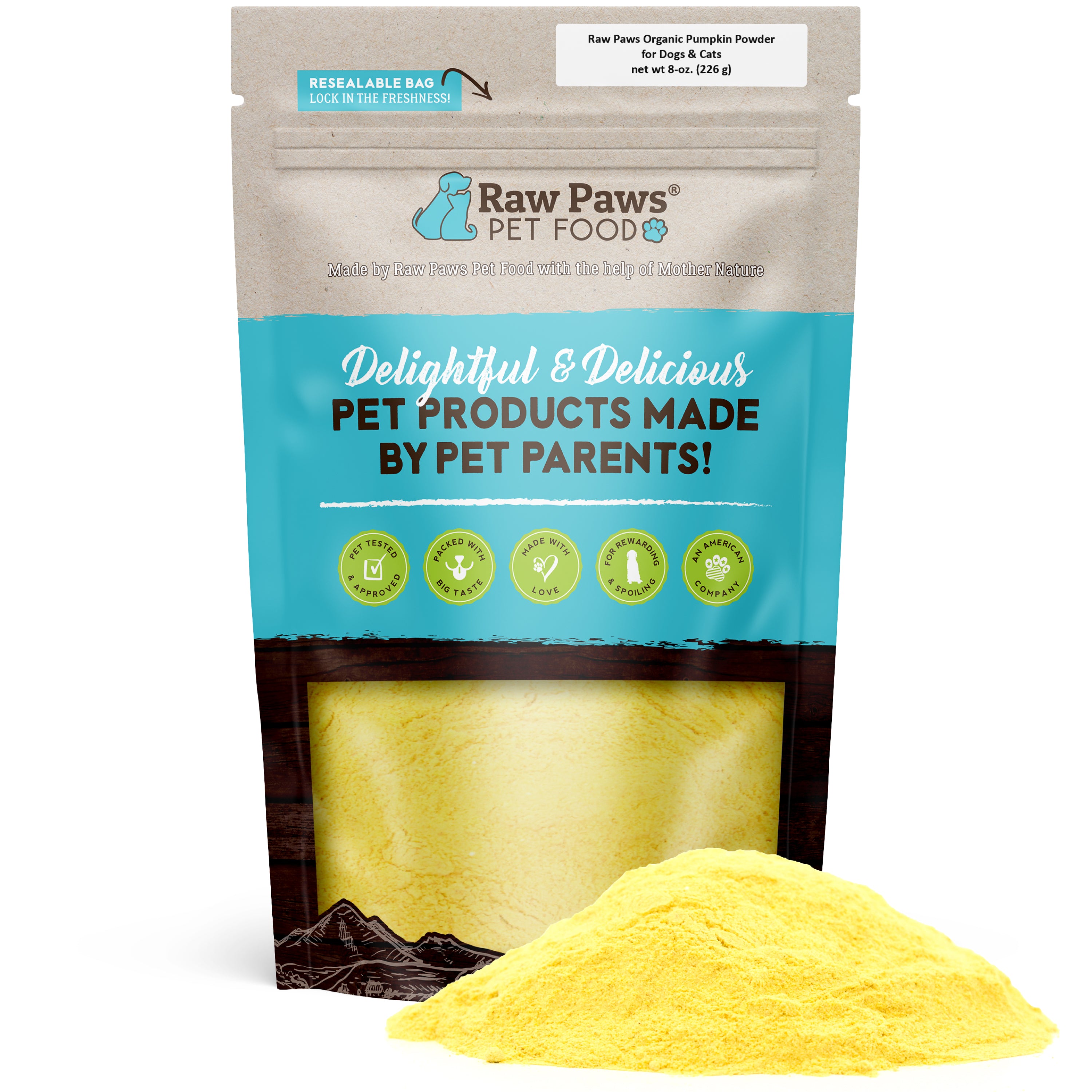
Raw Paws Organic Pumpkin Powder
USDA organic · measured scoop · not a fridge item
- ✓ A known amount of pumpkin per scoop, unlike a random can
- ✓ No opened-can leftovers to store
- ✓ Still pumpkin’s fiber math, just more concentrated, not a psyllium substitute
on Raw Paws Pet Food
Price as of Oct 26, 2026, 9:21 AM EDT. Product prices and availability are accurate as of the date/time indicated and are subject to change.
The short version
- Canned pumpkin’s fiber math rarely adds up. To match a therapeutic high-fiber diet, a cat would need more than two and a half cups of pumpkin a day, not the spoonful most owners stir in. [1][2]
- Psyllium husk is the fiber behind a lot of vet-authorized GI diets, and a 2024 feline study found it increased how often cats went, how soft their stool was and how much water it held, in ten days. [3]
- Pumpkin still has a real job: it’s a vehicle a fussy cat will eat. Plain canned pumpkin (never pumpkin pie filling) works fine as an occasional top-up.
- A pumpkin powder gives a measured scoop instead of a random can, but it’s still pumpkin’s fiber math, not a substitute for psyllium.
- Both are for mild, occasional sluggishness. Recurring or worsening constipation is a reason to call your vet, not to reach for a bigger scoop. [1][4]
What canned pumpkin actually does
Canned pumpkin earns its reputation honestly, it’s just earned for a smaller job than most owners expect. Pumpkin carries both soluble and insoluble fiber, and soluble fiber ferments in the colon into short-chain fatty acids that stimulate the muscle contractions moving stool along [1]. The trouble is dose. A cat food label reports only “crude fiber,” which measures the insoluble fraction and says nothing about how much soluble fiber actually made it into the can. Tufts’ Cummings School of Veterinary Medicine ran the math directly: to match the fiber level of a therapeutic high-fiber diet, a cat would need more than two and a half cups of pumpkin a day, not the teaspoon or tablespoon most owners mix into a meal [2]. Push toward that kind of volume and the extra fiber starts crowding out the nutrients the food was supposed to deliver in the first place.
Flavor matters more than the fiber math, and it’s the real reason pumpkin gets used at all. A finicky cat who refuses a fiber supplement will often eat pumpkin without a fight, so its value on my clinic’s shelf was less about hitting a fiber target and more about being a vehicle a fussy cat would accept. Skip pumpkin pie filling entirely (added sugar, and some brands run close to 600 milligrams of sodium per cup) and stick with plain canned pumpkin or a pet-formulated puree with nothing else added [2].
Where psyllium earns its reputation
Psyllium husk is the fiber behind a lot of the vet-authorized “gastrointestinal” or “fiber response” diets recommended for a constipated cat, and there’s a reason it keeps showing up there. Cornell’s own overview of feline constipation names psyllium specifically as a soluble fiber that helps by producing those same colon-stimulating short-chain fatty acids pumpkin relies on, just at a concentration you can control with a scoop instead of guessing at a can [1].
A 2024 study in the Journal of Feline Medicine and Surgery put that to a real test. Nine healthy cats ate a diet with 6% psyllium for ten days, then switched to a matched diet with 6% cellulose (a non-fermenting fiber used as the control) for another ten days. On psyllium, the cats had more bowel movements over the same tracking window (1.6 a day versus 1.1), softer stool by a standard scoring scale, more total stool weight and higher stool moisture, and every one of those differences held up statistically [3]. That’s a controlled study in healthy cats, not proof it fixes every constipated one, but it’s the clearest evidence behind either ingredient in this comparison.
The advantage of a plain psyllium husk powder over a full prescription fiber diet is that it’s an add-on, not a diet switch, so you can layer it onto whatever your cat already eats. Reach for the unflavored, single-ingredient kind (no added sweeteners, nothing meant for a human smoothie) and start small: a quarter teaspoon mixed into wet food once a day is a reasonable starting point for most cats, increased gradually and only under your vet’s direction, since too much fiber too fast can trade constipation for loose stool [1].
Pumpkin, pumpkin powder or psyllium: picking one
If your cat will eat canned pumpkin and the issue is occasional and mild, a spoonful stirred into wet food two or three times a week is a reasonable, low-risk thing to try, more for the moisture and the variety than the fiber dose. A pumpkin powder made for pets solves the “how much fiber is really in here” problem canned puree can’t answer, since a measured scoop gives a known amount rather than whatever soluble fiber a random can happens to carry. It’s still not a substitute for a fiber supplement your vet has recommended; think of it as pumpkin’s more concentrated cousin, not a rival to psyllium.
If the constipation is recurring, or your cat is straining and producing little to nothing, psyllium is the better-supported choice, and it’s worth mentioning to your vet before you start rather than after. A cat with recurring or worsening constipation deserves an exam first. Constipation has causes ranging from a hairball to dehydration to, less commonly, a nerve or spine problem, and the right fix depends on which one you’re dealing with [1][4].

When to talk to your vet
None of this replaces a diagnosis. Call your vet if your cat goes more than 48 to 72 hours without a bowel movement, strains repeatedly without producing much or starts skipping meals or acting withdrawn alongside the constipation [4]. Left alone, repeated constipation can progress to megacolon, where the colon loses the ability to contract at all and stool becomes impossible to pass without medical help. That’s a surgical problem, not a fiber problem, and it’s the outcome every home remedy on this page exists to prevent [1]. If you’re already reaching for pumpkin or psyllium more than once every couple of weeks, that frequency is the signal to get your cat examined rather than a reason to increase the dose.
The bottom line
- Choose psyllium if your cat’s constipation is recurring, if a vet has already floated a fiber supplement or if you want the ingredient with a controlled study behind it.
- Choose pumpkin (plain canned or a pet-formulated powder) if your cat needs coaxing to eat anything fibrous at all and the issue is mild and occasional.
Treat either one as a supporting habit, not a fix you lean on over and over. A cat whose constipation keeps coming back needs an exam, not a bigger spoonful.
Sources
- Cornell Feline Health Center, “Constipation”
- Cummings School of Veterinary Medicine at Tufts, Petfoodology, “The Problem with Pumpkin”
- Keller et al. (2024), “Psyllium husk powder increases defecation frequency and faecal score, bulk and moisture in healthy cats,” Journal of Feline Medicine and Surgery
- VCA Animal Hospitals, “Constipation in Cats”