Purina Pro Plan Sensitive Skin & Stomach vs Hill’s Science Diet Sensitive Stomach & Skin: which wet food?
At the clinic intake desk, this question showed up in pairs. An owner would set two cans on the counter, one Hill’s Science Diet Sensitive Stomach & Skin and one Purina Pro Plan Sensitive Skin & Stomach, and ask which one would finally stop the 6 a.m. puddle on the rug. Both cans promise the same thing on the front. They get there differently. Hill’s Science Diet wins when you want a recipe proven in feeding tests and built around vegetables. Purina Pro Plan wins when you want a grain-free recipe in a smooth pâté. Neither one is a treatment, and I’ll say where each falls short. This is the head-to-head of the top two picks on our best wet cat food for sensitive stomachs roundup.
As Amazon Associates we earn from qualifying purchases. Some links in this post are affiliate links; if you buy through them, we earn a small commission at no extra cost to you. We only recommend products we’ve used or researched thoroughly. See our full disclosure.
How they compare at a glance
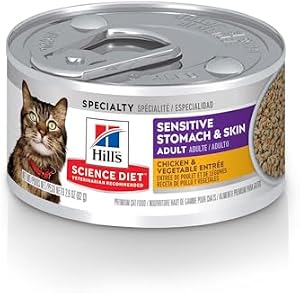
Hill’s Science Diet Sensitive Stomach & Skin
Chicken & Vegetable Entrée · 2.9 oz cans · for adult cats
- ✓ Backed by AAFCO feeding tests for adult maintenance
- ✓ Prebiotic fiber from FOS in the ingredient list
- ✓ Vitamin E and omega-6 fatty acids for skin and coat
- ✓ Vegetable-based entrée with no wheat, corn, rice or barley listed
on Amazon
Price as of Nov 6, 2026, 11:21 AM EST. Product prices and availability are accurate as of the date/time indicated and are subject to change.

Purina Pro Plan Sensitive Skin & Stomach Pâté
Chicken · 3 oz cans · grain-free · for adult cats
- ✓ Grain-free recipe with chicken as the first ingredient
- ✓ Chicory root inulin as a natural prebiotic fiber
- ✓ Smooth, uniform texture
- ✓ Formulated to AAFCO nutrient profiles for adult maintenance
on Amazon
Price as of Nov 6, 2026, 11:21 AM EST. Product prices and availability are accurate as of the date/time indicated and are subject to change.

Raw Paws Boost Organic Pumpkin Powder Topper
3 oz · organic pumpkin powder · a topper, not a food
- ✓ Made in the USA and grain-free, per the maker
- ✓ Earthy, mildly sweet flavor aimed at picky eaters
- ✓ Sprinkles over either wet food above
- ✓ Not a complete diet, so it never replaces a meal
on Raw Paws Pet Food
Price as of Nov 6, 2026, 11:21 AM EST. Product prices and availability are accurate as of the date/time indicated and are subject to change.
Swipe to compare
| Hill’s Sensitive Stomach & Skin | Purina Pro Plan Sensitive Skin & Stomach | Boost Pumpkin Powder | |
|---|---|---|---|
| Best for | Feeding-trial proof and a vegetable entrée | A grain-free, smooth pâté | A flavor add-on, not a food |
| Recipe | Chicken & Vegetable Entrée | Chicken pâté | Organic pumpkin powder |
| First ingredients | Chicken broth, chicken, pork liver, carrots, green peas | Chicken, water, poultry by-products, salmon, chicory root inulin | Not a standalone food, so no ingredient list to compare |
| Grains | No grain-free claim. No wheat, corn, rice or barley listed | Grain-free | Grain-free, per the maker |
| AAFCO basis | Animal feeding tests | Formulated to nutrient profiles | Not a complete food |
| Prebiotic fiber | Fructooligosaccharides (FOS) | Chicory root inulin | An add-on to whichever food you choose |
| Can size | 2.9 oz cans | 3 oz cans | 3 oz jar |
Ingredients and statements come from each manufacturer’s product page. Recipes change, so check the label on the case you receive.
The short version
- Both are complete and balanced for adult maintenance, but they earn that claim differently. Hill’s Science Diet cites animal feeding tests. Purina Pro Plan says it is formulated to meet AAFCO nutrient profiles.257
- Purina Pro Plan is the grain-free one, with chicken first and chicory root inulin as its prebiotic fiber.67
- Hill’s Science Diet leans on vegetables, with carrots, peas and potatoes alongside chicken and pork liver, with FOS as its prebiotic fiber.5
- Calories differ by the can. Hill’s lists 88 kcal in a 2.9 oz can and Purina lists 103 kcal in a 3 oz can, so adjust portions when you switch.57
- Neither is a limited-ingredient diet. Both mix several proteins, so a suspected ingredient problem belongs in a vet-guided elimination trial.
- Whichever you pick, switch slowly. A fast change is a common trigger for the upset you are trying to stop.3
In this guide
Who makes them · How each proves it is complete and balanced · Ingredients, calories and texture · Price · Which one fits an indoor cat · How I compared them · Common questions · When to talk to your vet
Who makes them
Hill’s Science Diet comes from Hill’s Pet Nutrition, a Colgate-Palmolive company, and Purina Pro Plan comes from Nestlé Purina PetCare. Both run their own research and quality programs, and both have the scale to turn out a consistent can batch after batch. That matters more than the logo, because a sensitive cat is the one most likely to notice when a recipe drifts.
How each proves it is complete and balanced
A cat food can claim “complete and balanced” two ways: by meeting an AAFCO nutrient profile on paper or lab analysis, or by passing animal feeding tests.2 The two cans split here, and it is a checkable difference. Hill’s states that animal feeding tests using AAFCO procedures substantiate its Chicken & Vegetable Entrée for adult maintenance.5 Purina states that its Sensitive Skin & Stomach Chicken Entrée is formulated to meet the AAFCO Cat Food Nutrient Profiles for adult maintenance.7
Both routes are legitimate. A feeding test is slower and costs more, and it shows the finished food held up in real cats, not only on a spreadsheet.2 That is a real edge for Hill’s Science Diet. It is not a knock on Purina Pro Plan, which clears the same nutritional bar by the other route.
Ingredients, calories and texture
The ingredient lists read differently. Hill’s Science Diet opens with chicken broth, chicken, pork liver, carrots and green peas, then adds potatoes, egg whites, spinach, potato protein, soybean oil and flaxseed meal, with fructooligosaccharides as its prebiotic fiber.5 Purina Pro Plan opens with chicken, water, poultry by-products and salmon, with chicory root inulin as its prebiotic fiber and guar gum as a thickener, and no grains.67 If you are hunting a single protein to rule out, neither list helps you. Each blends several animal sources.
The guaranteed analysis panels can’t be lined up directly. Purina publishes as-fed minimums and maximums, including 10 percent crude protein minimum, 7 percent crude fat minimum, 1.5 percent crude fiber maximum and 78 percent moisture maximum.7 Hill’s publishes dry-matter averages (43.3 percent protein, 22.1 percent fat and 2.4 percent crude fiber for the chicken entrée), and its as-fed panel sits in an image rather than in text.5 Converting one basis to the other needs the real moisture figure, so I won’t pretend the numbers settle anything.
Calories are easier to compare. Hill’s lists 1,073 kcal per kilogram and 88 kcal per 2.9 oz can. Purina lists 1,211 kcal per kilogram and 103 kcal per 3 oz can.57 By weight, Purina carries roughly 13 percent more energy, so a cat moved from one can to the other on a measured portion will quietly eat more or fewer calories than before.
Texture is where owners notice the difference first. Purina Pro Plan is a smooth, uniform pâté. Hill’s Science Diet is an entrée with visible vegetables, and Hill’s lists its form as a stew.56 A queasy cat that turns away from chunks often accepts a smooth pâté, and a cat that finds pâté boring can prefer pieces. Your cat’s mouth will settle this faster than any label.
Price
The two sit close together on cost per ounce at the 24-can size, and neither is a budget food. Purina Pro Plan and Hill’s Science Diet are both mid-range, widely stocked and easy to reorder in a pinch, which counts when your cat is mid-flare on a Sunday night. Prices move daily, so check the live price on the cards above instead of trusting a figure in an article.
Which one fits an indoor cat
An indoor cat burns fewer calories than a feeding chart written for the average cat assumes, so portion control matters as much as the logo. Weigh the portion, split it into two or more meals and watch body condition over a few weeks. If your cat does well on Hill’s Science Diet, there is no reason to switch for the sake of it. If a grain-free recipe appeals to you or the smooth texture suits a fussy eater, Purina Pro Plan is the more natural try. Either way, change the food and nothing else that week, so you can read the result.
How I compared them
This is a researched comparison, not a side-by-side feeding trial of my own. I haven’t run these two foods in my own home. I read both manufacturers’ product pages and label statements, check each AAFCO statement word for word, compare the ingredient lists and calorie figures and confirm both products are in stock as listed.567 They tie on the basics: both are complete and balanced for adult cats, and both add a prebiotic fiber. Hill’s Science Diet has the feeding-test substantiation. Purina Pro Plan has the grain-free recipe, the smoother texture and the higher calorie density, which is an advantage for a small eater and a drawback for a cat watching its weight.
Common questions
Are these the same as prescription sensitive-stomach diets?Short answerNo, these are over-the-counter foods.
No. Both are over-the-counter foods labeled for adult maintenance.57 Therapeutic diets such as Hill’s i/d are chosen and monitored by your vet for a diagnosed problem. We compare those in Royal Canin Gastrointestinal vs Hill’s i/d and Purina Pro Plan EN vs Hill’s i/d.
Can I switch between the two or mix them?Short answerYes, but go slowly.
Yes, as long as you go slowly. The American Animal Hospital Association suggests replacing about a quarter of the old food with the new at first and increasing from there, and notes that cats can take up to 40 days to come fully across.3 Because the calories per can differ, recheck the portion after the switch.
Is grain-free better for a sensitive stomach?Short answerNeither maker says so.
Neither maker claims it is. Purina lists grain-free as a feature of this pâté, while its digestive claim rests on the prebiotic fiber and digestibility.6 Hill’s makes no grain-free claim at all.5 If you suspect a particular ingredient, the reliable route is a vet-guided elimination trial. Our piece on cat food allergies versus intolerances explains the difference.
Can kittens or pregnant cats eat these?Short answerNot without checking with your vet.
When to talk to your vet
A sensitive-stomach food suits the cat who is otherwise bright, holding weight and just has an unsettled gut now and then. Cornell’s Feline Health Center advises prompt veterinary attention for a cat that vomits more than about once a week, or that vomits alongside lethargy, weakness, appetite loss, blood, increased thirst, a change in urination or diarrhea.4 Neither food treats that picture. Book the appointment first, and let your vet decide whether a therapeutic diet fits. Call sooner if a food change brings on vomiting, diarrhea lasting more than a day or two, or a refusal to eat.
The bottom line
- Choose Hill’s Science Diet if you want a recipe backed by feeding tests, your cat likes a stew-style entrée with vegetables and you are happy with a food that makes no grain-free claim.
- Choose Purina Pro Plan if you want a grain-free recipe, your cat prefers a smooth pâté or you need a slightly more calorie-dense can for a small eater.
- Add the Boost pumpkin powder topper only if flavor is the problem. It is an optional topper, and it does not replace a meal or a vet visit.
Both are legitimate foods from established makers. The better one is the one your cat eats, tolerates and keeps down, introduced slowly.
Sources
- Cornell Feline Health Center, “Feeding Your Cat”
- U.S. Food and Drug Administration, “‘Complete and Balanced’ Pet Food”
- American Animal Hospital Association, “Tips and Timelines for Transitioning Your Pet to a New Food”
- Cornell Feline Health Center, “Vomiting”
- Hill’s Pet Nutrition, “Adult Sensitive Stomach & Skin Cat Food” product page
- Purina, “Pro Plan Sensitive Skin & Stomach Chicken Entrée Grain Free Classic Wet Cat Food” product page
- Purina, Pro Plan Sensitive Skin & Stomach Chicken Entrée Grain Free Classic product label (guaranteed analysis and AAFCO statement)
TheCatWellness is reader-supported and we are not veterinarians. This article is general information, not medical advice for your individual cat. If your cat vomits often, loses weight or seems unwell, talk to your vet.