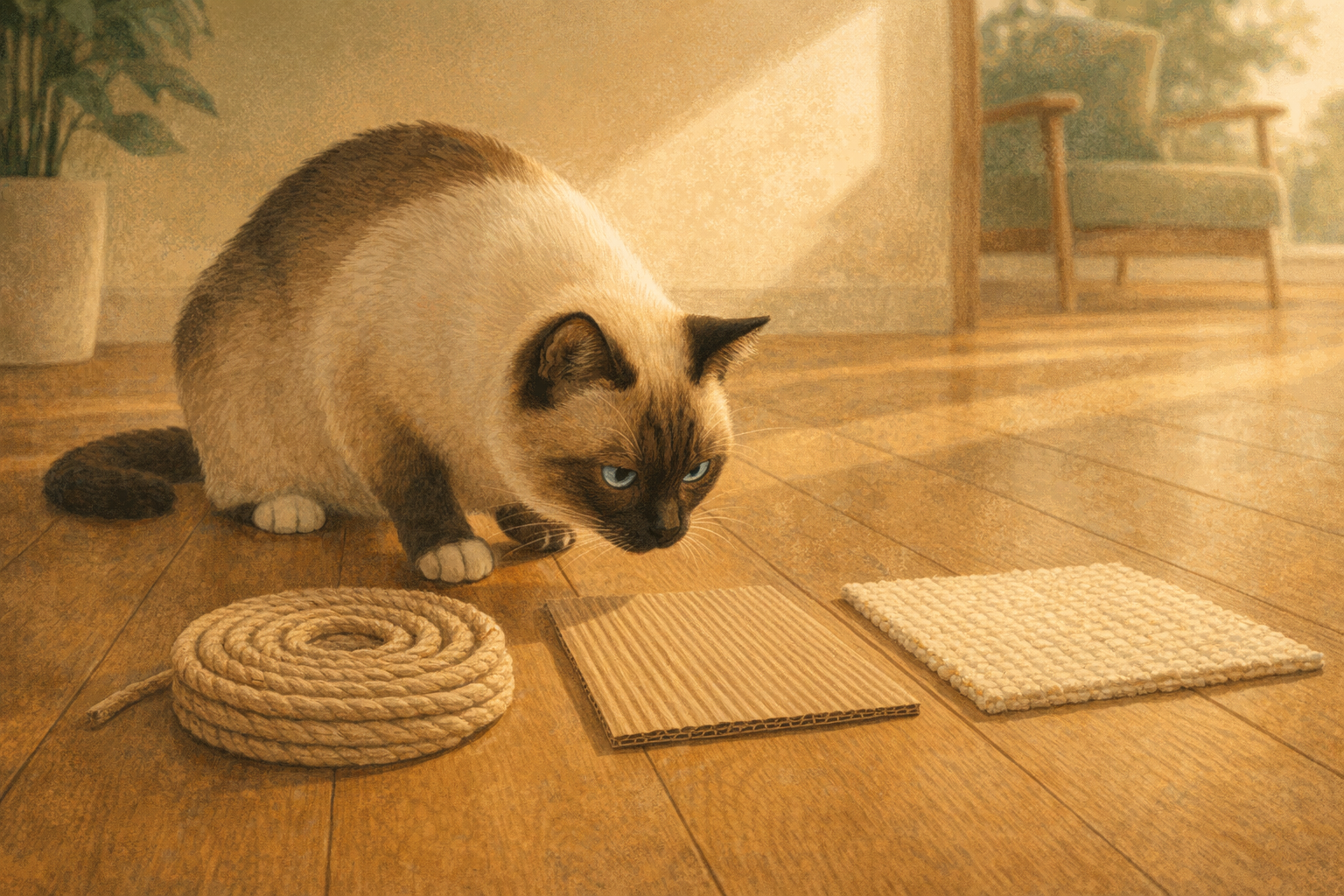
Sisal vs cardboard vs carpet scratchers: which surface will your cat use?
A gray tabby at the rescue walked past a brand new carpet-covered post to rake the cardboard pad beside it, and the following week she flipped, ignoring the flattened pad and working over the post. The sizes were right both times. What changed was what her claws wanted that week. That is the whole puzzle with scratchers: the surface is a choice the cat makes, not the owner. Sisal is the dependable pick for a cat who reaches up to scratch. Cardboard is the cheap, flat option for a cat who rakes the rug, and it takes catnip well. Carpet only earns its place for a cat who already goes for carpet, and it wears out soonest. Watch where and how your cat scratches now, then buy the surface that matches.
As Amazon Associates we earn from qualifying purchases. Some links in this post are affiliate links; if you buy through them, we earn a small commission at no extra cost to you. We only recommend products we’ve used or researched thoroughly. See our full disclosure for details.
How they compare at a glance

SmartCat Ultimate Scratching Post (32 in, Gray Sisal)
Vertical · woven sisal and wood · 32 inches tall · 16 inch square base
- ✓ Tall enough for a full-body stretch
- ✓ Woven sisal covering that holds up to claws
- ✓ Wide square base so it resists tipping
- ✓ Plain, neutral look that sits beside a sofa
on Amazon
Price as of Oct 31, 2026, 9:05 AM EDT. Product prices and availability are accurate as of the date/time indicated and are subject to change.

SmartyKat Super Scratcher Chaise (Catnip Infused)
Horizontal · corrugated cardboard · lies on the floor
- ✓ Low chaise shape for scratching, crouching and lounging
- ✓ Catnip infused in the corrugated layers
- ✓ Corrugated texture for cats that rake flat surfaces
- ✓ Light enough to move from room to room
on Amazon
Price as of Oct 30, 2026, 2:59 AM EDT. Product prices and availability are accurate as of the date/time indicated and are subject to change.

PAWZ Road 32 in Carpet Cat Scratching Post
Vertical · carpet covering · 32 inches tall · wide square base
- ✓ Carpet covering for cats that already favor carpet
- ✓ 32 inches tall for a full stretch
- ✓ Dangling ball on the post for play
- ✓ Assembly tools included in the box
on Amazon
Price as of Oct 31, 2026, 9:05 AM EDT. Product prices and availability are accurate as of the date/time indicated and are subject to change.

Raw Paws Kitty Ganja Natural Dried Catnip
An add-on for any of the three, not a scratcher itself · 1 oz
- ✓ Maker’s suggested use: sprinkle on a toy, bed or scratch post
- ✓ All-natural loose leaf catnip
- ✓ A way to make a new surface worth a first visit
- ✓ Works with whichever scratcher you choose above
on Raw Paws Pet Food
Price as of Oct 31, 2026, 9:05 AM EDT. Product prices and availability are accurate as of the date/time indicated and are subject to change.
Swipe to compare
| SmartCat Ultimate (sisal) | SmartyKat Chaise (cardboard) | PAWZ Road (carpet) | Raw Paws Catnip | |
|---|---|---|---|---|
| Surface | Woven sisal fiber | Corrugated cardboard | Carpet covering | Loose catnip leaf |
| Orientation | Vertical post | Flat on the floor | Vertical post | Sprinkled on any surface |
| Where it suits | Beside a sofa or by a sleeping spot | Where a cat rakes the rug or floor | Where a cat already goes for carpet | On a surface she ignores |
| What wears first | Slowest to shred, per shelter guidance | Shreds into flakes and flattens | Sheds and snags soonest | Not applicable |
| Catnip | Hard to work into the weave | Takes it well, and this one is pre-infused | Can be sprinkled on | The point of it |
| Best fit | A cat who stretches up to scratch | A budget test or a floor scratcher | A cat who has picked carpet already | A new scratcher that sits unused |
The short version
- Start with how she scratches now. Cornell advises matching the post to the surface and the direction your cat already prefers, upright or flat. [1]
- Sisal is the sturdy all-rounder. The AAFP says many cats prefer sisal rope, and shelter guidance calls sisal tough and slow to shred. [2][3] The SmartCat Ultimate post stands 32 inches tall on a 16 inch base. [5]
- Cardboard suits floor scratchers on a budget. It is cheap and takes catnip well, though it shreds and some cats chew it. [3] The SmartyKat Chaise is the ready-made version with catnip built in. [6]
- Carpet is for cats who already like carpet. Cornell says a carpet-covered post suits a cat who scratches carpet, but shelter guidance notes it sheds and snags claws. [1][3] The PAWZ Road carpet post is a 32 inch example. [7]
- Offer more than one. The AAFP says cats differ in what they prefer and advises trying a variety of surfaces. [2]
- A pinch of scent can break the ice. The maker of Raw Paws catnip suggests sprinkling it on a toy, bed or scratch post. [8]
In this guide
Why the surface matters · Sisal · Cardboard · Carpet · Matching a surface to your cat · How I compared them · Common questions · When to talk to your vet
Why the surface matters
Scratching is not bad manners. Cornell describes it as mainly a marking behavior: it leaves scent from glands in the paws and sheds the outer sheath of the claw. [1] The AAFP adds that cats scratch to stretch and that it can also signal stress, which is a reason to provide places that work. [2] What the sources agree on is that the same cat will not like every surface. The AAFP says many cats prefer sisal rope while others favor corrugated cardboard, carpet or wood. [2] The Humane Veterinary Medical Alliance says to watch whether your cat scratches upright on a couch or at floor level on a rug, then pick a vertical post or a flat scratcher to match. [4] That is the filter for everything below. The material is half the decision and the direction is the other half.
Sisal: the durable vertical
If your cat rears up against the arm of the sofa, sisal is where I would start. Shelter guidance from Maddie’s Fund calls sisal tough and resistant to shredding, with the one drawback that catnip is hard to work into it. [3] The AAFP and Cornell both say a vertical post must be sturdy and tall enough for the cat to stretch out fully, which rules out the knee-high posts sold in many pet aisles. [1][2] The SmartCat Ultimate post lists a 32 inch height and a 16 inch square base in woven sisal and wood, which is built for exactly that stretch. [5] It is plain, it sits beside furniture without drawing the eye and the wide base is the part that stops it wobbling. The limit is that it is a vertical post only, so a cat who prefers to scratch flat will walk past it. Place it where she already scratches or by her sleeping spot, since the AAFP advises putting scratchers near sleeping areas. [2]
Cardboard: cheap, flat and short-lived
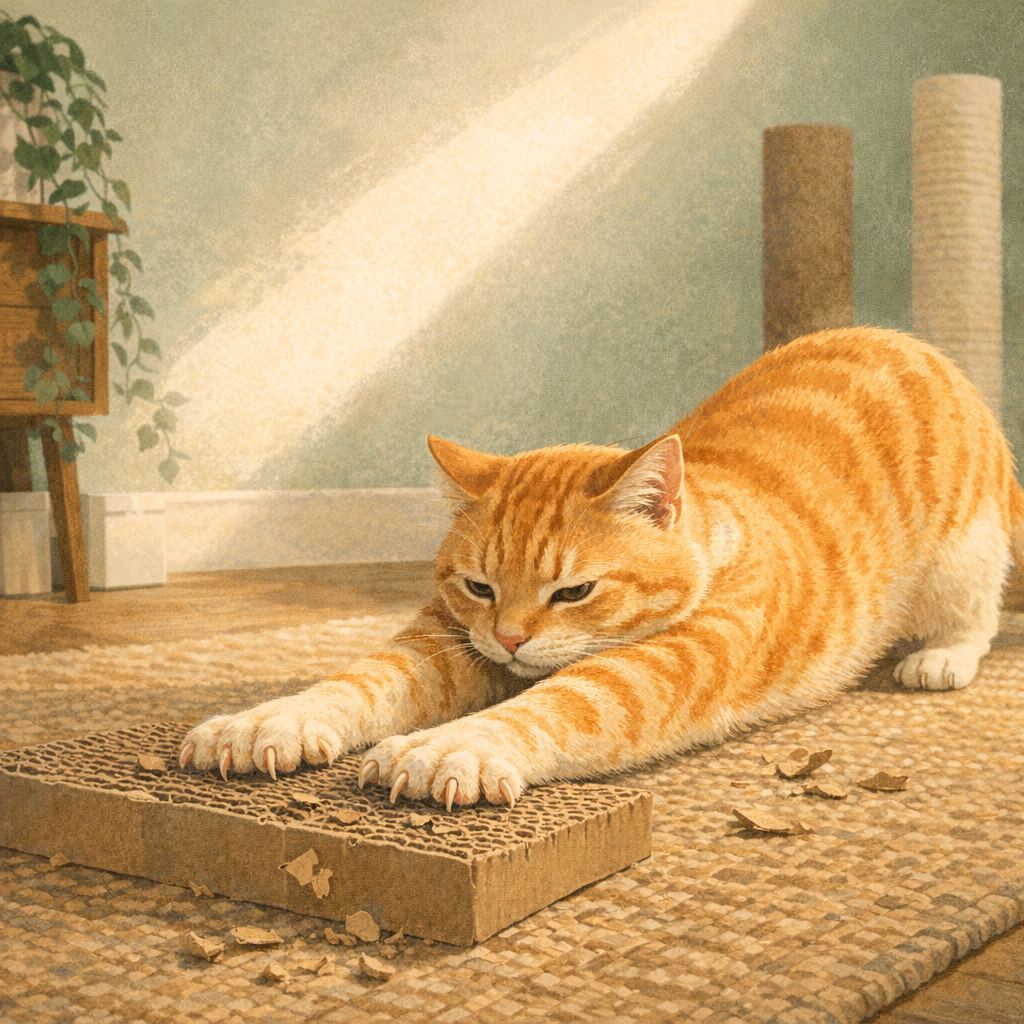
Cardboard is the easiest surface to try because it costs little and lies on the floor. Cornell names a flattened cardboard box as an example of a horizontal scratching surface. [1] Maddie’s Fund lists the trade-offs plainly: it is cheap, it takes catnip well, it shreds and some cats chew it. [3] The SmartyKat Chaise packages the idea as a low chaise with catnip infused in the corrugated layers. [6] I like it as a test, because if she never touches it you have lost very little, and if she shreds it down to flakes in a month you have learned she wants a floor-level surface and can buy a better one. Expect to replace it. A corrugated pad is a consumable, and that is the price of the low cost. If your cat chews the cardboard, pick up the pieces so she does not swallow them.
Carpet: only if she already likes it
Carpet is the surface I would buy last, and only for a particular cat. Cornell says a carpet-covered post suits a cat who is already scratching carpet. [1] Maddie’s Fund calls carpet the most common manufactured covering but not as durable as sisal, noting that it sheds its nap, traps dirt and can snag a cat’s claws in the loops. [3] The PAWZ Road carpet post is a 32 inch carpeted post with a dangling ball and the tools to assemble it. [7] The listing is also inconsistent about whether the pillar is carpet or sisal-wrapped, so look at the photos for your color before you order. [7] None of the sources I read say a carpet post teaches a cat to shred floors, so treat my caution about wall-to-wall carpet as a judgment call and not a finding. In a home with carpeted floors I would rather steer a cat to sisal or cardboard, because a clear difference between her scratcher and the floor is easier for her to learn.
Matching a surface to your cat
Spend three days watching before you buy. Note where she scratches, whether she stands to do it or lies along the floor and what the surface is: couch fabric, rug, door frame or a wooden leg. A cat who stands and rakes a couch corner wants a tall sisal post set right beside it. A cat who drags her claws across a doormat wants a flat cardboard pad in that spot. A cat who already works over a carpeted stair tread is the one for whom a carpet post makes sense. [1][4] If the picture is mixed, buy a cheap cardboard pad and a sisal post and let her vote. The AAFP’s advice to try a variety is the practical version of that. [2]
A new scratcher that sits unused is usually a placement problem, not a verdict. Move it next to her bed or to the spot she already scratches. If it still sits there, a small sprinkle of Raw Paws catnip on the surface is a low-cost nudge, following the maker’s suggestion to use it on a toy, bed or scratch post. [8] Not every cat responds to catnip, so treat it as a trial. Cardboard is the easiest to scent, since sisal is hard to work catnip into. [3]
How I compared them
This is a researched comparison, not a side-by-side test. I haven’t had these three in a home with a cat, so I won’t claim I did. I read the Cornell Feline Health Center page on destructive behavior, the AAFP’s scratching handouts, the Humane Veterinary Medical Alliance fact sheet and Maddie’s Fund guidance on scratching posts, then lined up each product’s stated height, base, material and extras from the listing pages and checked them against that advice. I’d point most people to the SmartCat Ultimate post first because sisal is the surface with the best-supported case for durability and the broadest appeal. The SmartyKat Chaise gets credit for the lowest cost of entry and for being a way to find out whether your cat is a floor scratcher. The PAWZ Road carpet post comes last, which is not a knock on it, only a reflection that carpet fits the narrowest set of cats. Where the three tie, your cat’s own habits decide.
Common questions
How many scratchers does one cat need?Short answerTwo or three, in different spots.
The AAFP advises providing them in several locations and in more than one form, such as tall, flat and angled. [2] Two or three, placed where she already scratches, beats one perfect post in a back room.
Does scratching sharpen claws?Short answerNo. It removes the outer claw sheath.
The Humane Veterinary Medical Alliance says scratching removes the outer claw sheath and does not sharpen the tip. [4] It is maintenance, which is one reason to offer a surface she enjoys.
My cat ignores the new post. What now?Short answerMove it next to where she already scratches.
Move it. Cornell advises placing a post next to an area the cat already scratches and moving it gradually later. [1] Reward use right away, since the AAFP says to do it within a few seconds, and never punish her for missing it. [2]
When to talk to your vet
Scratching is normal, and a change in it can be a signal. If a cat who always scratched stops, avoids stretching up or flinches when she touches her paws to a post, mention it to your vet, especially in an older cat. Frequent, intense scratching alongside hiding, appetite changes or litter box trouble can reflect stress, which the AAFP notes scratching can signal. [2] If she chews cardboard and then vomits, stops eating or seems uncomfortable, call your vet. Swollen toes, a torn claw or a claw that curls into the pad also need a clinic visit and not a better scratcher.
The bottom line
- Choose the SmartCat Ultimate post if your cat stands to scratch, you want something durable and you have a spot beside her bed or the sofa.
- Choose the SmartyKat Chaise if she rakes the rug or floor, you want a low-cost test or you like a scratcher that doubles as a lounge.
- Choose the PAWZ Road carpet post if she already scratches carpet and you want a post that matches what she picked.
- Add the Raw Paws catnip if a new scratcher sits unvisited and you want a low-cost nudge before you move it again.
Whichever you pick, put it where she already scratches. A modest scratcher in the right spot beats a perfect one in the wrong room.
Sources
- Cornell Feline Health Center, “Feline Behavior Problems: Destructive Behavior”
- American Association of Feline Practitioners, “Claw Friendly Educational Toolkit: Client Resources” (includes “It’s Natural for Cats to Scratch”)
- Maddie’s Fund and San Francisco SPCA, “Why Get a Scratching Post?”
- Humane Veterinary Medical Alliance, “How to Help Your Cat Scratch in the Right Places”
- Mud Bay, “SmartCat The Ultimate Cat Scratching Post, 32-in” (retailer listing, used for specs only)
- Kohl’s, “SmartyKat Super Scratcher Corrugate Chaise Lounge” (retailer listing, used for specs only)
- Amazon listing for the PAWZ Road 32″ Large Cat Scratching Post, Vertical Carpet Cat Scratcher (retailer listing, used for specs only)
- Raw Paws Pet Food, “Kitty Ganja Natural Dried Catnip for Cats, 1-oz” (manufacturer product page, claims are the maker’s own)