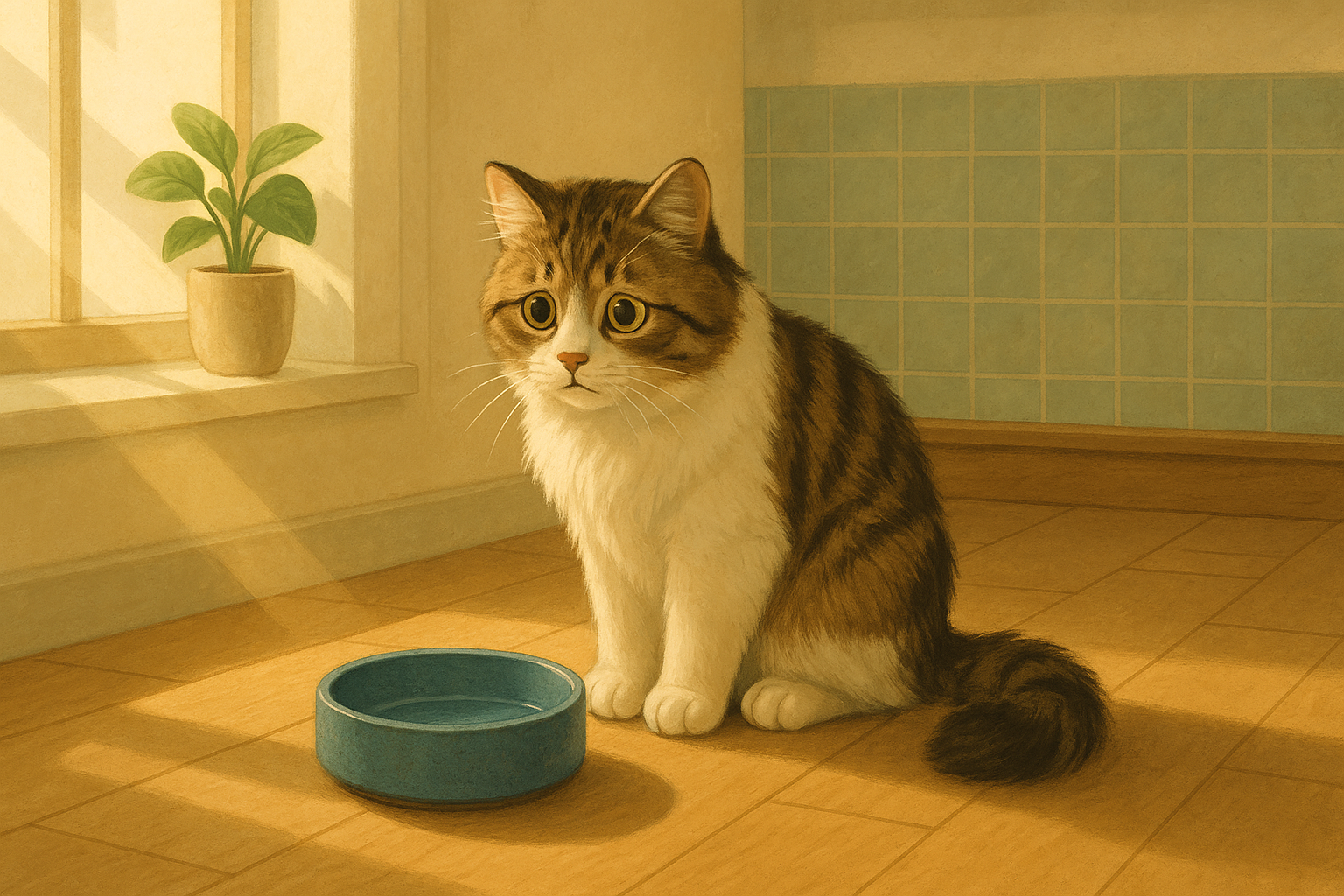
Why is my cat throwing up clear liquid?
Clear-liquid vomit usually means your cat’s stomach was empty when something irritated it. The fluid is stomach acid, bile or saliva (not food), and it’s most common first thing in the morning or right before a usual mealtime. An occasional episode is rarely a crisis. A pattern is information.
Quick fixes:
- Split the daily ration into smaller, more frequent meals so the stomach is less often fully empty.
- Add a small wet-food meal at bedtime if morning vomiting is the pattern.
- Slow fast eaters with a puzzle feeder or a flat plate instead of a deep bowl.
- Watch the next 24 hours: any blood, repeated episodes or lethargy is a vet call now, not later.
Dr. Sarah Wooten, DVM walks through the common reasons cats vomit and what to do about each (PetMD).
What clear-liquid vomit actually is
Cats vomit clear liquid when there’s no food in the stomach to come up. The fluid is some mix of saliva swallowed between meals, stomach acid and bile that’s refluxed up from the small intestine. The trigger is usually irritation of an empty stomach lining. It looks alarming but the contents themselves aren’t unusual. What matters is the pattern around it.
The most common cause: an empty stomach
For many cats on twice-a-day feeding, the gap between dinner and breakfast is long enough that the stomach gets irritated overnight. The classic shape is a small puddle of clear or pale-yellow liquid on the floor around the time you’d normally feed. Splitting the daily food into three or four smaller meals (or adding a small wet-food snack at bedtime) often resolves it without anything else changing.
When it’s a hairball in progress
Sometimes clear-liquid vomit is the first event in a hairball cycle: the cat retches, brings up only fluid, retches again later and eventually produces the hairball. Long-haired and senior cats are more prone. If your cat is shedding heavily or you’ve noticed more grooming than usual, brushing every day for a week often does more than any supplement.
When it’s not just the empty stomach
Cornell flags vomiting more than once a week (any kind of vomit, including clear liquid) as outside the normal range and worth a vet conversation.1 In older cats especially, frequent vomiting can be the first visible sign of inflammatory bowel disease, hyperthyroidism, kidney disease or pancreatitis. Sudden changes in frequency matter more than any single episode.
When to call the vet
- Vomiting more than once a week, or several episodes in a single day1
- Any blood in the vomit
- Vomiting plus lethargy, hiding, refusing food or weight loss
- An older cat where the pattern is new
For the broader picture of indoor-cat digestion, see our complete guide to indoor cat digestion.