Wand Toys vs Puzzle Feeders: Which Enrichment Fits Your Indoor Cat?
Every shelter play session I ran had the same split. Some cats lost their minds over a feather on a string and would chase it until their sides heaved. Others watched the wand with polite interest, then wandered off to paw at a kibble-stuffed toy for twenty minutes. Both cats were hunting. They just wanted to do it differently. For most indoor cats the answer to wand toys versus puzzle feeders is both, with the wand covering the chase and the feeder covering the long, quiet work of finding food.
As Amazon Associates we earn from qualifying purchases. Some links in this post are affiliate links; if you buy through them, we earn a small commission at no extra cost to you. We only recommend products we’ve used or researched thoroughly. See our full disclosure for details.
How they compare at a glance

GoCat Da Bird Rod and Feather Toy
Wand toy · you control the motion · short, intense sessions
- ✓ Feather attachment on a line, built to mimic a bird in flight
- ✓ Lets you stage the stalk, pounce and catch
- ✓ Counts as shared time with you, not solo play
on Amazon
Price as of Oct 31, 2026, 9:05 AM EDT. Product prices and availability are accurate as of the date/time indicated and are subject to change.

Doc & Phoebe’s Indoor Hunting Cat Feeder
Puzzle feeder · 3 plush mice and a scoop · works while you’re out
- ✓ Turns part of a regular meal into a scavenger hunt
- ✓ Hide the mice around the home before you leave
- ✓ Uses the kibble you already feed, so no extra calories
on Amazon
Price as of Oct 31, 2026, 9:05 AM EDT. Product prices and availability are accurate as of the date/time indicated and are subject to change.
Swipe to compare
| Wand toy (GoCat Da Bird) | Puzzle feeder (Doc & Phoebe’s) | |
|---|---|---|
| Who drives it | You, with your cat reacting | Your cat, on her own schedule |
| Mimics | The chase, pounce and catch | The search for and working at food |
| Energy output | High, in short bursts | Low to moderate, spread out |
| Needs from you | Ten minutes of attention, plus storing it out of reach | A minute to fill and hide it |
| Best fit | Restless, social cats and anyone home in the evening | Cats left alone for long stretches or fast eaters |
The short version
- Feline welfare guidelines ask for both. The AAFP and ISFM environmental guidelines call for interactive play that simulates a capture and for feeding that makes the cat work for food. [1]
- A wand toy burns energy fast. It’s the better pick for a cat who zooms at 3 AM or leaps at your ankles.
- A puzzle feeder fills the quiet hours. It gives a cat something to do while you’re at work, and it uses food she’s already getting. [2]
- Safety differs. Wands carry string and feathers that Cornell warns can come loose and be swallowed, so they get put away after play. [3]
- If you can only buy one, match it to the gap in your cat’s day. Lonely and bored while you’re out points to the feeder. Wired when you’re home points to the wand.
In this guide
Two hunting styles · Where wand toys win · Where puzzle feeders win · Making it work in a small space · How I compared them · Common questions · When to talk to your vet
Two hunting styles, one indoor cat
An outdoor hunter does two jobs: she finds prey, then she catches it. Indoors, both jobs disappear. Dinner shows up in a bowl and nothing runs from her. The AAFP and ISFM guidelines treat that gap as a welfare issue and ask owners to rebuild both halves: interactive play where the cat can catch the toy at the end of a rod or wand, and feeding that makes her work for food, including puzzle feeders and several small meals. [1] They also suggest rotating toys so she doesn’t get used to them. [1]
Seen that way, the question stops being a contest. A wand toy rebuilds the chase and a puzzle feeder rebuilds the search. The review on food puzzles in the Journal of Feline Medicine and Surgery makes the same point from the health side, tying indoor housing to urinary signs and behavior problems and positioning food puzzles as a way to use a cat’s instinct to work for her food. [2]
Where wand toys win
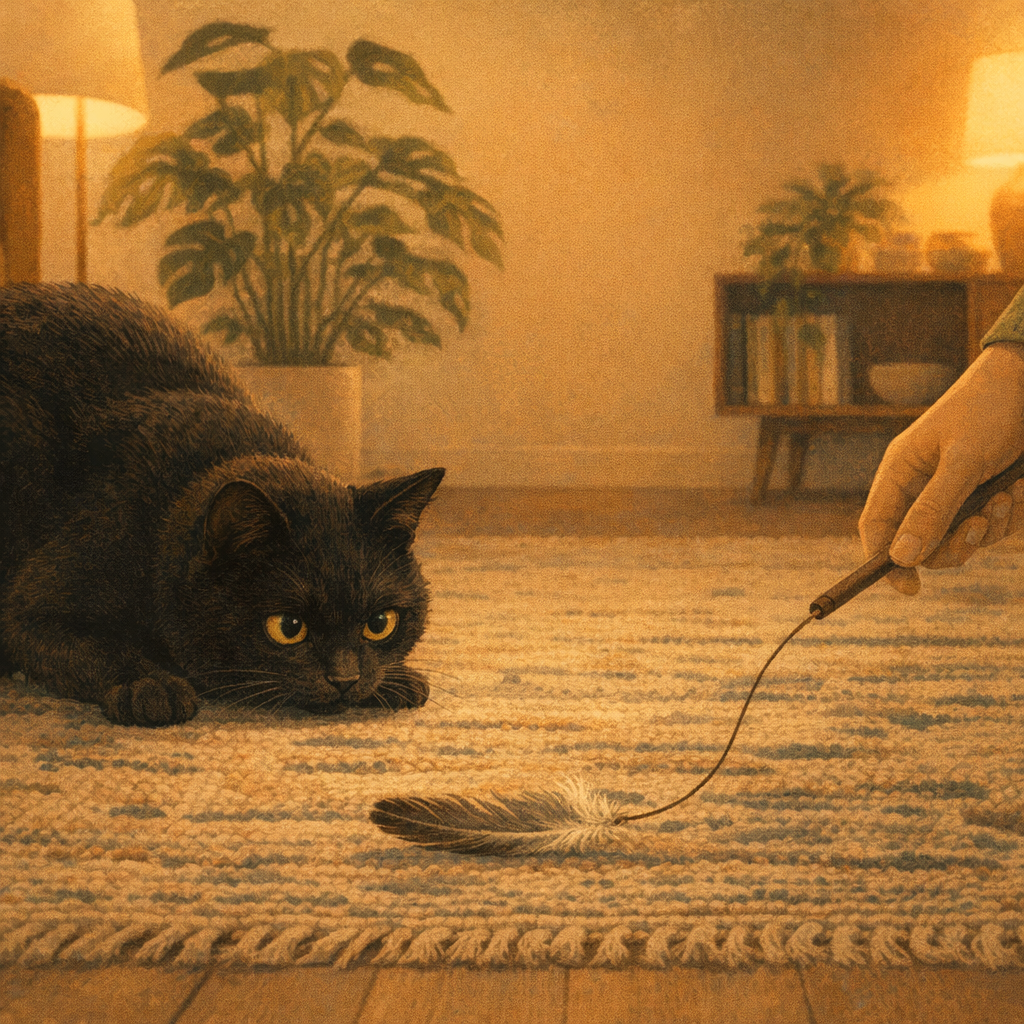
A rod and feather toy like Da Bird beats a puzzle feeder at one thing: it puts you in the game. At the rescue, the shy cats who wouldn’t touch a free-standing toy would often commit to a feather once I kept it low, slow and a little hidden. You control the pace, so you can build to a pounce and finish with a catch instead of dragging the feather past her until she gives up. The guidelines specifically advise letting the cat catch the toy at the end of the wand to simulate a capture. [1]
That also makes it the better tool for a cat with energy to burn. Two or three short sessions a day, ideally ahead of a meal, tends to calm evening zoomies better than any amount of solo toys. The same hunt, play, eat sequence you see in the wild helps explain why.
The downside is built into the design. Wands depend on you, so they do nothing during a ten-hour workday. And the feather and line are the parts that go missing. Cornell advises against toys with strand-like parts, such as feathers and string, that can separate and be ingested. [3] My rule is simple: wand goes back in a closed drawer when play ends, every time.
Where puzzle feeders win
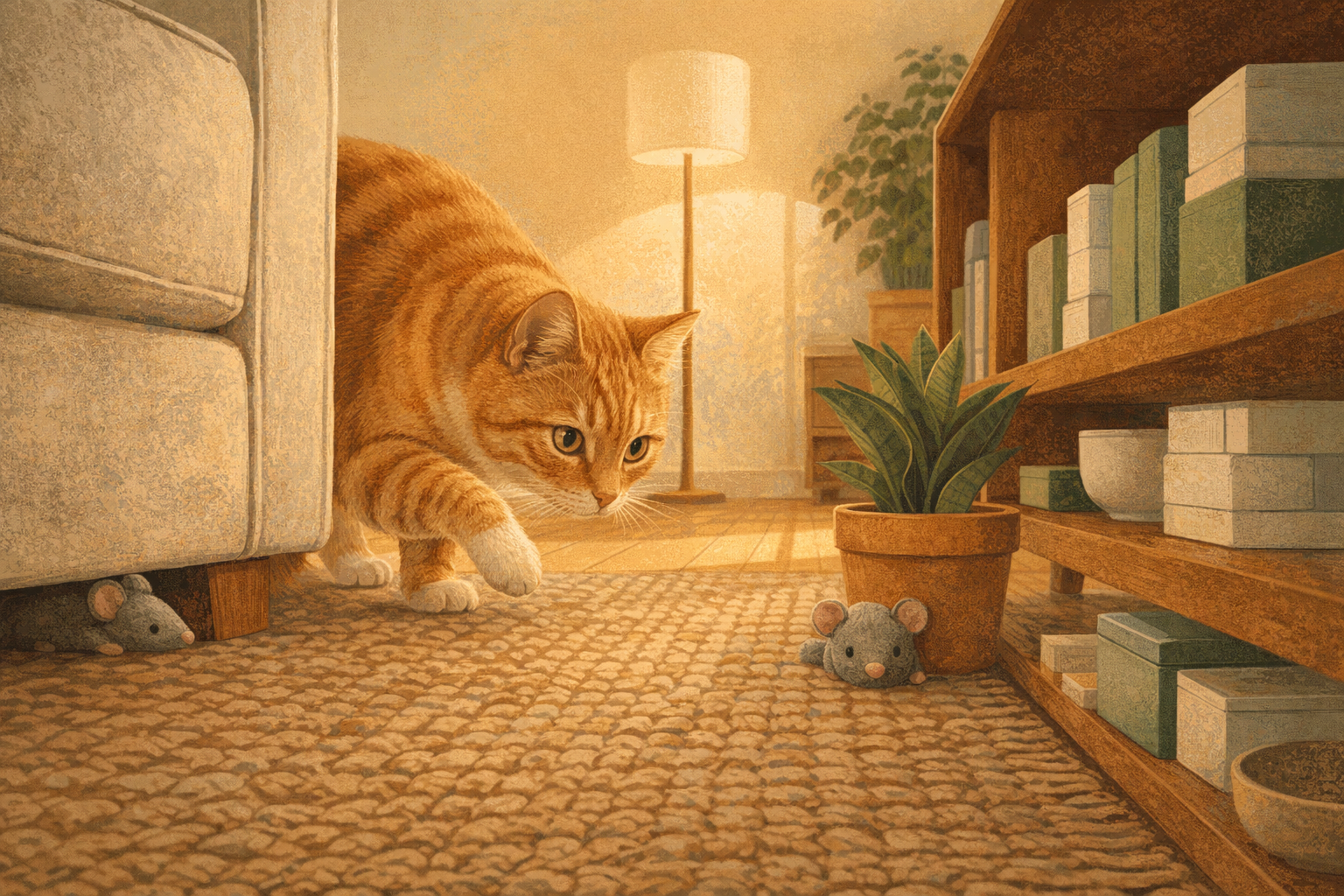
A hide-and-find feeder like Doc & Phoebe’s runs without you. You load the mice with part of the day’s kibble and tuck them behind a plant, under a chair edge or on a low shelf, and your cat spends the morning doing what she was built to do. The food comes from her normal ration, so you aren’t adding calories. For a fast eater or a cat who cries for breakfast at 5 AM, spreading a meal across a search slows things down and gives her something to do besides stare at you.
The research on food puzzles for cats is still young. The Dantas review is candid that it combines early empirical evidence with case studies from the authors’ own practices, which is a fair reminder that the benefits are promising but not settled. [2] What it does give you is practical advice on introducing puzzles and troubleshooting when a cat ignores them. [2]
The honest limit of a feeder is the learning curve. A cat who has only ever eaten from a bowl may sniff a hidden mouse and walk away. Start with the mice in plain sight, let her win easily, then make it harder over a week or two. If she still refuses, don’t force it. Some cats prefer the chase and that’s fine.
Making it work in a small space
Apartments make the choice easier. A wand needs only a clear patch of floor, and a hide-and-find feeder uses spaces you already have: the gap behind a bookshelf, the base of a plant, the second step of a cat tree. In a studio, I’d run a wand session when you get home and set out the mice just before you leave in the morning, so each toy has a clear job. Rotate which one you pull out, since the guidelines point to rotation as a defense against boredom. [1] Cornell says the same about toys in general. [3]
How I compared them
This is a researched comparison, not a side-by-side test. I haven’t run these two products in my own home, so I won’t claim I did. I read the AAFP and ISFM environmental guidelines, the food puzzle review and Cornell’s toy safety page, checked each product’s listing for what it includes and weighed all of it against what I saw for years at the rescue. The feeder has a real edge I’ll concede: it’s the only one of the two that works when nobody is home, and it carries no loose-feather risk to speak of. The wand’s edge is that it’s the only one that lets a cat complete a full hunt with a catch at the end. Neither replaces the other.
Common questions
How long should a wand session last?Short answerAbout ten minutes.
Ten minutes is plenty for most cats. Stop while she’s still keen, finish on a catch and put the wand away rather than leaving it out.
Will a puzzle feeder make my cat lose weight?Short answerNot by itself.
Not by itself. It spreads out the food she already gets, so it changes the pace of eating more than the amount. If weight is a concern, your vet can set a daily calorie target.
My cat ignores both. Now what?Short answerChange the target before you give up.
Change the target before you give up. Try a different prey type, a different height or a different time of day. Cats are choosy about movement and texture, and what works for one rarely works for another.
When to talk to your vet
Talk to your vet if a previously playful cat suddenly loses interest in both, if she starts pouncing at you or others with real aggression or if she vomits after eating from a feeder, since fast eating can be a medical or behavioral issue. Any cat who swallows string, ribbon or feather pieces needs prompt veterinary care, not a wait-and-see approach. [3]
The bottom line
- Choose the wand toy if your cat is wired in the evening, you’re home to play or you want a way to bond through a full hunt that ends in a catch.
- Choose the puzzle feeder if your cat spends long stretches alone, eats too fast or needs something to do before you wake up.
If budget lets you have both, give each one a set time of day. Her days will feel less repetitive, and so will yours.
Sources