Cat won’t eat after being sick? How to bring a recovering cat’s appetite back
Your cat was sick, you got through it, and now the hard part is the part nobody warned you about: she still will not eat. The vomiting has stopped, the infection is clearing, the medication is doing its job, and the food bowl sits untouched. This is one of the most common and most worrying moments in cat care, and it has real reasons behind it. Here is what is happening and exactly how to coax a recovering cat back to the bowl.
Quick take:
- Appetite often lags behind recovery. Nausea, a stuffed-up nose, pain and medication side effects all suppress hunger even after a cat is “better.”
- The biggest hidden cause is learned food aversion: a cat links whatever she ate right before feeling sick with the sickness itself, and refuses it for weeks.
- Cats cannot safely go without food. A cat eating almost nothing for 24 to 48 hours needs a vet, especially an overweight cat.
- The fixes are practical: warm the food, lean on aroma, offer small frequent meals in a calm spot, and switch to novel foods she has no bad memory of.
- Never force the issue by withholding food to “make her hungry.” With a recovering cat that backfires fast.
Why a recovering cat still refuses food
It feels backwards. The illness is resolving, so the appetite should bounce back with it. But appetite is one of the last things to return, and several forces are usually working against it at once.
Lingering nausea. Many illnesses, and many of the drugs used to treat them, leave a cat queasy well after the obvious symptoms fade. A nauseous cat will sit hunched in front of food, lick her lips, turn her head away, or walk off. She is not being difficult. The smell of food when you feel sick is the opposite of appetizing.
A blocked nose. Cats decide whether to eat almost entirely by smell. After an upper respiratory infection, a congested cat may genuinely not be able to smell her food, and a cat that cannot smell her dinner usually will not touch it. This is why aroma matters so much in recovery, more than flavor or even texture.
Pain and weakness. Dental disease, mouth ulcers, an abscess, surgery or simple post-illness fatigue all make the act of eating uncomfortable or exhausting. A cat that wants to eat may still give up after a few bites.
Medication side effects. Antibiotics and many other prescriptions commonly suppress appetite or upset the stomach. If your cat stopped eating right as a new medication started, mention it to your vet. Sometimes the timing or the drug can be adjusted.
The cause most owners miss: learned food aversion
Here is the one that explains the strangest cases, the cat who has fully recovered but still snubs the exact food she ate every day of her life before getting sick.
Cats form fast, durable associations between a food and feeling ill. If your cat happened to eat her usual chicken pate in the hours before the nausea hit, her brain files that food under “this made me sick,” even though the food had nothing to do with it. The result is a learned aversion: she will refuse that specific food, sometimes that whole flavor or texture, for a long time. It is the same mechanism that makes a person avoid a dish they once got food poisoning from.
This single fact changes how you should feed a recovering cat, and most people get it exactly wrong. The instinct is to tempt her with her old favorite. But offering the familiar food while she still feels off is the surest way to “burn” it, turning a food she loved into one she now associates with feeling sick. During the queasy stretch of recovery, the smarter move is to reach for foods she has no history with at all.
First, rule out the emergency
Before the coaxing tips, one non-negotiable. Cats are built for frequent small meals, not fasting, and a cat that eats almost nothing for a day or two is in real danger. When the body has no incoming food, it floods the liver with fat for energy, and the feline liver handles that badly. The result, hepatic lipidosis or fatty liver disease, can become life-threatening within days and overweight cats are the most vulnerable and decline the fastest.1
So the coaxing strategies below are for a cat with a reduced or finicky appetite who is still taking in some food. If your cat is refusing everything, has eaten essentially nothing for 24 to 48 hours, or the food refusal comes with ongoing vomiting, hiding or worsening lethargy, that is a medical situation, not a feeding one.2 Our guide on a cat who suddenly will not eat walks through the warning signs and when to go straight to the vet.
How to coax a recovering cat back to the bowl
1. Warm the food. Gently warming wet food to about body temperature, a few seconds in the microwave then stirred and tested so it is never hot, releases the aroma that drives a cat to eat. For a congested, post-illness cat this is the single highest-impact thing you can do. Warm, strong-smelling food can reach a nose that cold food cannot.
2. Lead with aroma, not the bowl she rejected. Strong-smelling foods cut through residual nausea and a stuffy nose. Freeze-dried raw foods are a standout here: rehydrate the morsels with a little warm water and you get an intensely meaty smell plus a soft texture that is easy for a weak cat to eat. They are also novel for most cats, which sidesteps the learned-aversion trap. We cover the options in our roundup of the best freeze-dried cat foods.
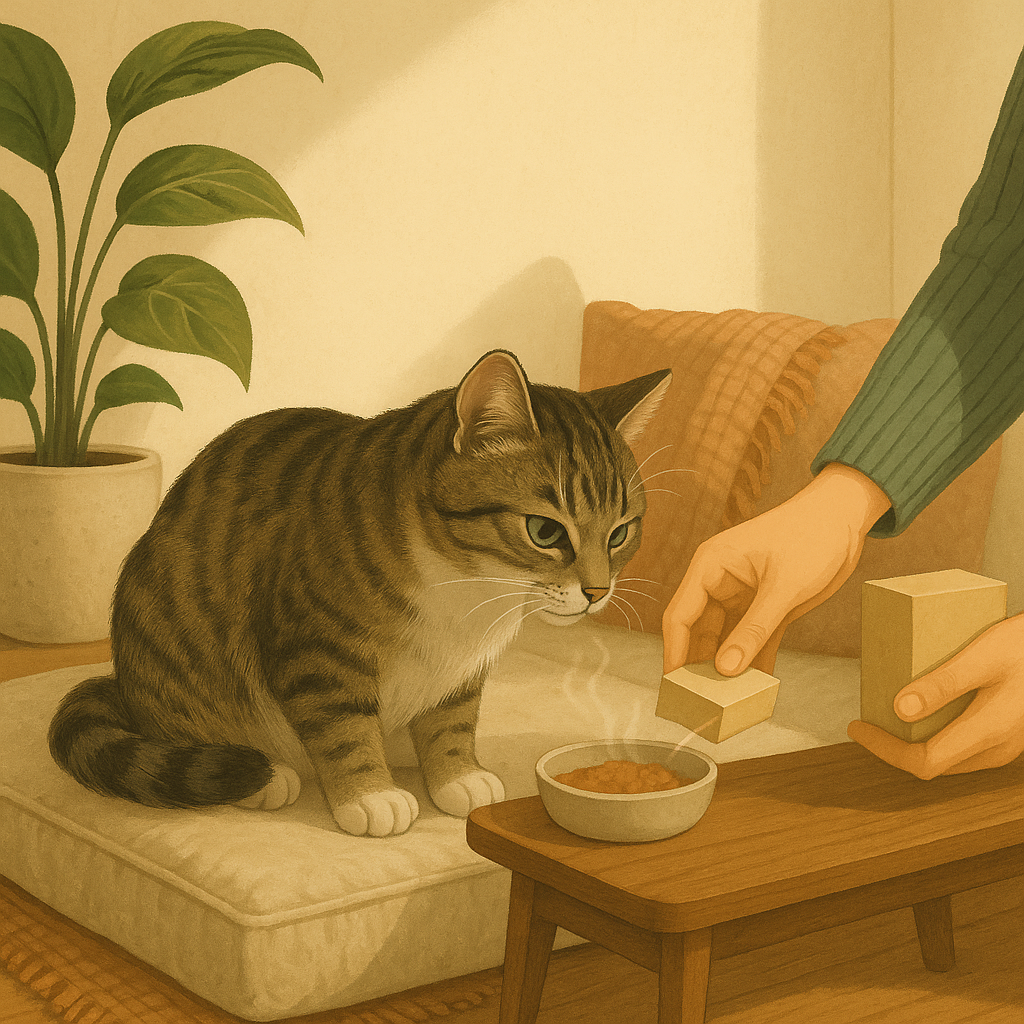
3. Offer novel, simple foods. Because of learned aversion, recovery is the moment to introduce something she has never eaten. A single-ingredient food gives her brain nothing to file under “this made me sick” and nothing complicated to react to. Plain freeze-dried chicken treats are a favorite tool of veterinary behaviorists for exactly this reason, gently rebuilding a positive link with eating. Hand-fed, one piece at a time, they double as a way to reconnect a recovering cat with the act of eating. See our picks for the best single-ingredient cat treats.
4. Small meals, often. A big bowl can overwhelm a queasy cat and the food goes stale before she circles back. Offer a tablespoon or two at a time, fresh and warm, several times a day. Small wins build appetite back faster than one large untouched plate.
5. Fix the setting. A recovering cat wants to eat where she feels safe. Move the dish to a quiet, low-traffic spot, away from the litter box, away from other pets, away from noise. Try hand-feeding or simply sitting nearby and talking softly. A calm cat eats. A guarded one will not.
6. Ask about an appetite stimulant. If a few days of coaxing is not enough, do not white-knuckle it. Vets have safe, effective appetite stimulants, including a transdermal gel dosed onto the ear, that can restart eating while the underlying cause finishes resolving. It is a normal, low-drama part of recovery care and worth asking about early rather than late.
What not to do
- Do not withhold food to force hunger. It works on a healthy animal. On a recovering cat it accelerates the slide toward fatty liver disease.
- Do not keep pushing the food she refused. If she turned away from her old favorite, retire it for now. Repeatedly offering it only deepens the aversion. You can reintroduce it weeks later once she is eating happily again.
- Do not force food into her mouth. Syringe feeding has a place, but only when your vet directs it and shows you how. Done wrong it adds stress, risks aspiration, and can create its own aversion to being fed.
- Do not assume slow is fine. A cat nibbling a little is buying time, not recovering. If real appetite has not returned in two to three days, call your vet.
Getting back to normal
Once your cat is eating reliably again, reintroduce her regular food gradually, mixing a little of it into the food that got her eating and increasing the ratio over several days. If she snubbed her old food because of a learned aversion, give it a couple of weeks before trying it again, and do not be surprised if she has simply moved on to a new preference. Cats do that.
If picky eating lingers well after she is otherwise back to herself, the issue may be less about the illness and more about her individual eating personality. Our free picky-eater quiz sorts out what kind of eater your cat is, whether she is driven by texture, smell, novelty or routine, and returns a feeding plan built around it. It takes about two minutes and is the fastest way to stop guessing.
When to call the vet
- Your cat has eaten little or nothing for 24 to 48 hours1
- Food refusal comes with ongoing vomiting, lethargy, hiding or weight loss2
- Your cat is overweight and has missed more than a day of meals
- Appetite has not meaningfully returned two to three days after the illness otherwise resolved
- She stopped eating right as a new medication began
This article is general information, not veterinary advice. Appetite loss in cats can move quickly from minor to serious, so when in doubt, check with your vet. TheCatWellness may earn a commission from links to products we recommend, at no extra cost to you.