Do Indoor Cats Get Bored? Yes, and Here’s What to Do About It
A long-haired grey cat named Pewter came back to the rescue twice. Not because anyone disliked him. He shredded the arm of a couch, yowled at four in the morning and tore around the apartment knocking things off shelves, and two well-meaning adopters decided he was “too much.” He wasn’t a difficult cat. He was a bored one. He’d been left alone all day in a quiet studio with one flattened mouse toy and nothing to climb, and a smart, athletic cat with nothing to do will always find itself a job. Usually one you’d rather it didn’t. His third home gave him a tall perch at the window, a few minutes of hunting games every evening and dinner he had to dig out of a puzzle, and within a month the “too much” cat was an easy one.
So the honest answer to the question is yes. Indoor cats do get bored, and in a small home with nothing to do, boredom doesn’t stay quiet. It comes out as the behavior that gets cats surrendered. The useful part isn’t the yes, though. It’s understanding what “bored” actually means for a cat, because once you see it the way she does, the fixes are cheaper and simpler than another bin of toys.
The short version
- Yes, they get bored. A cat indoors has had the hunting, climbing and patrolling taken out of her day, and nothing put back.1
- “Bored” really means unmet needs. Cats have specific environmental needs, and when those go unmet you get stress and unwanted behavior.1
- Let her hunt for food. Puzzle feeders and scattered kibble turn a thirty-second meal into a real activity.
- Play with her every day. Ten to fifteen minutes of interactive, prey-style play does more than a roomful of toys she ignores.2
- Build up, not just out. Vertical space matters more than floor space, which is good news in an apartment.2
- Give her something legal to scratch. Scratching is a need, not a vice, so redirect it instead of fighting it.3
What “bored” really means to a cat
It helps to drop the word boredom for a second and think about what an indoor cat has lost. A cat is a small predator wired to spend her waking hours stalking, pouncing, climbing, patrolling a territory and solving the daily problem of catching enough food.2 Move her into a clean, safe, climate-controlled apartment and you’ve removed almost every one of those jobs at once. The safety is real and worth it. Indoor cats live longer. But nothing automatically replaces the work you took away, and a brain built for hunting doesn’t switch off just because dinner now arrives in a bowl.
This is why I find the veterinary framing more useful than “bored.” The AAFP and the International Society of Feline Medicine lay out five basic environmental needs every cat has: a safe place to retreat, multiple separated resources like food, water and litter, the chance to play and hunt, predictable and gentle human interaction and respect for her powerful sense of smell.1 When those needs go unmet, and in a bare apartment several of them usually do, cats don’t shrug it off. They get stressed, and that stress shows up as behavior we read as bad.1 So a bored cat isn’t being naughty or spoiled. She’s a predator with an empty schedule, telling you so the only way she can.
What boredom looks like in your living room
Understimulation rarely announces itself politely. What you tend to see instead is one or more of these. The 4 a.m. zoomies and yowling, the energy of a full day with no outlet finally spilling over at night. Destructive scratching of the couch or the door frame, because a cat without an approved surface will use the one she has.3 Counter-surfing and the famous slow push of a glass off the table, which is often a bid for the reaction it reliably gets. Overeating and the weight gain that follows, since a cat with nothing to do treats the bowl as entertainment. And at the quieter end, overgrooming a patch of fur bare, or a cat who sleeps twenty-two hours a day not from contentment but because there’s no reason to be awake.
Here’s the catch, and it’s an important one. Almost every sign on that list can also be a medical problem or a fear-based stress response rather than plain boredom.4 Overgrooming can be allergies or pain. Night yowling in an older cat can be a thyroid or cognitive issue. A sudden change in a previously settled cat especially deserves a vet’s eye before you decide it’s a lifestyle problem. Boredom is common, but it’s a diagnosis of having ruled the other things out, not a first guess.
How to give an indoor cat a job
The fix isn’t more stuff. It’s giving back the activities the indoors took away. A handful of these, done consistently, changes most cats within a couple of weeks.
Make her work for food
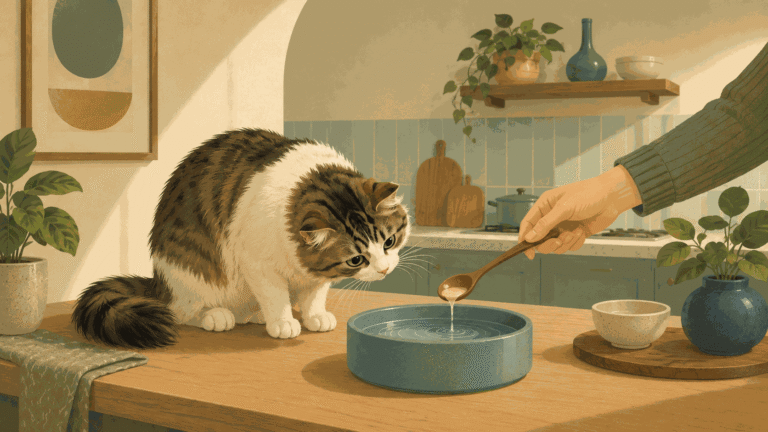
This is the single highest-value change, and it costs almost nothing. Instead of putting a full bowl down, scatter a portion of her kibble across the floor for her to find, or feed her out of a puzzle feeder she has to paw and roll to empty. You’re handing back the hunting and the problem-solving in one move, and you’re slowing down a cat who eats out of boredom. You can buy puzzle feeders or make one from a cardboard egg carton or a yogurt tub with holes cut in it. Start easy so she wins quickly, then make it harder.
Play like it’s a hunt, every day
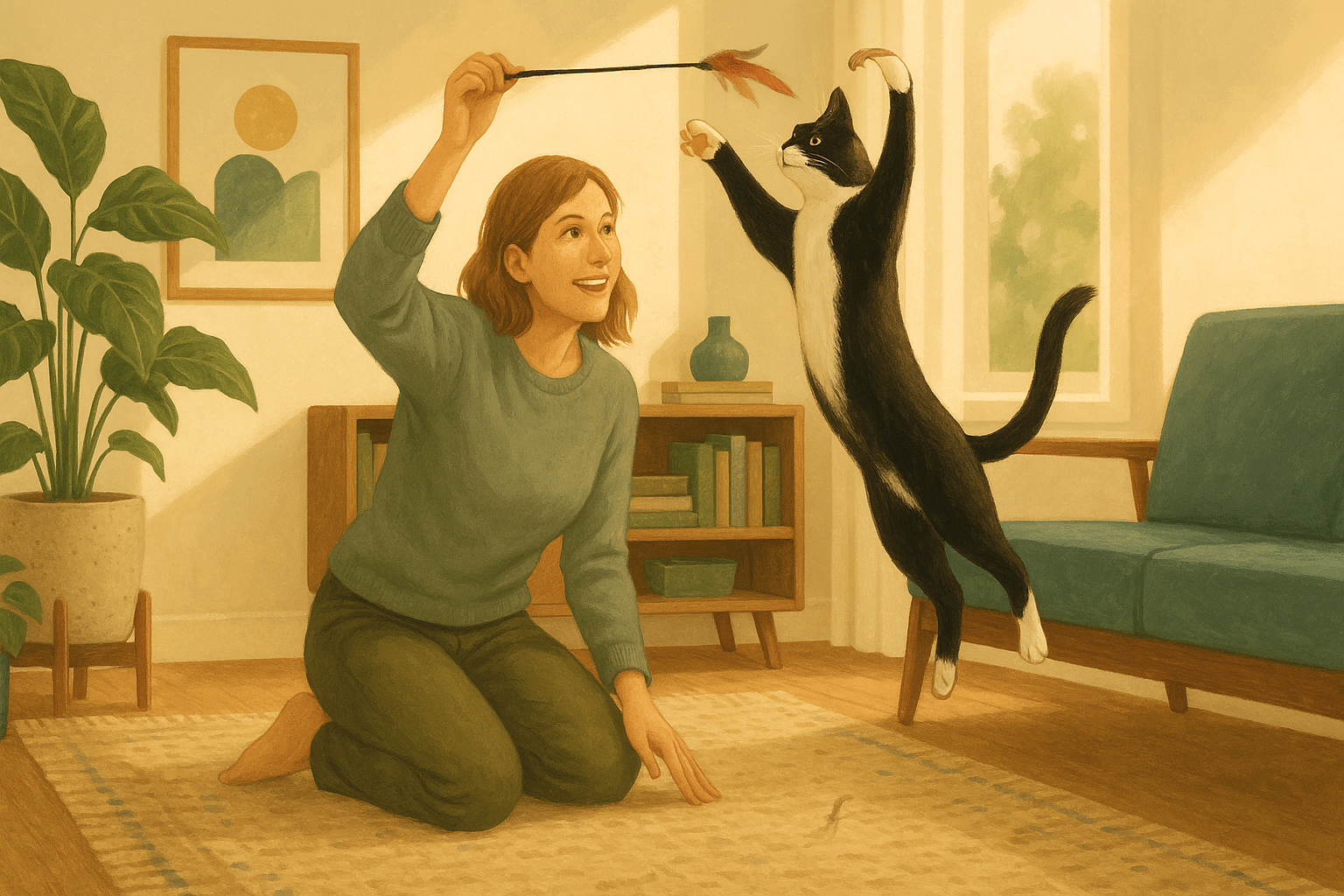
A pile of toys on the floor isn’t enrichment. A cat needs the sequence of a real hunt: stalk, chase, pounce, catch. That means you on the other end of a wand toy, dragging it like wounded prey, letting her actually catch it at the end so the game resolves instead of frustrating her. Cornell suggests aiming for daily interactive play, on the order of ten to fifteen minutes, to head off the obesity and the destructive habits that follow understimulation.2 Two short sessions beat one long one for most cats, and an evening session burns off the energy that would otherwise become 4 a.m. zoomies. Our guide on how much play indoor cats need goes deeper, and the best toys for indoor cats rundown covers what’s worth buying.
Build upward
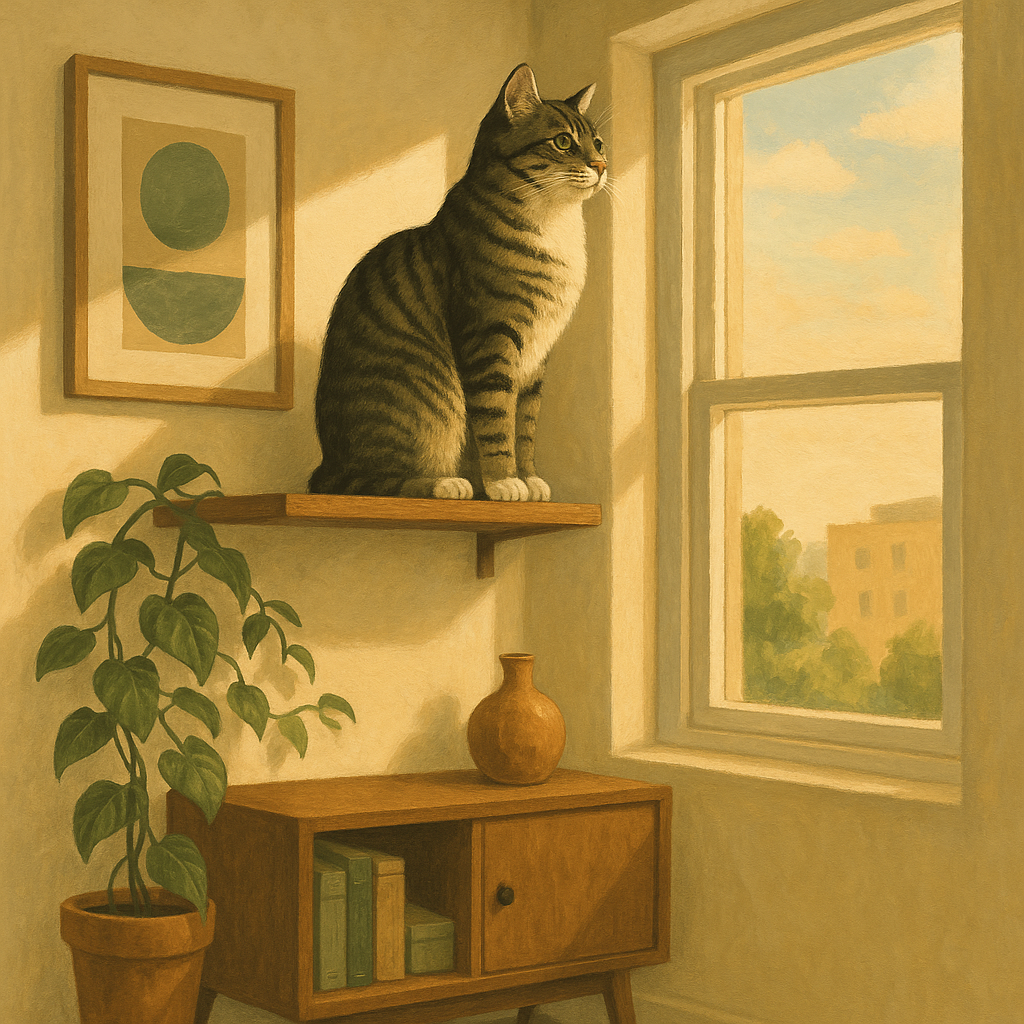
Cats live in three dimensions, and vertical territory is where a small apartment can punch above its square footage. A tall cat tree, a cleared shelf, a window perch or a clip-on hammock gives her somewhere to climb, survey her domain and retreat to when she wants out of the action.2 A window seat with a view of a bird feeder or a busy street is cat television, and it’s free. If you’re weighing whether it’s worth the floor space, our take on whether indoor cats need a cat tree makes the case.
Redirect the scratching, don’t punish it
Scratching isn’t your cat being spiteful about the couch. It’s a normal feline need for marking, stretching and claw care, and the goal is to give her a better target rather than to stop the behavior.3 Put a sturdy post or an angled cardboard scratcher right next to the spot she’s already using, make it tall and stable enough that she can lean her full weight into it, and most cats switch over. Our piece on why cats scratch the furniture walks through placement in detail.
Keep the day predictable, and rotate the novelty
Cats are creatures of routine, and a predictable rhythm of feeding, play and quiet is part of a low-stress home.1 Predictable doesn’t mean monotonous, though. Keep most of her toys put away and rotate a few out at a time so the old ones feel new again, swap a cardboard box for a paper bag, leave a treat to find in a different spot. Small novelty inside a steady routine is the sweet spot. For the full picture of a calm, well-resourced home, our indoor cat behavior and enrichment pillar pulls it all together, and if night-time energy is your particular problem, the 3 a.m. zoomies piece is the targeted fix.
When it isn’t boredom
Before you commit to an enrichment overhaul, rule out the body. Call your vet if a behavior is new or has changed suddenly, if your cat is grooming herself to bald or sore patches, if her appetite or litter box habits have shifted or if the night yowling has appeared in a senior cat for the first time. Pain, hyperthyroidism, urinary trouble and cognitive decline can all look like behavior problems from across the room.4 Enrichment helps a healthy bored cat enormously, but it can’t fix a medical one, and the only way to tell them apart is an exam.
The bottom line
Indoor cats get bored because we’ve given them a safe life and forgotten to give them a job. The answer isn’t guilt and it isn’t a bigger apartment. It’s handing back the hunting through puzzle feeders, the daily chase through real play, the high ground through vertical space and a scratching surface she’s allowed to wreck, all on a routine she can count on. None of it is expensive. Pewter didn’t need a bigger home or a different person. He needed his third one to see that the shredded couch and the 4 a.m. opera were a job application, and to finally give him the work.