Indoor cat coat and skin: what works, what doesn’t
A black sweater that won’t stop attracting hair. A cat that licks one spot until it’s bare. Dandruff on the back of a long-haired cat in February. Coat and skin problems are some of the most visible cat health issues, and most of the small ones have a setup fix you can do before anything else. Here’s what “normal” looks like, what to change first and the signs that mean it’s a vet visit, not a brush and a supplement.
The short version:
- A healthy coat is shiny, lies flat and doesn’t shed in clumps. A healthy skin underneath is smooth, not flaky, not scabby.
- Indoor cats shed all year. There’s no real season because indoor temperature doesn’t change.
- Brush long-haired cats daily. Short-haired cats can usually get away with weekly. Senior cats often need more.
- Diet drives coat quality more than any supplement. Cheap food shows up in the coat first.
- Dandruff in winter is usually dry air. Dandruff year-round, with itching or scabs, is a vet visit.
- Real bald patches, repeated scratching at one spot or skin that’s red or weepy are vet calls.
What I saw at the clinic
The coat-and-skin conversations at the intake desk clustered into three patterns. The first was shedding: owners convinced their cat was shedding way more than normal, often after a season change that didn’t really matter (the cat had been indoors all year). The second was self-induced bald patches, where the cat had been over-grooming one spot for weeks and the owner finally noticed when the skin was raw. The third was dandruff, especially in winter, which was sometimes dry air and sometimes a senior cat who couldn’t reach her back anymore.
The pattern underneath all three: the visible coat is downstream of three things the owner can actually influence (diet, grooming setup, ambient air) and one thing they can’t (underlying medical issues). When the setup is right, most of these calls don’t happen.
What a healthy cat coat actually looks like
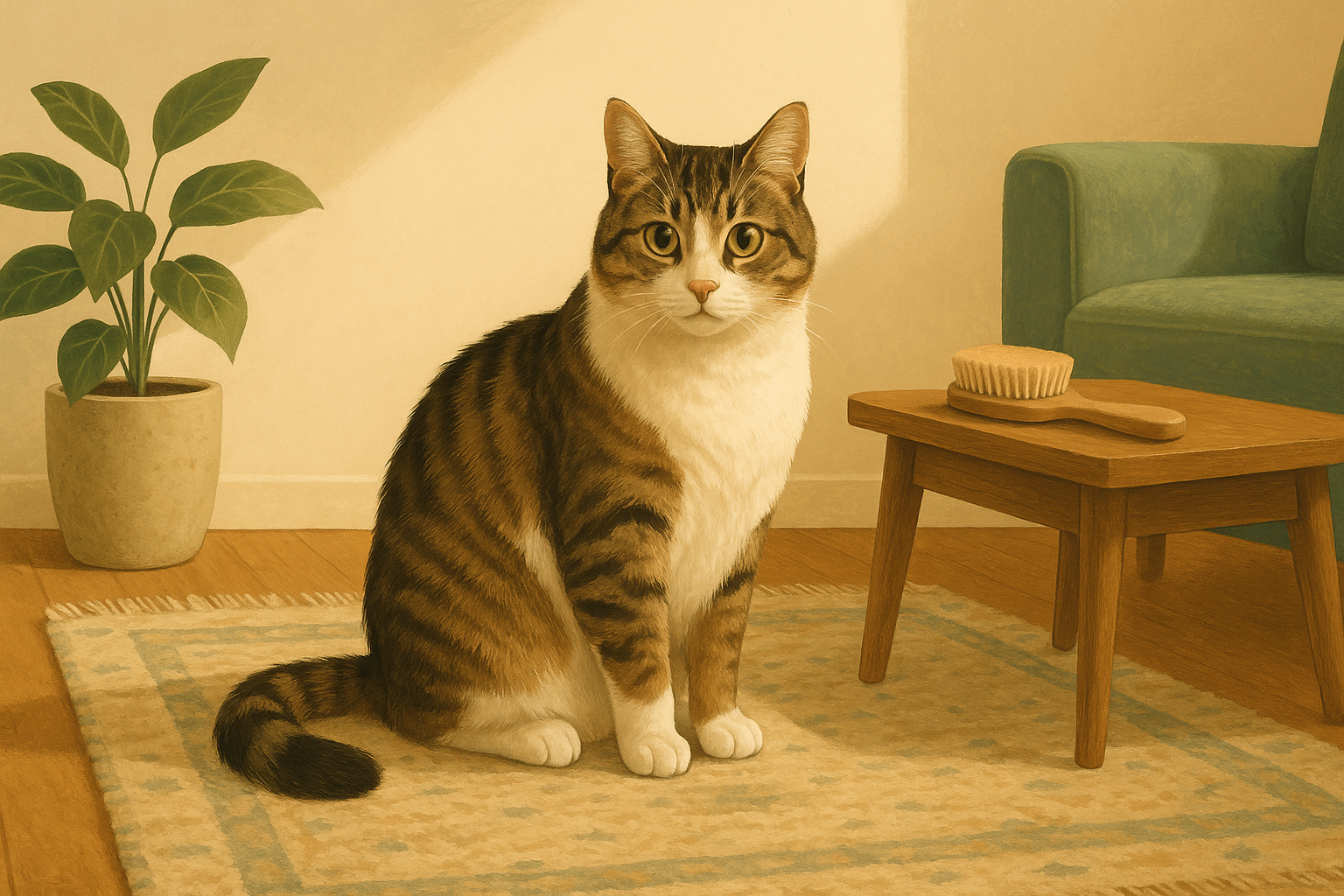
A healthy coat is shiny without being greasy, lies flat against the body and pulls away in your hand with a little resistance rather than coming out in clumps. The hair shafts look uniform when you part the coat. There shouldn’t be visible mats, scabs, flaky skin or bare patches. Cornell describes the range of problems on the other side: dry brittle hair, baldness, open wounds and skin that looks irritated, scabby or thickened.1 VCA Animal Hospitals frames it from the other direction in their healthy-coat reference: shine, smoothness and the absence of dandruff or greasiness are the visible markers of a healthy cat.4 In practice, the visible coat is one of the easiest things to read on a cat and a change in coat quality is often one of the first signs of a problem somewhere else.
Why indoor cats are different
Indoor life changes coat behavior in three ways. First, shedding patterns flatten. Outdoor cats shed in response to changing day length and temperature, with a heavy spring shed as the winter coat comes out and a lighter fall shed as it grows back. Indoor cats live in artificially stable temperature and lighting, so the seasonal cycle is muted or absent. They shed steadily all year. Second, indoor cats groom more, partly because they aren’t using that time hunting. More grooming means more swallowed hair and more hairballs, which sit on the boundary between coat care and digestion. Hairball vs vomit, side by side. Third, indoor air is drier than outdoor air, especially in winter when heating systems are running. Dry air pulls moisture out of skin, and dandruff is the visible result.
Diet does more for coat than any supplement
The single biggest lever for coat quality is what the cat eats. Cornell flags nutritional deficiencies and food hypersensitivity as direct causes of dry brittle hair and skin problems.1 A cat on a complete and balanced commercial diet (look for the AAFCO statement on the bag) usually has a coat that reflects the diet. A cat on cheap food, or on a home-cooked diet that isn’t formulated properly, often shows it in the coat first: dull, brittle, more shedding than expected, sometimes dandruff.
The piece of marketing to push back on is the supplement aisle. Omega-3 supplements (fish oil, salmon oil) get sold as a coat fix and there’s real evidence behind them for inflammatory skin conditions, but for an otherwise-healthy cat on a complete diet, the case is much weaker. The diet does the work; the supplement provides modest additional benefit at best. The full evidence on omega-3 for cats.
Grooming: how much, what tool, when
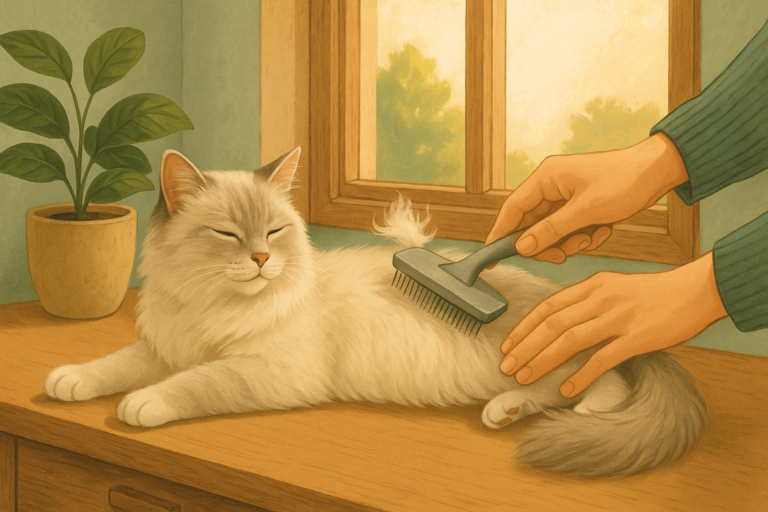
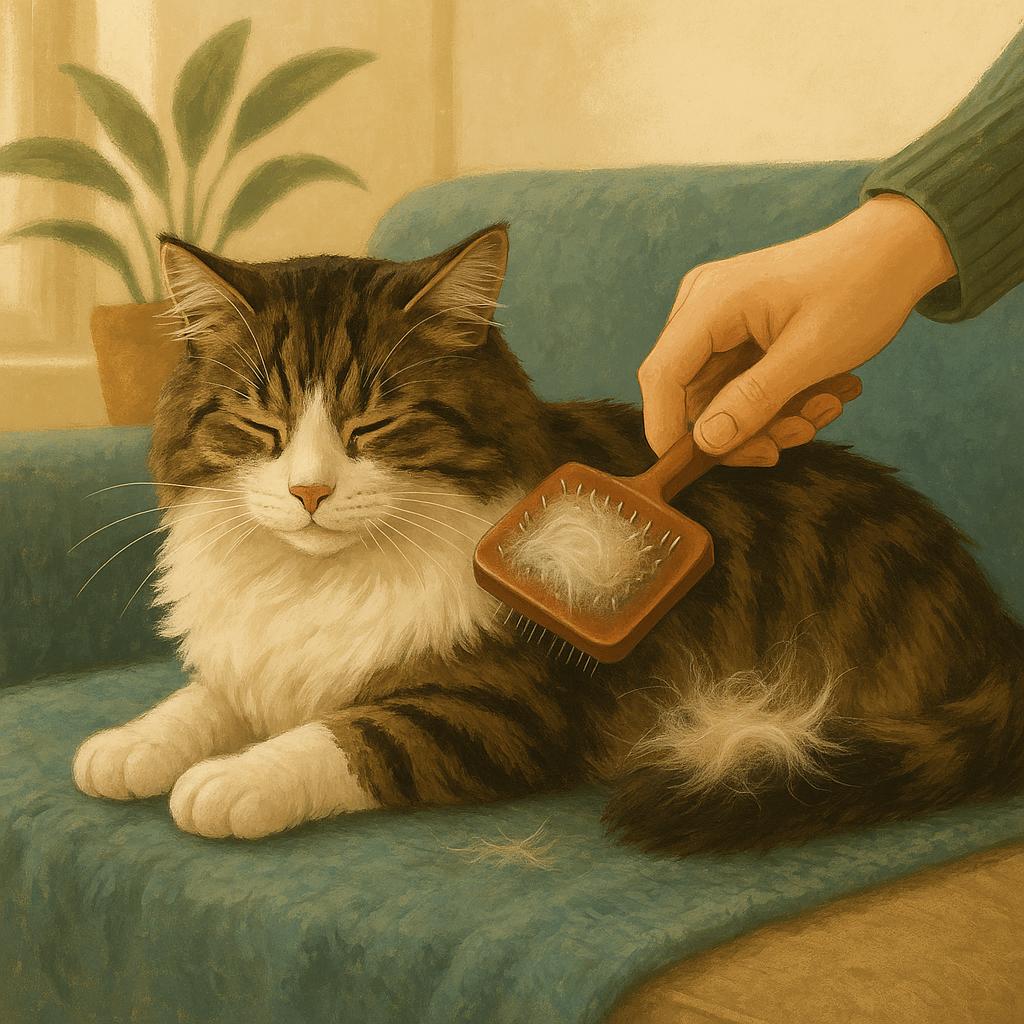
The right grooming frequency depends on coat length and the individual cat. Long-haired cats (Ragdolls, Maine Coons, Persians) need daily brushing. Daily isn’t an aesthetic preference. It’s the difference between a coat that flows and one that mats. Mats pull the skin painfully, can hide developing skin problems underneath and once they form they often need professional clipping rather than brushing out. Short-haired cats can usually get away with brushing once or twice a week, more during heavy-shed periods.
The brush matters less than the routine. A simple slicker brush works for most coats; long-haired cats often benefit from a metal comb to catch the tangles closer to the skin that a slicker misses. Skip the wire-bristle brushes that bite into the skin if pressed too hard; cats hate them and the brushing session ends in a fight. Brush a section at a time, with the grain of the coat and stop before the cat is annoyed. A two-minute session every day beats a fifteen-minute session once a week.
Senior cats are a special case. Older cats often groom less than they used to. Arthritis makes it hard to reach the back and the rump, and the coat there gets matted and greasy. If you have a senior cat with a deteriorating coat in those specific places, brush her there. It’s care she can’t do herself anymore.
Shedding: what’s normal, what’s not
Heavy shedding in an otherwise-healthy indoor cat is annoying but usually not a medical issue. The fixes are mechanical: brush more, vacuum more, accept the black sweater is going to lose. There is no supplement that materially reduces shedding in a healthy cat. The body sheds the hair it sheds. The full take on cat shedding.
Real flags are bald patches, especially symmetrical ones and shedding alongside other symptoms. Cornell lists nutritional deficiencies, parasites, fungal infections, viral and bacterial infections and environmental allergies as causes of coat problems severe enough to include actual hair loss rather than just shedding.1 If your cat has gone from “sheds a lot” to “has visible bare spots,” that’s a different problem entirely.
Dander and the allergic household
Cat dander (the small flakes of skin and saliva-coated hair that cats shed) is the actual cause of cat allergies in humans, not the hair itself. For households with mild-to-moderate allergies, three setup changes do most of the work: regular brushing (removes loose hair and dander before it ends up on furniture), HEPA air filtration in the bedrooms and washing soft furnishings (cat-favorite blankets, cat beds) on a weekly cycle. Bathing the cat doesn’t help nearly as much as people think; it’s also stressful for most cats and the effect is short-lived.
There’s no such thing as a hypoallergenic cat. Some breeds (Siberians, Balinese, certain Rex breeds) produce less of the specific protein that triggers most human reactions, but “less” is not zero and individual cat variation matters more than breed. For severe allergies, the practical conversation is with a doctor about immunotherapy, not with a breeder.
Dandruff, dry skin and winter air
Dandruff in indoor cats spikes in winter for a reason. Indoor heating dries the air, the skin underneath dries and the visible result is white flakes on a dark coat. The same effect happens to human skin. The fix is usually environmental rather than medical: a humidifier in the rooms the cat spends the most time in, more water through the diet (wet food does this passively) and consistent brushing to distribute the natural oils in the coat.
Year-round dandruff, or dandruff that comes with itching, scabs or repeated grooming of one spot, is different. Cornell flags flaky skin alongside open wounds as the territory of allergy, parasite or infection rather than just dry air.2 If the dandruff doesn’t seasonally improve, or if it’s accompanied by other skin or behavioral changes, that’s a vet visit. More on dandruff causes and what helps.
When to talk to your vet
Most coat problems can be addressed with diet, grooming and ambient air. These should not be:
- Bald patches, especially symmetrical ones or any patch where you can see skin
- Repeated grooming or scratching at one specific spot
- Red, weepy or thickened skin anywhere on the body
- Scabs, especially around the head and neck
- Any sudden change in shedding alongside weight loss, appetite changes or lethargy
- Dandruff with itching, year-round dandruff or dandruff with secondary skin signs
Allergies (food, environmental, flea), parasites and fungal infections like ringworm all show up first in the coat and skin. Cornell flags ringworm specifically as both common in cats and contagious to humans, which is another reason not to wait it out at home.3 Earlier diagnosis usually means a shorter course of treatment.
The bottom line
Indoor cat coat and skin problems are mostly setup problems with one big exception. Setup: feed a complete commercial diet, brush at the right frequency for the coat length, manage winter dryness, accept that indoor cats shed all year. The exception: any visible skin change, bald patch or persistent grooming pattern is medical territory, not a brushing problem and deserves a vet visit rather than another supplement.
Sources
More on coat & skin care
Buying guides:
- Best waterless cat shampoo: the two real no-rinse options
- Best soft nail caps for cats: the two real options
- Best Omega-3 Supplements for Cats: 3 Picks for Coat and Skin
- The Best Deshedding Brushes for Long-Haired Cats
Common questions:
- Why does my cat have red, irritated skin?
- Why does my cat smell bad if cats groom themselves?
- Should I shave my matted long-haired cat?
- What is stud tail in cats, and should I worry?
- Why does my cat have black spots on her chin?
- How to Groom a Ragdoll Cat: Coat, Mats and the Weekly Routine
- Why does my cat have a greasy, oily coat?
- How can I tell if the black specks in my cat’s fur are flea dirt?
- What does ringworm look like on a cat?
- Why is my cat scratching when she doesn’t have fleas?
- Furminator vs DakPets vs Hertzko deshedding: which tool fits your cat?
- Why does my cat have scabs on her neck and back?
- Why is my cat over-grooming one spot?
- Why does my cat have a bald spot?
- Why does my cat have flakes only on her lower back?
- Can I use human shampoo on my cat?
- What’s the difference between dandruff and dander?
- Can I cut a mat off my cat with scissors?
- How do I get a mat out of my cat’s fur?
- How do I get my cat to tolerate brushing?
- Do I need to bathe my cat?
- How often should I brush my cat?
- Is there a hypoallergenic cat breed?
- How do I get cat hair off furniture and clothes?
- Do some cat breeds shed less than others?
- Why is my cat shedding so much in winter?
- Hairball control food vs supplements: what works
- Does my indoor cat need flea prevention?
- Is coconut oil safe for cats’ skin?
- Are omega-3 supplements safe for cats?
- How do I reduce cat dander in my apartment?
- Why is my cat’s coat suddenly dull?
- Do air purifiers help with cat allergies?