Feliway Classic vs MultiCat vs Comfort Zone: which calming diffuser fits your cat
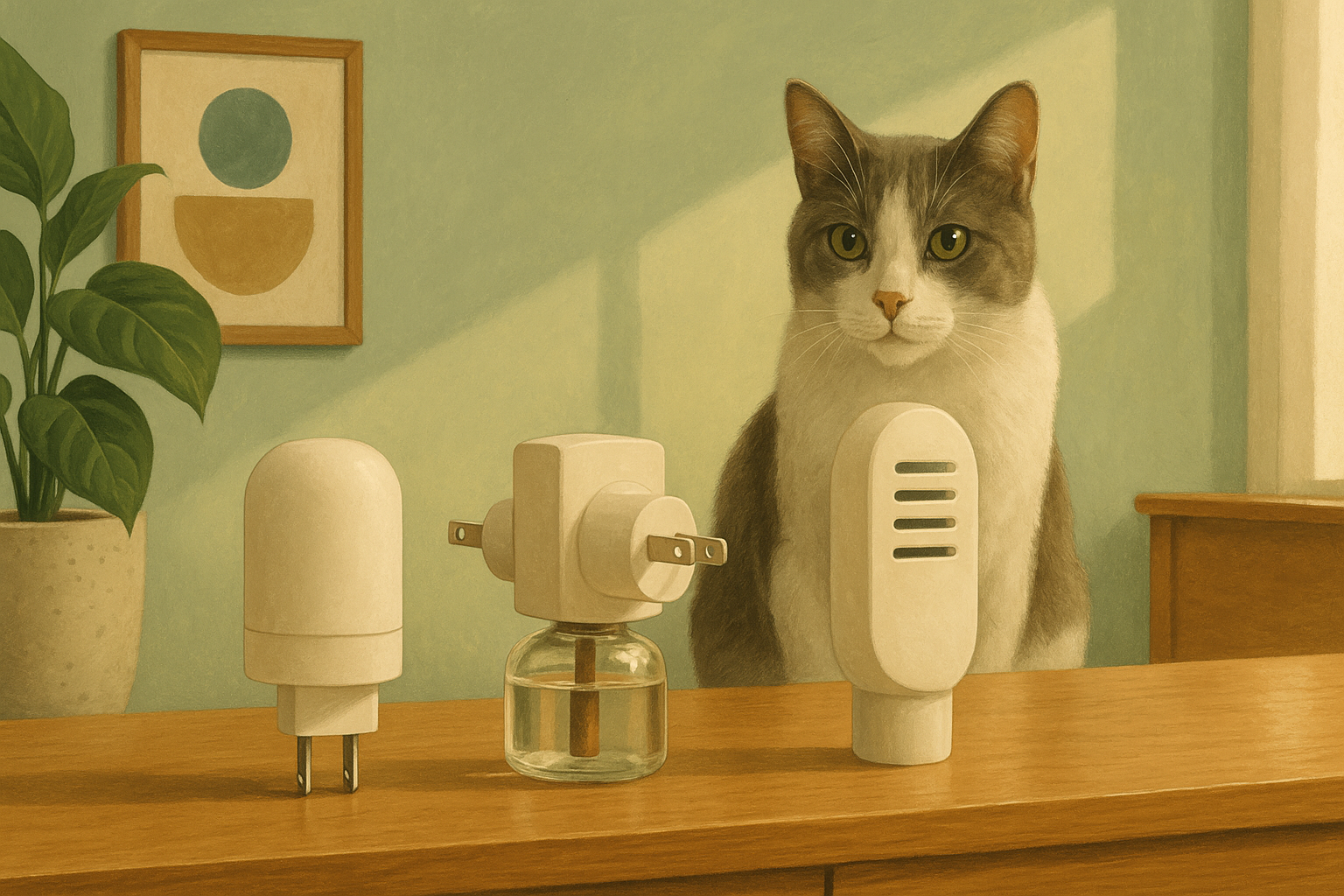
At the rescue, the diffuser questions always came in pairs. Someone would be standing at the adoption desk with a cat who’d started shredding the couch, or with two cats who used to nap together and now wouldn’t share a room, and they’d ask the same thing: which one of these plug-ins does something. Feliway Classic, Feliway MultiCat and Comfort Zone were the three names they’d usually been staring at on the shelf, and the boxes look almost identical. Feliway Classic wins when you have one stressed cat and want the widest room coverage. Comfort Zone wins when you want that same calming signal and don’t need to cover as much space. Feliway MultiCat wins only when the real problem is two cats who can’t get along.
As Amazon Associates we earn from qualifying purchases. Some links in this post are affiliate links; if you buy through them, we earn a small commission at no extra cost to you. We only recommend products we’ve used or researched thoroughly. See our full disclosure.
How the three compare at a glance
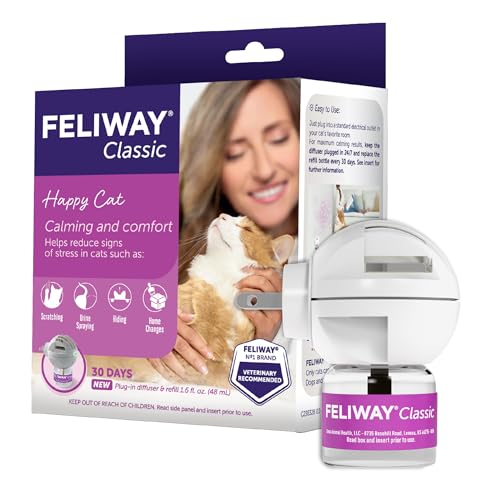
Facial-pheromone copy · solo-cat stress · widest room coverage
- ✓ Copies the cheek-rub pheromone that marks a place as safe
- ✓ Aimed at scratching, marking and post-move stress
- ✓ The most-studied of the three
- ✓ Covers up to about 700 sq ft per diffuser, 30-day refills
on Amazon
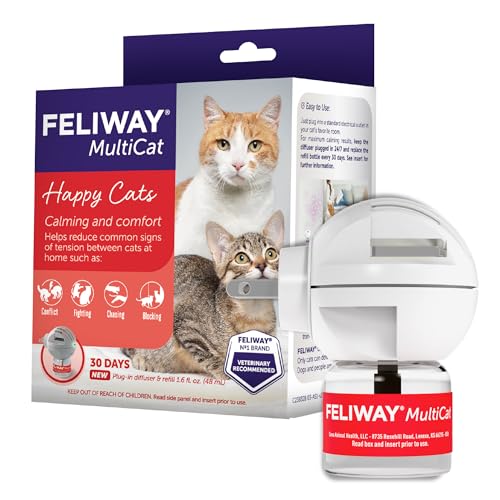
Appeasing-pheromone copy · inter-cat tension · multi-cat homes
on Amazon
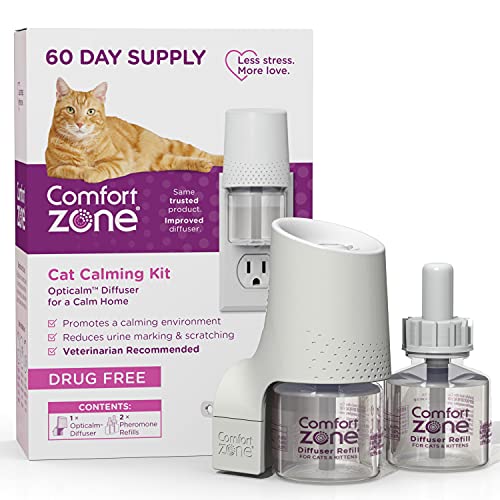
Facial-pheromone copy · same signal as Classic · widest retail availability
- ✓ Uses the same facial-pheromone approach as Feliway Classic
- ✓ Aimed at scratching, marking and general unease
- ✓ Priced within about a dollar of Classic at Chewy and Petco, so budget alone isn’t the deciding factor
- ✓ Smaller coverage, up to about 400 sq ft per diffuser
on Amazon
| Feliway Classic | Feliway MultiCat | Comfort Zone | |
|---|---|---|---|
| Pheromone signal | Facial (cheek-rub) copy | Appeasing (nursing) copy | Facial (cheek-rub) copy |
| Aimed at | Solo-cat scratching, marking, stress | Fighting, chasing, tension between cats | Solo-cat scratching, marking, stress |
| Coverage per diffuser | Up to about 700 sq ft | Up to about 700 sq ft | Up to about 400 sq ft |
| Price for a 30-day kit | About $25 at Chewy and Petco | About $25 per diffuser (two-diffuser kit runs about $50) | About $24 to $25 at Chewy, price swings more at mass retailers |
| Best fit | One anxious cat, a larger or open floor plan | Two or more cats in active conflict | One anxious cat, a smaller space or a same-day store run |
The short version
- Two of these three send the same signal. Feliway Classic and Comfort Zone both diffuse a synthetic copy of the facial pheromone a cat leaves when it rubs its cheek on your furniture. That scent says “this place is mine and it’s safe.”
- Feliway MultiCat is the odd one out. It copies the appeasing pheromone a nursing mother gives off, and it’s built for tension between cats, not solo-cat nerves. [2]
- The best evidence is modest and specific. A large triple-blind trial found the facial pheromone reduced unwanted scratching, though the placebo diffuser helped a lot too. [1]
- Price isn’t the differentiator the packaging implies. A 30-day Feliway Classic kit and a 30-day Comfort Zone kit run within about a dollar of each other at Chewy and Petco.
- Pick by the problem, not the brand. One anxious cat points you to Classic or Comfort Zone. Cats in conflict point you to MultiCat.
- A diffuser is the finishing touch, never the foundation. Scratching posts, vertical space and separated food, water and litter come first. [3]
In this guide
What’s inside each one · What the research supports, and what it doesn’t · Price: not the differentiator you’d expect · Coverage, placement and the apartment angle · Which one fits your cat · How I compared them · Common questions · When to talk to your vet
What’s inside each one
The single fact that clears up most of the confusion: there are two different pheromones across these three boxes, not three. Cats produce a range of chemical signals, and two of them matter here. The first is the facial pheromone a cat deposits when it cheek-rubs a doorframe, a chair leg or your ankle. To a cat, a surface carrying that scent reads as familiar and secure. Feliway Classic and Comfort Zone are both built around a synthetic version of that signal, which is why they target the same situations: a cat scratching to mark territory, urine-marking or a household thrown off by a move, a new sofa or a renovation.
Feliway MultiCat works on a different signal entirely. It mimics the appeasing pheromone a queen produces while she’s nursing, the scent that tells a litter of kittens they’re safe together. Copied into a diffuser, the goal is to take the edge off friction between adult cats who share a home. So MultiCat is not a stronger Classic. It’s a separate tool for a separate job. Reach for it when the trouble is one cat versus another, the staring, the blocking of hallways, the swats by the litter box, rather than a single cat who seems on edge.
What the research supports, and what it doesn’t
Here’s where honesty matters more than marketing. The strongest study on the facial pheromone was a 2023 trial that randomized 1060 cat-and-owner pairs over 28 days, triple-blind, against a placebo diffuser. Unwanted scratching dropped in about 84 percent of the pheromone homes, versus roughly 69 percent in the placebo homes. [1] That gap is real and statistically significant, so the product does something. The placebo number is the part worth sitting with: most of the improvement people see comes from watching their cat more closely and tweaking the room around it, not from the plug-in alone. The pheromone added something like a 15 percentage-point edge on top of that.
For the appeasing pheromone behind MultiCat, the evidence is thinner but points the same direction. A 2019 pilot study randomized 45 multi-cat households between the appeasing pheromone and a placebo and found modest reductions in aggression between cats in the treated group. [2] Smaller sample, smaller effect, still a measurable signal. The pattern across both formulas is the same: a genuine, moderate benefit for specific behaviors, well short of the calm-cure the packaging hints at. I’ve watched plenty of cats settle after a diffuser went in, and I’ve watched plenty where it changed nothing, and the difference almost always came down to whether the rest of the environment was right first.
Price: not the differentiator you’d expect
The old assumption on this page used to be that Comfort Zone was the budget pick and Feliway Classic the premium one. Checking current listings at Chewy and Petco doesn’t support that. A 30-day Comfort Zone starter kit runs about $24 at Chewy, and a 30-day Feliway Classic kit runs about $25 at both Chewy and Petco. That’s not a meaningful gap. Where the two do split is at mass-market retailers: Comfort Zone is the one you’re likelier to find on a Walmart or grocery-store pet aisle shelf the same day, sometimes at a genuinely lower price than a Feliway listing at the same store, while Feliway skews toward pet-specialty and vet-clinic shelves. Feliway MultiCat runs about the same per-diffuser price as Classic, and a household needing two diffusers for a larger space will pay roughly double, which reflects the extra hardware, not a markup.
Coverage, placement and the apartment angle
For an indoor cat, where you plug the thing in matters as much as which one you buy. A diffuser warms a pheromone-soaked pad and lets the scent drift on the room’s air, so it can only treat the space it can reach. Feliway lists each Classic or MultiCat diffuser as covering up to roughly 700 square feet. Comfort Zone lists its diffuser at up to about 400. Both run on 30-day refills. In a studio or a one-bedroom apartment, a single Feliway unit can blanket most of the living space, while the smaller Comfort Zone coverage is something to plan around if your layout is open. In a larger or chopped-up floor plan, one diffuser won’t reach every room, which is a common reason people decide it “didn’t work.”
Plug it into an open wall low to the floor, in the room where your cat spends the most time, not behind a couch or under a shelf where the scent gets trapped. For a multi-cat home, put MultiCat where the friction happens: the room the cats compete over, or near the litter and feeding stations where standoffs tend to start. And give it time. The trials ran four weeks for a reason. A diffuser you judge after three days hasn’t had a fair trial.
Which one fits your cat
Sort it by the problem on the floor of your home. If you have one cat and the issue is scratching the furniture, marking or a stretch of stress after a change, start with the facial-pheromone signal. Feliway Classic is the version with the most research behind it and the widest coverage, so it’s the safe default for a larger or open home. Comfort Zone gives you the same approach at close to the same price, and it’s the one to grab if your space is small enough that 400 square feet covers it or you need something today rather than in two days by mail.
If the problem is two or more cats who can’t keep the peace, the facial-pheromone diffusers are the wrong tool and Feliway MultiCat is the right one. Match the formula to the friction. One caveat worth putting in bold: none of the three fixes a setup problem. The 2013 AAFP and ISFM environmental needs guidelines are blunt that cats in a shared home need their own separated resources, enough vertical space and predictable routines, and that resource competition is a root cause of inter-cat tension. [3] Sort the litter boxes, the feeding spots and the perches first. Then a diffuser has something to build on. Backwards, it’s a plug-in fighting a losing battle.
How I compared them
This is a researched comparison, not a side-by-side trial with three diffusers running in three rooms, so I won’t claim I ran one. What I did do is read both underlying studies past the abstract, pull Feliway‘s and Comfort Zone‘s own published coverage numbers and check current prices for the 30-day starter kits across two retailers, Chewy and Petco, rather than trusting a single listing. That check overturned an assumption I walked in with: Comfort Zone isn’t the clear budget pick once you’re comparing like-for-like kits at the same retailers. A 30-day Comfort Zone kit and a 30-day Feliway Classic kit landed within about a dollar of each other at both stores. Comfort Zone‘s real advantage is availability, not price: it turns up on a Walmart shelf and other mass-market stores where Feliway is harder to find same-day, and it’s built on the same well-studied facial pheromone as Classic. What it gives up is coverage, about 400 square feet per diffuser against Classic‘s 700, so a bigger apartment needs more Comfort Zone units to do the same job. Feliway MultiCat isn’t competing with either one on the metrics above, since a household with active conflict between cats needs the appeasing pheromone, not the facial one, and that would be true even if MultiCat cost more than it does.
Common questions
Can I run two different diffusers in the same home?
Yes. If one cat is anxious and two others are fighting, a facial-pheromone diffuser like Feliway Classic or Comfort Zone in the anxious cat’s main room and Feliway MultiCat near the friction zone can run at the same time. They don’t cancel each other out.
Do I need one diffuser per room?
For any space bigger than one diffuser’s coverage, yes. The pheromone doesn’t travel well through closed doors or down a hallway, so a separate wing of the house or an upstairs bedroom generally needs its own unit.
How long before I’d know if it’s working?
Give it the full four weeks the trials ran. Both studies measured change over 21 to 28 days, so a diffuser judged after three days hasn’t had a fair test. [1][2]
Is a calming diffuser safe to run all the time, around other pets?
These are synthetic copies of pheromones a cat already produces, not a medication, so there’s no dosing to get wrong and no reason to switch it off on a schedule. If you have dogs or other pets in the house, there’s no evidence they’re bothered by a cat-pheromone diffuser either way.
When to talk to your vet
A pheromone diffuser is for a healthy cat working through a behavior wrinkle, not a substitute for a workup. If your cat suddenly stops using the litter box, starts hiding, turns aggressive out of nowhere or changes habits sharply, book a vet visit before you reach for a plug-in. A lot of “behavior” problems start as pain, a urinary issue or thyroid trouble, and a diffuser will only delay the fix. [3] Same goes for a senior cat with new restlessness or confusion, which can signal cognitive decline worth examining. And if you’ve run a diffuser correctly for four to six weeks alongside the right environmental setup and nothing has shifted, that’s your cue to loop in your vet or a behavior professional rather than buy a third box.
The bottom line
- Choose Feliway Classic if you have one stressed cat, want the most-studied option and need to cover a larger or open floor plan.
- Choose Comfort Zone if you want that same facial-pheromone signal in a smaller space, or you’d rather pick one up at a store today than order and wait.
- Choose Feliway MultiCat if the real problem is cats in conflict with each other, not one cat’s nerves.
All three do a modest, real job for the specific behaviors they’re built for, and none of them does the job the box implies. Get the scratching posts, the vertical space and the separated resources right first. The diffuser is the finishing touch on a good foundation, not a rescue for a broken one.
Sources
- Pereira, J.S., et al. (2023). “Efficacy of the Feliway Classic Diffuser in reducing undesirable scratching in cats: A randomised, triple-blind, placebo-controlled study.” PLOS One
- DePorter, T.L., et al. (2019). “Evaluation of the efficacy of an appeasing pheromone diffuser product vs placebo for management of feline aggression in multi-cat households: a pilot study.” Journal of Feline Medicine and Surgery
- Ellis, S.L.H., et al. (2013). “AAFP and ISFM Feline Environmental Needs Guidelines.” Journal of Feline Medicine and Surgery