Soft Paws vs Nail Trimming for Cats: Which Fits Your Cat?
The nail question came up at the clinic desk almost weekly, usually phrased as a plea: the couch is shredded, the cat hates the clippers, so can’t I just glue something on? You can, and it works for some households. It also swaps one chore for another. Soft nail caps win when your cat tolerates paw handling but trimming goes badly or leaves furniture damage behind. Regular trimming wins when you want the cheapest, simplest routine and your cat sits through it.
As Amazon Associates we earn from qualifying purchases. Some links in this post are affiliate links; if you buy through them, we earn a small commission at no extra cost to you. We only recommend products we’ve used or researched thoroughly. See our full disclosure.
How they compare at a glance
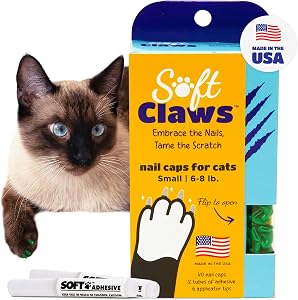
Vinyl caps · glued over trimmed claws · kitten through extra-large sizes
- ✓ Blunt tips so scratching leaves furniture alone
- ✓ Kit includes adhesive and applicator tips
- ✓ Needs replacing on a schedule as the claws grow
on Amazon
Price as of Oct 14, 2026, 2:16 PM EDT. Product prices and availability are accurate as of the date/time indicated and are subject to change.

Vinyl caps · many colors and finishes · kitten through large sizes
- ✓ Same cap-and-adhesive idea in a wider color range
- ✓ Complete kit with caps, glue and applicator tips
- ✓ Sized by approximate cat weight
on Amazon
Price as of Oct 26, 2026, 9:21 AM EDT. Product prices and availability are accurate as of the date/time indicated and are subject to change.

Pet Republique Cat Nail Clippers
Scissor-style · stainless-steel blades · sized for cats and other small pets
- ✓ Small scissor shape that gives a clear view of the nail
- ✓ Budget-friendly, no refills or glue
- ✓ Works on any cat who will hold still for a few seconds
on Amazon
Price as of Oct 26, 2026, 9:21 AM EDT. Product prices and availability are accurate as of the date/time indicated and are subject to change.
| Soft Claws nail caps | Pet Republique clippers | |
|---|---|---|
| Approach | Glue-on vinyl sheaths over trimmed claws | Cut the nail tip back on a schedule |
| Upkeep | Replace every 4 to 12 weeks depending on the source, plus regular checks | Every 1 to 4 weeks depending on the source |
| Cat must tolerate | Having paws handled and manipulated | Paw handling plus a few seconds of holding still |
| Protects furniture | Yes, while the caps stay on | Partly, by removing the sharp hook |
| Best fit | Cats who scratch hard and tolerate paw handling | Calm cats and owners who want the simplest routine |
The short version
- The AVMA lists trimming and nail caps together as parts of one toolkit for redirecting scratching, next to proper scratching posts and positive reinforcement.1
- Caps are for cats who let you handle and manipulate their paws. Cornell says so directly.2
- The sources disagree on schedule. VCA says trim indoor cats every 2 to 4 weeks while the AVMA says every 1 to 2. Caps run 4 to 6 weeks (AVMA) or 6 to 12 (Cornell).123 Pick the shorter interval until you know how fast your cat’s nails grow.
- Either method goes better when treats come with it, and VCA lays out a gradual one-nail-at-a-time plan.3
- Punishing a cat for scratching doesn’t work, so neither method replaces giving her a post she likes.12
In this comparison
What trimming does
Trimming removes the hooked tip of the nail and nothing else, which is why it’s the baseline every other option sits on. VCA’s instructions are specific. Press the middle pad so the claw extends, then cut short of the pink quick on a pale nail or where a dark nail begins to curve downward. Several small cuts beat one big one. If you do clip the quick, styptic powder (or flour or cornstarch in a pinch) stops the bleeding.3 VCA names two clipper styles, guillotine and scissors, and notes that many owners prefer a small scissor-style clipper made for cats. That’s the shape of the Pet Republique clippers above.
The catch is frequency. VCA points out that indoor cats don’t need long nails, and that neglected nails can curl into the paw pad and cause infection, a risk that rises for older or less active cats.3 Trimming also doesn’t stop scratching. It only blunts the claw, so a cat who loves the sofa arm will still go for it.
What caps do
Caps are small plastic sheaths glued over the claws. The cat can still extend the claw and go through every scratching motion, but nothing sharp reaches the furniture.2 The kits I’ve read through, including Soft Claws (the line many people call Soft Paws) and Purrdy Paws, come with caps, adhesive and applicator tips, and both have you trim the nails before gluing. That means caps don’t remove the trimming step. They add a second job on top of it.
Cornell says caps should only go on cats who allow you to handle and manipulate their paws.2 A cat who fights the clippers will usually fight the glue and the fitting too, so caps are a poor rescue for a cat who won’t tolerate paw work. Cornell also puts replacement at every 6 to 12 weeks, while the AVMA says 4 to 6.12 Since a cap hides the nail’s growth, I’d use the shorter number.
Which one fits your cat
Start with the cat in front of you. A relaxed cat who lets you hold a paw can do either, and trimming is the cheaper, lower-maintenance default. A cat who tolerates handling but whose scratching still wrecks a sofa between trims is where caps earn their place. A cat who panics at paw contact needs the gradual plan first, because neither method works on a cat who won’t hold still. VCA’s version starts with handling the feet alongside praise and treats. Then you clip one nail and reward, move to two nails, then three, then a full paw, over several weeks. If resistance stays strong, stop and call your vet.3
Whichever you pick, the post matters. Cornell advises matching the scratching post to your cat’s preferred material and orientation, and making it tall and sturdy enough for a full stretch.2 If you’re building out that side, our guide to the two soft nail caps worth trying goes deeper on application.

How I compared them
I haven’t run these side by side on my own cats, so I won’t claim I did. Instead I read the AVMA, Cornell and VCA pages on nail care and scratching. I lined up their schedules and caveats, then compared the three product listings on what they include and how they’re sized. The clippers have a clear edge on cost and simplicity: no glue, no refills and no replacement schedule beyond the next trim. Caps have the edge on furniture protection while they’re on. For a cat who won’t be handled, the two methods tie, since neither works until she tolerates paw contact.
Common questions
Can I use caps instead of trimming? The kits I looked at have you trim first, and the nail keeps growing under the cap, so regular checks and replacements stay on your list.
What if I cut the quick? VCA says to apply styptic powder, or flour or cornstarch if you don’t have it, to stop the bleeding.3
Should I scold my cat for scratching the couch? No. The AVMA says punishment isn’t an effective deterrent, and Cornell adds that cats connect it with you instead of the behavior, which can build fear.12
When to talk to your vet
Call your vet about a nail that has curled into the pad or a toe that looks swollen or oozes after a trim or a cap. The same goes for a cat who resists paw handling so strongly that you can’t make progress. VCA says a vet may suggest calming medication in that case.3
The bottom line
- Choose regular trimming with a scissor-style clipper if your cat tolerates paw handling and you want the cheapest, simplest routine to repeat every few weeks.
- Choose Soft Claws or Purrdy Paws caps if your cat accepts paw handling but still damages furniture between trims, and you’re willing to replace caps on schedule.
- Start with the gradual treat plan before buying anything if your cat won’t let you touch her feet, because both methods depend on that tolerance.
Sources