Stella & Chewy’s Magical Dinner Dust Review: Does a Freeze-Dried Topper Fix a Picky Eater?
You serve a perfectly good meal, your cat sniffs it, looks at you like you have insulted her and walks off. Before you go down the road of buying yet another food she might also reject, there is a smaller move worth trying first: change the smell of the bowl she already has. That is the whole idea behind a freeze-dried topper, and Stella & Chewy’s Magical Dinner Dust is the one I point owners toward most often. It is a fine raw powder you sprinkle over whatever she is refusing, so the food underneath stays the same while the aroma she meets first does not. Here is what it is, when it earns its keep and where it falls short.
As Amazon Associates we earn from qualifying purchases. Some links in this post are affiliate links; if you buy through them, we earn a small commission at no extra cost to you. We only recommend products we’ve used or researched thoroughly. See our full disclosure.
The short version
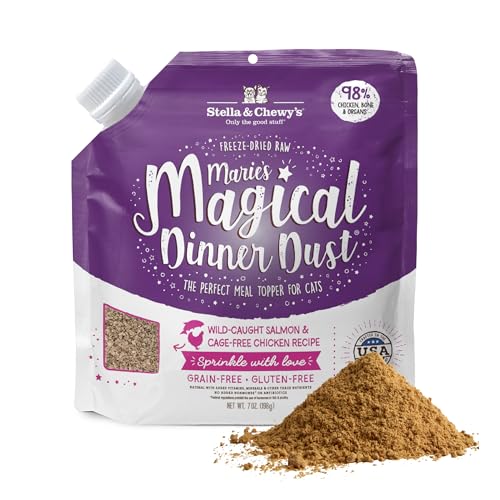
Stella & Chewy’s Magical Dinner Dust
Freeze-dried raw · salmon & chicken · sprinkle topper
- ✓ Strong meaty aroma to relight a snubbed bowl
- ✓ 98% animal protein, organs and bone, with added taurine
- ✓ Fine powder mixes into wet, dry or a prescription diet
- ✓ Premium tier, and a topper rather than a full meal
on Amazon
Price as of Oct 26, 2026, 9:21 AM EDT. Product prices and availability are accurate as of the date/time indicated and are subject to change.
Quick take:
- It is a freeze-dried raw powder you sprinkle on top of food, not a meal on its own. The label calls it intermittent or supplemental feeding only.1
- Aroma is most of what makes a bowl appealing to a cat, and a strong-smelling topper gives a fresh scent hit without changing the food underneath.2
- It shines on a cat who has cooled on a food she used to eat, or one easing back into eating after a stuffy-nosed illness.
- Keep it in proportion. Toppers and treats should stay within about 10% of daily calories so the complete diet still does its job.3
- It is freeze-dried raw, so handle it like raw food and skip it for an immune-compromised cat or household.4
What Magical Dinner Dust actually is
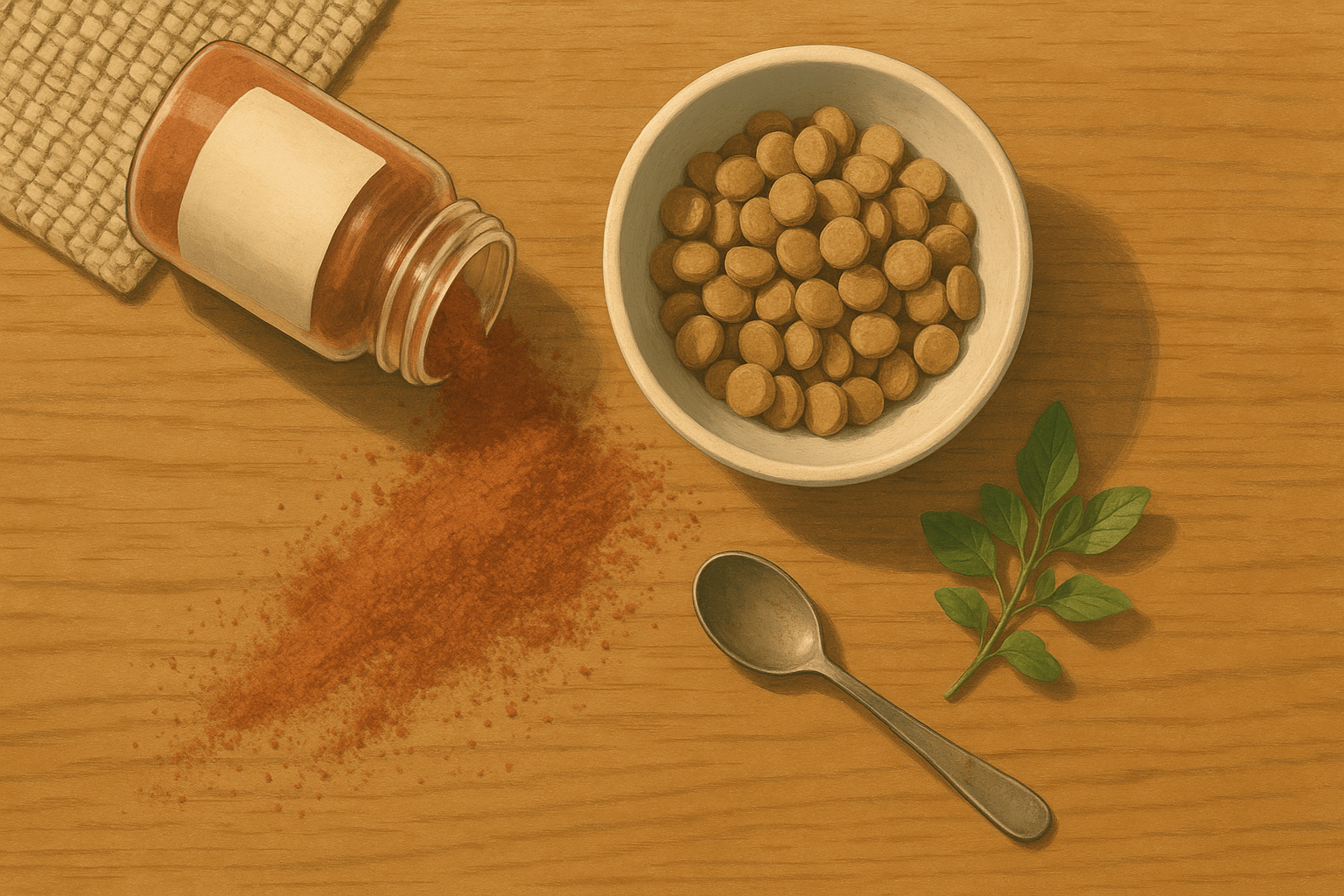
Strip away the name and it is a jar of freeze-dried raw meat ground into a coarse powder. The salmon and chicken recipe is built from roughly 98% animal ingredients: salmon and chicken with ground bone, chicken liver and chicken gizzard, plus pumpkin seed for fiber, added taurine and a set of probiotics.1 Freeze-drying pulls the moisture out without cooking the protein, which is why the powder is shelf-stable and why it keeps the concentrated smell of raw meat. For a cat, that smell is the point.
One detail matters more than any marketing line on the jar, and the manufacturer states it plainly: this is intended for intermittent or supplemental feeding only.1 In plain terms, it is a topper, not a complete and balanced diet. It is there to make the real food more tempting, not to replace it. Hold onto that. It shapes everything about how you should use the product.
Why a topper like this works on a fussy cat
Cats decide whether to eat largely with their nose. I spent several years at the intake desk of a small-animal clinic, and the clearest version of this came in every cold-and-flu season: a congested cat who could not smell her dinner would sit in front of a full bowl and starve herself, then dig in the moment we warmed something pungent under her chin. Appetite follows aroma. A topper works by putting a strong, fresh scent right where she meets the bowl first.
Warmth does the same job from another angle. A Waltham study found cats ate the most when wet food was warmed to about body temperature, because warming releases the meaty volatile compounds they hunt by.2 A freeze-dried meat dust layered on top adds that scent directly. There is a nutrition angle too. Cats are obligate carnivores, wired to want and need animal protein, so a concentrated hit of meat, organ and bone reads to them as exactly the right kind of food.5 The strong smell and the animal-first content are pulling in the same direction.
How to use it
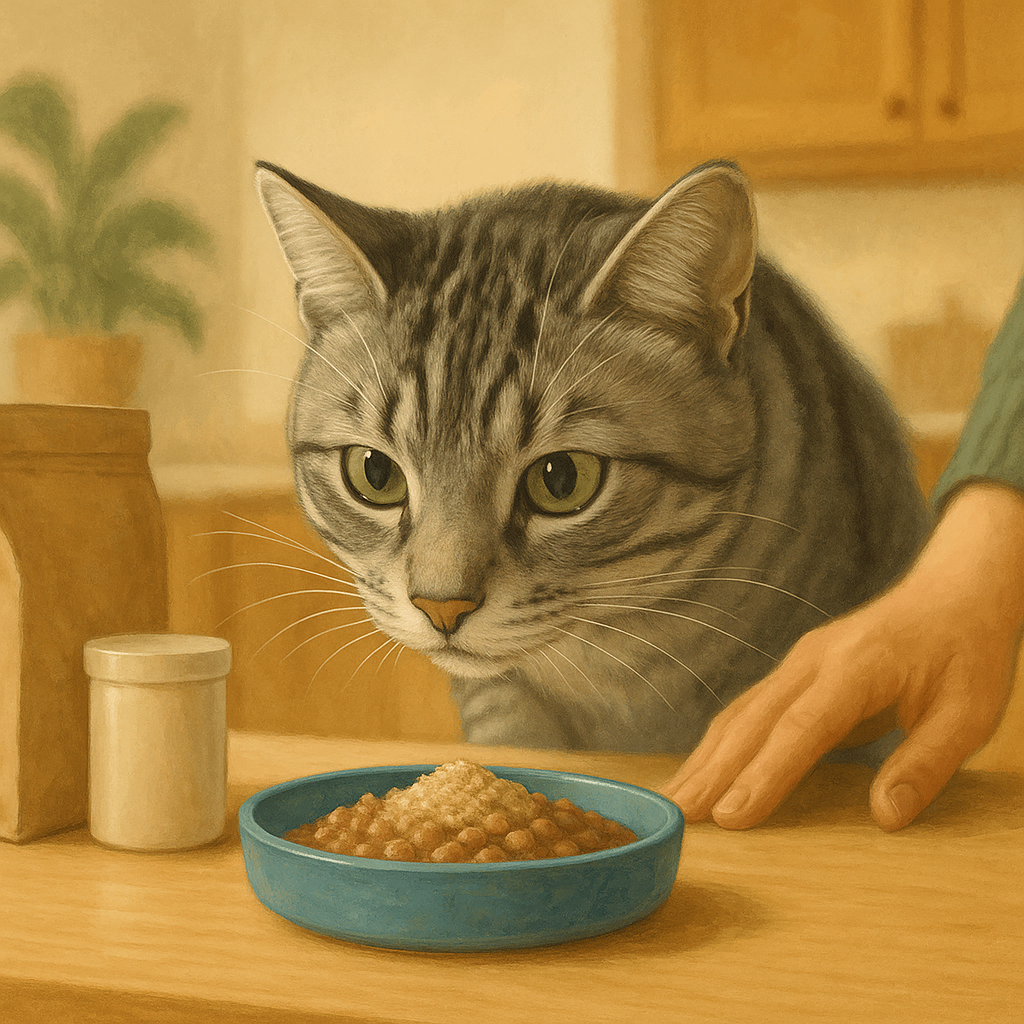
The feeding guideline is half a tablespoon sprinkled over every quarter cup of her usual food.1 A few habits make it work better than a careless shake.
- Start small and dry. A light dusting over the top of the meal she is refusing is usually enough to change the first thing she smells. You do not need to bury the food.
- Try it moistened for an extra aroma push. Stirring a little warm water into the powder rehydrates it into a fragrant paste, which spreads the scent further for a cat who needs more convincing.
- Ease it in over a week. Any new food can unsettle a stomach, so introduce it gradually rather than dumping a full serving on day one.
- Mix it into the food you want her on. The fine powder folds into wet food, dry kibble or a prescription diet, so you can use it to carry her toward the meal she should be eating rather than away from it.
The honest limits
A topper is a lever, not a cure, and treating it like a meal causes problems. Because it is supplemental rather than complete, it should stay a small share of what she eats. A good rule of thumb from veterinary nutrition is that treats and extras like this stay within about 10% of daily calories, since they are not balanced foods and crowding out the complete diet can tip a cat toward nutritional gaps or extra weight.3 The dust is potent and a little goes a long way, which helps, but it is easy to get heavy-handed with something your cat clearly loves.
There is a raw-food caveat as well. This is freeze-dried raw, not cooked, and freeze-drying reduces but does not reliably eliminate bacteria like salmonella. The FDA recommends handling raw pet food carefully and notes the risk it can pose, especially in homes with very young, elderly or immune-compromised people or pets.4 Wash your hands and the scoop, and if anyone in your household is immune-compromised, a cooked topper is the safer pick. On cost, it sits in the premium tier, so I treat it as a targeted tool for a genuine eating problem rather than an everyday sprinkle.
Who it’s best for
This is a strong pick for a cat who has gone off a food she used to like, where the food is fine and the novelty has worn thin. It is also one of the gentler tools for a cat easing back into eating after illness, when a stuffed-up nose has flattened her appetite and a stronger smell helps her find the bowl again. We walk through that recovery situation in our guide to a cat who won’t eat after illness, and we compare the dust against other toppers in our freeze-dried toppers guide. If you would rather rotate a crunchy single-ingredient topper, our roundup of single-ingredient cat treats covers options that crumble well over a meal.
It is less useful for a cat who needs strict calorie control, since any extra topping works against a weight plan, and it does nothing for a cat whose problem is the bowl or the location rather than the food. A topper makes good food smell better. It cannot fix a feeding setup that stresses her out.
When a topper isn’t the answer
A sprinkle is the right move when a cat is picky but otherwise well, eating something most days and acting like herself. It is the wrong move when she has stopped eating across the board. A cat who refuses everything, hides, drools or is losing weight is not bored, she may be unwell, and that is worth reading carefully in our guide to a cat who suddenly won’t eat.
The safety line is firm. Cats must not go without food for long. Cornell’s Feline Health Center notes that going without eating puts a cat at risk of hepatic lipidosis, a dangerous fatty-liver condition that can become life-threatening.6 If your cat is eating almost nothing for 24 to 48 hours, that is a vet call, not a topper problem. Put down whatever she will reliably eat and phone your vet.
Not sure what kind of picky eater she is?
A topper helps some fussy cats a lot and barely moves others, because picky eating comes in different flavors. A cat who burns through favorites needs a different plan from one who quits mid-meal, stays loyal to kibble or gets anxious at the dish. Our picky-eater quiz sorts your cat into a profile in a couple of minutes and points you to the approach and the products most likely to suit her, so you are not buying things on guesswork.
Sources
- Stella & Chewy’s, “Marie’s Magical Dinner Dust Salmon & Chicken” (product ingredients, guaranteed analysis and feeding guidelines)
- Waltham Petcare Science Institute, “Could science hold the answer to senior cats’ picky palate?”
- VCA Animal Hospitals, “True or False? Treats should make up to 10% of your pet’s calories”
- U.S. Food & Drug Administration, “Get the Facts! Raw Pet Food Diets Can Be Dangerous to You and Your Pet”
- Cornell Feline Health Center, “Feeding Your Cat”
- Cornell Feline Health Center, “Hepatic Lipidosis”
TheCatWellness is reader-supported and we are not veterinarians. This article is general information, not medical advice for your individual cat. If your cat stops eating, loses weight or seems unwell, talk to your vet.
More cat food guides
- The Best Kitten Foods: 3 Picks That Meet the Growth Standard
- Best dry foods for senior cats: the two real options
- The Best High-Protein Dry Cat Foods for Indoor Cats
- Best indoor cat food: 5 formulas that account for a life spent mostly on the couch
- Royal Canin vs Hill’s Science Diet: which one fits your indoor cat?
- Instinct Raw Boost vs Blue Buffalo Wilderness: which grain-free kibble for your indoor cat?
- Stella & Chewy’s vs Primal freeze-dried: which raw food fits your indoor cat?
- The Quest cat food recall: what happened, and what I’d feed instead