Cat buries food and walks away? What food caching really means
You put the food down, your cat takes a sniff, and instead of eating she starts pawing at the floor around the bowl as if she is trying to bury it, then turns and walks off. It looks like a tiny insult, and it leaves a lot of owners wondering whether something is wrong with the food, the cat, or both. The good news is this behavior almost always has a clear explanation. Here is what your cat is actually telling you when she buries her food and walks away, and when it is worth paying closer attention.
Quick take:
- The pawing-and-covering motion is “food caching,” an inherited instinct to hide leftovers so the scent does not attract competitors or predators. It is normal cat behavior, not a flaw.
- When a cat caches food she did eat from, she is usually saving it for later. That is harmless.
- When she caches food she barely touched and walks away, she is often telling you she finds it unsatisfactory, too strong-smelling, wrong texture, or simply not appealing right now.
- Strong-smelling wet food triggers the instinct more than dry food, because there is more scent to “hide.”
- If the burying is brand-new, paired with weight loss, drooling or other changes, rule out dental pain or nausea with your vet before assuming it is just preference.
What the burying behavior actually is
The technical name is food caching, and it is one of the oldest habits in the feline playbook. In the wild, a cat that makes a kill rarely eats all of it at once. To protect the leftovers, she covers them with dirt, leaves or whatever is handy, masking the scent so rival cats and scavengers do not find the stash.1 The same instinct shows up in big cats; leopards famously drag and hide their kills for exactly this reason.
Your indoor cat has no predators to hide from and no leftovers that will spoil in an hour, but the wiring is still there. When she scratches at the floor, the rug or the wall beside her bowl, she is running an ancient program: cover the food, hide the smell, come back later. She is not confused and she is not trying to insult your cooking. She is being a cat.
The two very different messages behind it
Here is where it pays to watch closely, because the same motion can mean two opposite things depending on what happened just before it.
She ate, then buried the rest. If your cat had a good meal and only starts caching once she is full, this is the harmless version. She is saving the remainder for later, exactly as her instincts tell her to. There is nothing to fix. You can cover or refrigerate the leftover food and serve fresh next time so it does not sit out and go stale.
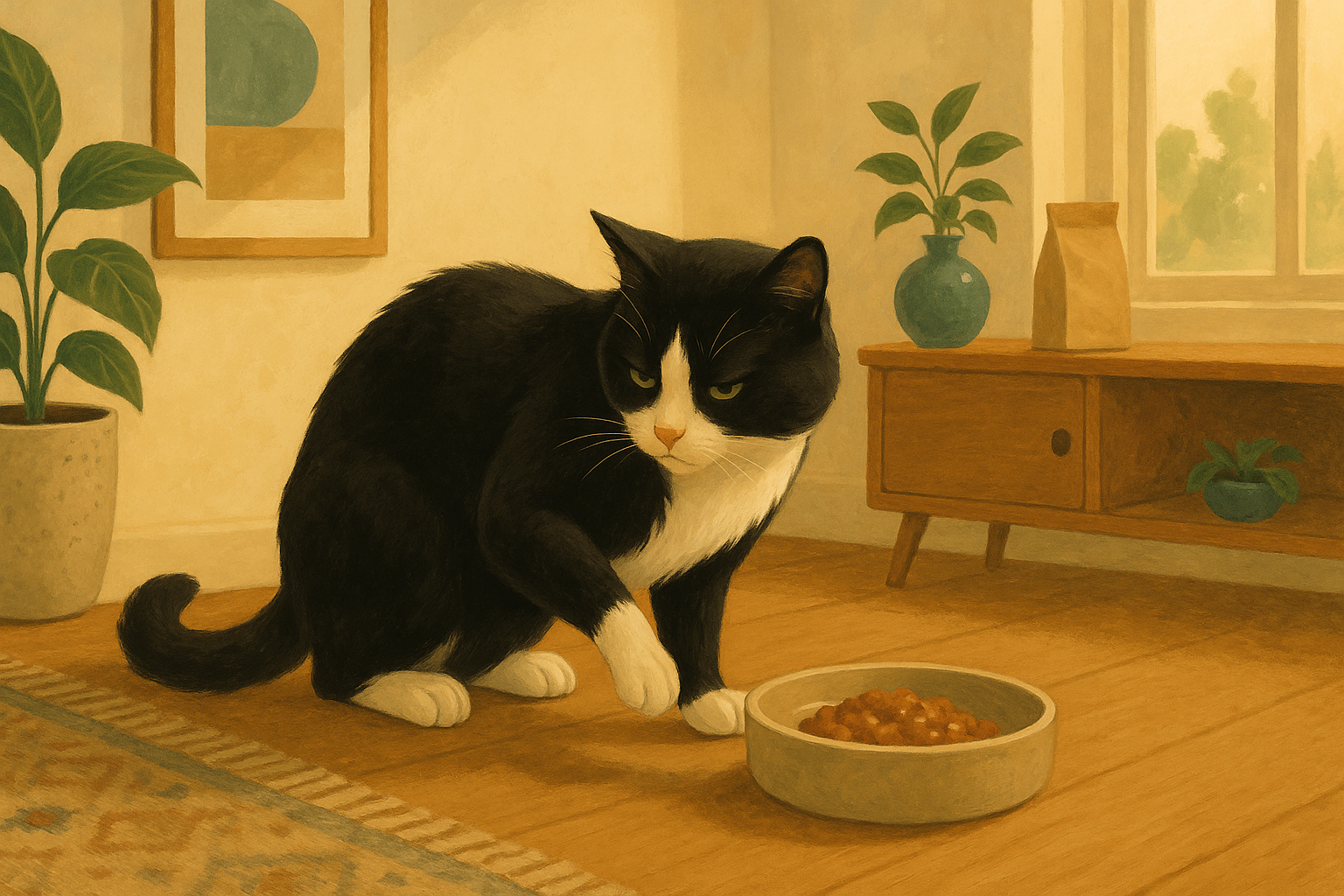
She barely touched it, then buried it and left. This is the version most owners are asking about, and it carries a different message. When a cat covers food she has hardly eaten, she is often saying she does not want it right now, and the caching instinct is a convenient way to “deal with” food she finds unappealing.2 The food might smell too strong, have the wrong texture, be the wrong temperature, or simply be a flavor she has lost interest in. The burying is the symptom; the picky preference underneath it is the real story.
Why wet food triggers it more
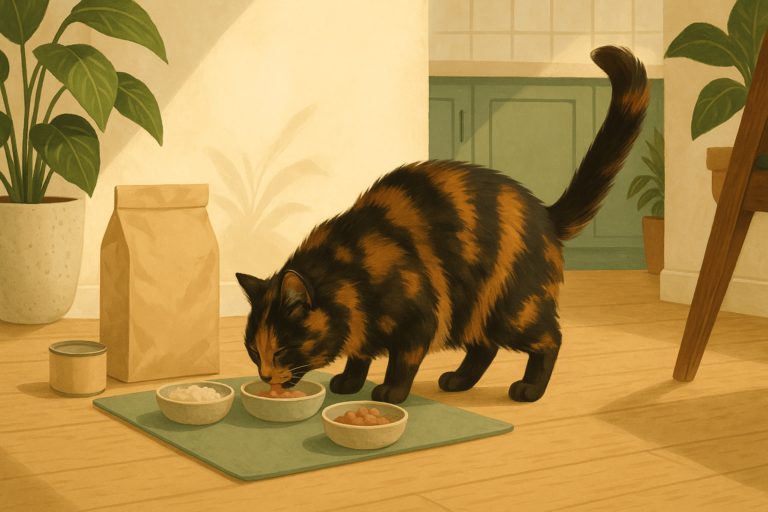
If you notice the burying happens mostly with canned or pouch food and rarely with kibble, that is expected. Wet food has a much stronger aroma, and a stronger scent is exactly what the caching instinct evolved to hide.1 A pungent pate that has been sitting out for twenty minutes can read, to a cat’s nose, like a beacon that needs covering. Warming wet food briefly and serving smaller portions so it gets eaten fresh, rather than lingering, often quiets the behavior on its own.
When burying is really a picky-eating signal
If your cat consistently snubs and buries what you serve, the burying is a window into her eating personality, not a quirk to train away. Some cats are texture critics who reject anything outside their preferred consistency. Some are flavor fatiguers who adored a food last month and now act offended by it. And some are what we call instinct-driven refusers: cats whose wild wiring runs strong, who treat an unsatisfying meal exactly as their ancestors would have, by covering it and moving on.
For these cats, the fix is not more of the same food served more insistently. It is matching the food to what actually drives her to eat. A few practical levers tend to work:
Lead with aroma. Instinct-driven and finicky cats respond to smell first. Freeze-dried raw food is a standout here: rehydrate the morsels with a little warm water and you get an intensely meaty aroma plus a soft texture that satisfies the cat who is “hunting” for something that smells like real prey. We compare the options in our roundup of the best freeze-dried cat foods.
Add a high-value topper. A small amount of something irresistible scattered over the regular meal can flip a cat from “cover and leave” to “clear the plate.” Toppers work by hitting the palatability triggers, aroma and texture, that a bland bowl misses; our guide to the best freeze-dried cat food toppers explains the why and how.
Rotate before she gets bored. A flavor fatiguer buries today what she devoured last week. Keeping two or three proteins in rotation, and offering single-ingredient treats she has a clean, positive history with, keeps novelty on her side. See our picks for the best single-ingredient cat treats.
When to look past instinct and call the vet
Caching is normal, but a sudden change in how and how much your cat eats is worth a closer look. The instinct itself is harmless; what matters is whether real eating is happening underneath it. Treat the burying as a flag, not a diagnosis, if any of the following are true.
- The burying is brand-new for a cat who never did it, especially if she is eating noticeably less.
- She covers and refuses nearly every meal and is losing weight.
- You see drooling, pawing at the mouth, bad breath or dropping food, which can point to dental pain.
- The food refusal comes with vomiting, lethargy or hiding.
- She has eaten little or nothing for 24 to 48 hours, which is a medical situation in cats and not a feeding one.3
A cat who is otherwise bright, holding her weight and clearly eating before she buries is almost certainly just running her instincts. A cat who is burying because she will not eat is a different problem; our guide on a cat who suddenly will not eat covers the warning signs and when to go straight to the vet.
The bottom line
A cat who buries her food and walks away is usually doing one of two things: saving a good meal for later, or politely declining one she does not love. Neither is a behavior problem. If it is the second version and it keeps happening, the food is not matching your cat, and that is fixable. Our free picky-eater quiz sorts out what kind of eater your cat is, whether she is driven by texture, smell, novelty or instinct, and returns a feeding plan built around it. It takes about two minutes and is the fastest way to stop guessing at the bowl.
This article is general information, not veterinary advice. A sudden change in your cat’s appetite or eating habits can signal a medical problem, so when in doubt, check with your vet. TheCatWellness may earn a commission from links to products we recommend, at no extra cost to you.